right direction?
pp. 43-44 · Read in the full issue
Png/Solomon Relations
A step in the right direction?
SOLOMON Mamaloni’s defeat as Sol omon Islands prime minister in June has signalled new and positive development in its relations with Papua New Guinea, especially where the border issue is concerned. Why else would PNG Foreign Minister John Kaputin have rushed across to Honiara the next weekend to meet the new government there to try and set the agenda for
renewed friendship?
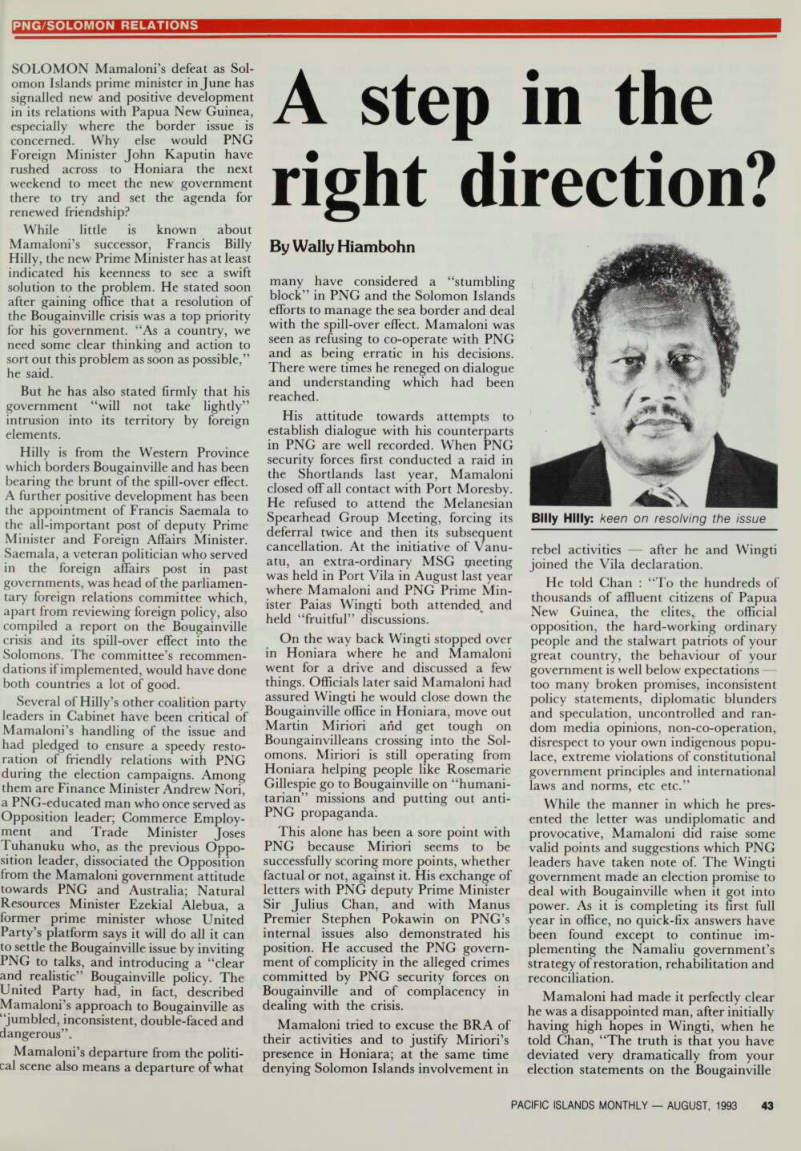
While little is known about Mamaloni’s successor, Francis Billy Hilly, the new Prime Minister has at least indicated his keenness to see a swift solution to the problem. He stated soon after gaining office that a resolution of the Bougainville crisis was a top priority for his government. “As a country, we need some clear thinking and action to sort out this problem as soon as possible,” he said.
But he has also stated firmly that his government “will not take lightly” intrusion into its territory by foreign elements.
Hilly is from the Western Province which borders Bougainville and has been bearing the brunt of the spill-over effect.
A further positive development has been the appointment of Francis Saemala to the all-important post of deputy Prime Minister and Foreign Affairs Minister.
Saemala, a veteran politician who served in the foreign affairs post in past governments, was head of the parliamen tary foreign relations committee which, apart from reviewing foreign policy, also compiled a report on the Bougainville crisis and its spill-over effect into the Solomons. The committee’s recommen dations if implemented, would have done both countries a lot of good.
Several of Hilly’s other coalition party leaders in Cabinet have been critical of Mamaloni’s handling of the issue and had pledged to ensure a speedy resto ration of friendly relations with PNG
during the election campaigns. Among
them are Finance Minister Andrew Nori, a PNG-educated man who once served as
Opposition leader; Commerce Employ
ment and Trade Minister Joses Tuhanuku who, as the previous Oppo sition leader, dissociated the Opposition from the Mamaloni government attitude towards PNG and Australia; Natural Resources Minister Ezekial Alebua, a former prime minister whose United Party’s platform says it will do all it can to settle the Bougainville issue by inviting PNG to talks, and introducing a “clear
and realistic” Bougainville policy. The
United Party had, in fact, described Mamaloni’s approach to Bougainville as “jumbled, inconsistent, double-faced and
dangerous”.
Mamaloni’s departure from the politi cal scene also means a departure of what
By Wally Hiambohn
many have considered a “stumbling block” in PNG and the Solomon Islands efforts to manage the sea border and deal with the spill-over effect. Mamaloni was seen as refusing to co-operate with PNG and as being erratic in his decisions.
There were times he reneged on dialogue and understanding which had been reached.
His attitude towards attempts to establish dialogue with his counterparts in PNG are well recorded. When PNG security forces first conducted a raid in the Shortlands last year, Mamaloni closed off all contact with Port Moresby.
He refused to attend the Melanesian
Spearhead Group Meeting, forcing its
deferral twice and then its subsequent cancellation. At the initiative of Vanu atu, an extra-ordinary MSG meeting was held in Port Vila in August last year where Mamaloni and PNG Prime Min ister Paias Wingti both attended, and held “fruitful” discussions.
On the way back Wingti stopped over in Honiara where he and Mamaloni went for a drive and discussed a few things. Officials later said Mamaloni had assured Wingti he would close down the Bougainville office in Honiara, move out Martin Miriori and get tough on Boungainvilleans crossing into the Sol omons. Miriori is still operating from Honiara helping people like Rosemarie Gillespie go to Bougainville on “humani tarian” missions and putting out anti-
PNG propaganda.
This alone has been a sore point with PNG because Miriori seems to be successfully scoring more points, whether factual or not, against it. His exchange of letters with PNG deputy Prime Minister Sir Julius Chan, and with Manus Premier Stephen Pokawin on PNG’s internal issues also demonstrated his position. He accused the PNG govern ment of complicity in the alleged crimes committed by PNG security forces on Bougainville and of complacency in dealing with the crisis.
Mamaloni tried to excuse the BRA of their activities and to justify Miriori’s presence in Honiara; at the same time denying Solomon Islands involvement in
rebel activities after he and Wingti joined the Vila declaration.
He told Chan : “To the hundreds of thousands of affluent citizens of Papua New Guinea, the the official opposition, the hard-working ordinary people and the stalwart patriots of your great country, the behaviour of your government is well below expectations too many broken promises, inconsistent policy statements, diplomatic blunders and speculation, uncontrolled and ran dom media opinions, non-co-operation, disrespect to your own indigenous popu lace, extreme violations of constitutional government principles and international laws and norms, etc etc.”
While the manner in which he pres ented the letter was undiplomatic and provocative, Mamaloni did raise some valid points and suggestions which PNG leaders have taken note of. The Wingti government made an election promise to deal with Bougainville when it got into power. As it is completing its first full year in office, no quick-fix answers have been found except to continue im plementing the Namaliu government’s strategy of restoration, rehabilitation and reconciliation.
Mamaloni had made it perfectly clear he was a disappointed man, after initially having high hopes in Wingti, when he told Chan, “The truth is that you have deviated very dramatically from your election statements on the Bougainville
Billy Hilly: keen on resolving the issue
crisis. If I were to offer you my personal opinion, I would say that your statement reflects some disarray in your govern ment.”
Hilly has come at a time when both sides have now agreed on joint border surveillance and direct communications to ensure there are no longer any rebel
crossings.
The recommendations of the Saemala committee report are : • That the parliament of Solomon Islands recognises Bougainvilleas an integral part of Papua New Guinea and, on this basis, endorses the PNG govern ment’s position that while the Bougain ville crisis is an internal matter it, unfortunately, does have spill-over effects into the sovereign territory of Solomon Islands, and thereby causes peace and security concerns for the Solomon Islands government and people. • That the Solomon Islands govern ment undertakes a much more subtle diplomatic role in an endeavour to bring the two parties to the principles of the Honiara Declaration. This is in view of the difficulty with formulating and adopting a realistic refugee policy, and as such a safer strategy would be to prevent such an incident from occuring. • Because of the peace and security
concerns resulting from the spill-over effects of the crisis, the government should, without any further delay, attend to formalising the Memorandum of Understanding (MOU) for the Joint Surveillance of the Border with Papua New Guinea and to implement it forthwith after its ratification by both governments. • Immediately following the im plementation of the MOU the two governments should conclude, sign, rat ify and implement the Draft Agreement concerning the Administration of the
Special Area.
• The operation of an office in Honiara, ostensibly as an information clearing centre on the Bougainville crisis, has caused embarrassment to the Sol omon Islands government. Accommo dating this office on Solomon Islands sovereign territory is of grave concern to the Papua New Guinea government which has claimed this office has been used to wage a campaign against its sovereignty. Having regard to the mutual respect which these two govern ments have towards each other, the Solomon Islands government should close this office and request a reputable non-governmental organisation to set up and operate a centre for co-ordinating
humanitarian assistance for the suffering people of Bougainville. • Martin Miriori has attested to the committee that his residency in Honiara has contributed to the strained relations between Solomon Islands and Papua New Guinea. For the interest of good neighbourliness, the government should review its grant of residency to both Miriori and Rutana. • The governments of Great Britain, Germany and United States of America should be approached to assist with the setting up of the administrative system for the Special Border Areas since they contributed to the initial separation of the people in those areas who were geographically and culturally related. • The government should consult closely with both Commonwealth and Forum countries on the need to study and consider the implications of United Nations Resolution 46/43 of December 9, 1991 regarding the protection and secur ity of small states. • The Foreign Relations Committee should continue to monitor the situation with regard to the Bougainville crisis to ensure the spill-over effects into Solomon Islands are being contained or elimin ated under the bilateral arrangements as recommended herein. □