Long live the King
pp. 17-20 · Read in the full issue
Celebration
\sk a Tongan when the best time to visit his country would be and the answer would nost likely be “ during the Heilala Festival”. In late June and early July each year he world smallest - and arguably quietest - kingdom is suddenly shaken from its slumber s a kaleidoscope of colour explodes. Dancing, singing and music rock the capital Vuku’alofa as work is forgotten and general merriment begins.
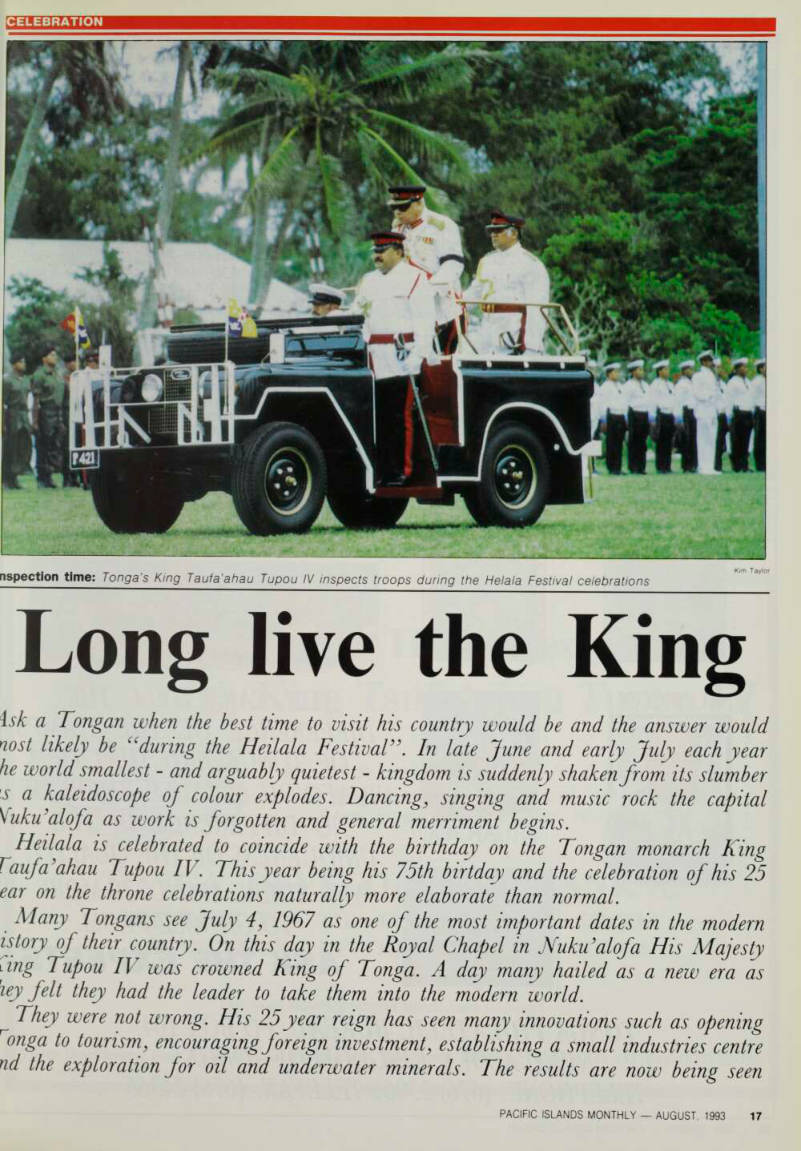
Heilala is celebrated to coincide with the birthday on the Tongan monarch King Taufa’ahau Tupou IV. This year being his 75th birtday and the celebration of his 25 ear on the throne celebrations naturally more elaborate than normal.
Many Tongans see July 4, 1967 as one of the most important dates in the modern istory of their country. On this day in the Royal Chapel in Nukualofa His Majesty ling Tupou IV was crowned King of Tonga. A day many hailed as a new era as ley felt they had the leader to take them into the modern world. r They were not wrong. His 25year reign has seen many innovations such as opening r onga to tourism, encouraging foreign investment, establishing a small industries centre nd the exploration for oil and underwater minerals. The results are now being seen
Kim Taylor
[?]nspection time: Tonga's King Taufa'ahau Tupou IV inspects troops during the Helala Festival celebrations
with tourism numbers increasing annu ally, foreign investors coming in and foreign exchange earnings climbing.
The King is the eldest son of the late Queen Salote Tupou 111 and was born on July 4, 1918 at the Royal Palace, Nuku’alofa. On the birth of the Crown Prince Tonga’s three ancient lines of kings, the Tu’i Tonga, Tu’i Ha’atakalaua and the Tu’i Kanokupolu, were united making him the paramount traditional leader.
After receiving his early education in Tonga King Taufa’ahau Tupou IV left for Australia and became the first Tongan to receive a university degree when he graduated from the University of Sydney with a BA and LLB degrees. The King was also an outstand ing sportsman and his pole vault record set at the age of 14 still stands. He also enjoyed gymnastics, rugby, cricket and lawn tennis. Also a keen mathematician the King is a member of the Interna tional Mathematics Association. He is an expert on the abacus and was responsible for its introduction to all Free Wesleyan primary schools in Tonga.
Also very interested in music the Tongan monarch, while Minister of Education in the mid- 19405, wrote a booklet on how to read the English musical notation and its translation into
the Tongan notation. The booklet is still in use.
In 1944, while Minister of Education, the portfolio of Health was added to his responsibilities. He was responsible for the two until he became Premier in December 1949. With this came the responsibility of Education, Agriculture and Foreign Affairs and later Works.
Wanting to better the standards of the kingdom’s education the king was the driving force behind the establishment of the Teachers’ Training College in 1944 and Tonga High School in 1947. He also established the Tonga Copra Board and was instrumental in setting up The Tonga Produce Board and the Agricul tural Council. His aim want the im proved marketing of the Kingdom’s produce.
During his 16 years as Premier he did much to firmly establish ties with overseas nations. For example the close links between Tonga and the United Kingdom has seen much financial and technical assistance provided. Further strengthening the bonds between the two countries, the king was appointed a CBE in 1951 and in 1958 was awarded the KBE by Queen Elizabeth 11.
The King married Halaevalu Mata’aho on June 10, 1947, they have three sons and a daughter. □
Kim Taylor Royal entertainment: The King's daugh ter Princess Pilolevu performs a traditional dance
The entertainers: some of the students who provided entertainment
Martin Tiffany Women power: just one of the happenings during Heilala
Kim Taylor