A touch of nostalgia
p. 15 · Read in the full issue
A GENERATION has grown up know ing nothing of those days 20 years ago when the eyes of the world were focussed on the Pacific, and memories of their elders who were around at the time have faded.
But it’s an anniversary worth remem bering, for the events of mid-1973 put an end to nuclear testing in the Pacific atmosphere and as such deserve a permanent place in the history of the region.
I refer to an extraordinary piece of unconventional diplomacy, the brainchild of New Zealand Prime Min ister Norman Kirk, who had a deep personal loathing of nuclear testing in this part of the world and was deter mined to do something about it.
Kirk, who became Prime Minister in December 1972, first tried conventional diplomatic means to stop France’s
atmospheric testing program that began in the Pacific six years earlier. He persuaded Australia to join New Zealand in a case against France at the World Court in The Hague and sent his deputy, Hugh Watt, on an abortive trip to Paris to plead for an end to the tests.
In June 1973, the World Court voted eight-six to grant New Zealand and Australia an interim injunction restraining France from starting a new series of tests at Mururoa Atoll.
France rejected the verdict, saying the court was not competent to rule on matters of “national defence”.
Kirk decided to send a New Zealand navy frigate to the testing zone not to try physically to stop the tests but to “ensure the eyes of the world are riveted on Mururoa”. The HMN£S Otago would, he said, station itself on France’s 12-mile limit as a “silent, accusing witness”.
“What we aim to do is to publicise what is happening in this remote part of the world, so as to stimulate world opinion (against nuclear testing) and attract wider support for rights of small nations.”
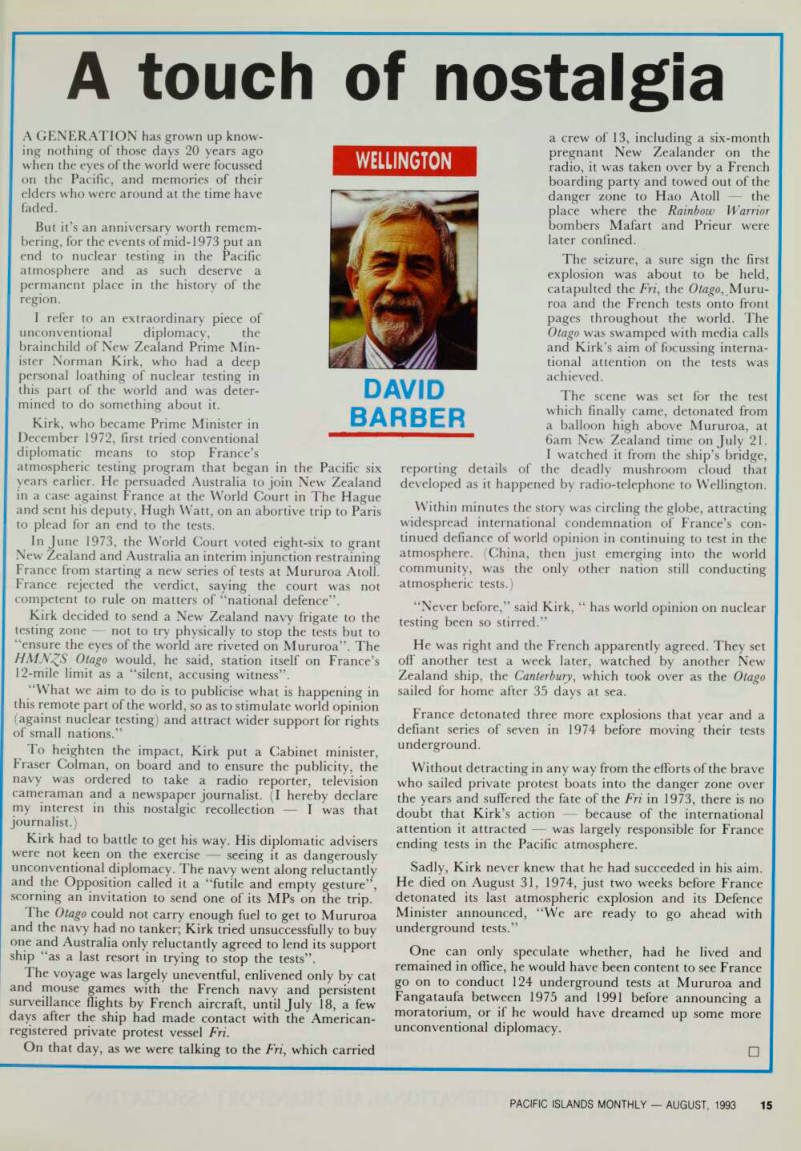
To heighten the impact, Kirk put a Cabinet minister, Fraser Colman, on board and to ensure the publicity, the navy was ordered to take a radio reporter, television cameraman and a newspaper journalist. (I hereby declare my interest in this nostalgic recollection I was that
journalist.)
Kirk had to battle to get his way. His diplomatic advisers were not keen on the exercise seeing it as dangerously unconventional diplomacy. The navy went along reluctantly and the Opposition called it a “futile and empty gesture”, scorning an invitation to send one of its MPs on the trip.
The Otago could not carry enough fuel to get to Mururoa and the navy had no tanker; Kirk tried unsuccessfully to buy one and Australia only reluctantly agreed to lend its support ship “as a last resort in trying to stop the tests”.
The voyage was largely uneventful, enlivened only by cat and mouse games with the French navy and persistent surveillance flights by French aircraft, until July 18, a few days after the ship had made contact with the American registered private protest vessel Fri.
On that day, as we were talking to the Fri, which carried
a crew of 13, including a six-month pregnant New Zealander on the radio, it was taken over by a French boarding party and towed out of the danger zone to Hao Atoll the place where the Rainbow Warrior bombers Mafart and Prieur were later confined.
The seizure, a sure sign the first explosion was about to be held, catapulted the Fri, the Otago, Muru roa and the French tests onto front pages throughout the world. The Otago was swamped with media calls and Kirk’s aim of focussing interna tional attention on the tests was achieved.
The scene was set for the test which finally came, detonated from a balloon high above Mururoa, at Gam New Zealand time on July 21.
I watched it from the ship’s bridge,
reporting details of the deadly mushroom cloud that developed as it happened by radio-telephone to Wellington.
Within minutes the story was circling the globe, attracting widespread international condemnation of France’s con tinued defiance of world opinion in continuing to test in the atmosphere. (China, then just emerging into the world community, was the only other nation still conducting atmospheric tests.) “Never before,” said Kirk, “ has world opinion on nuclear testing been so stirred.”
He was right and the French apparently agreed. They set off another test a week later, watched by another New Zealand ship, the Canterbury , which took over as the Otago sailed for home after 35 days at sea.
France detonated three more explosions that year and a defiant series of seven in 1974 before moving their tests underground.
Without detracting in any way from the efforts of the brave who sailed private protest boats into the danger zone over the years and suffered the fate of the Fri in 1973, there is no doubt that Kirk’s action because of the international attention it attracted was largely responsible for France ending tests in the Pacific atmosphere.
Sadly, Kirk never knew that he had succeeded in his aim.
He died on August 31, 1974, just two weeks before France detonated its last atmospheric explosion and its Defence Minister announced, “We are ready to go ahead with underground tests.”
One can only speculate whether, had he lived and remained in office, he would have been content to see France go on to conduct 124 underground tests at Mururoa and Fangataufa between 1975 and 1991 before announcing a moratorium, or if he would have dreamed up some more unconventional diplomacy.