Great Council
pp. 36-37 · Read in the full issue
Opinion
Great Council or House of Lords?
A recently concluded meeting of Fijian chiefs defines a new role they have taken on, one which could cause more problems than it solves.
FIJI’S controversial 1990 constitution has in almost every aspect been a source of contention within the
country.
However, for a w hile it looked like the bi-cameral system was going to be successful there would be discussion, accommodation, all in the Pacific way and in the end some sort of modus vivendi would arise. Fijians and Indians would never love each other but they would come to some sort of accommodation.
This is the Pacific way it has always been so.
In theory at least, the Fiji political system is based on a bi-cameral legis lature with nominal power being vested in the lower house, and with a nominated senate with review powers but little more. The Bose Levu Vakaturaga or Great Council of Chiefs was supposed to have authority in all matters directly con cerned with Fijians interests. However, with a commoner as Prime Minister and with a not unreasonably broad definition of what constitutes Fijian interests, the Great Council has tended to move far more centre stage to take on the role of House of Lords with broad veto powers over decisions that the Fiji government is making. While the 1990 constitution gave the Great Council broad powers it has taken on a role that is clearly political. It is a role that the Great Council may yet come to regret because if it involves itself in politics it will have to make decisions that may one day divide rather than unite the Fijian people.
The last meeting of the Bose Levu which
ended in May was perhaps the most contentious in years. The government of Sitiveni Rabuka in an attempt to stabilise itself due to the internal dissen sion within the ruling SVT party has for almost half a year been attempting to establish a government of national unity.
The opposition to Rabuka within the SVT party put pressure on him to submit the national unity issue to the Bose Levu for their ratification. As expected the Great Council did not make a decision but rather submitted the matter for further discussion to the tikina and provincial councils. In other words, the idea of a government of national unity has been ‘sent to committee’ which means it is effectively dead and so too may be the government of Sitiveni Rabuka.
Almost immediately Labour leader Mahendra Chaudhry, who has for one year supported Rabuka, declared that he had waited long enough and threatened to withdraw support from the govern ment and precipitate what would cer tainly be the worst political crisis in Fiji’s recent history.
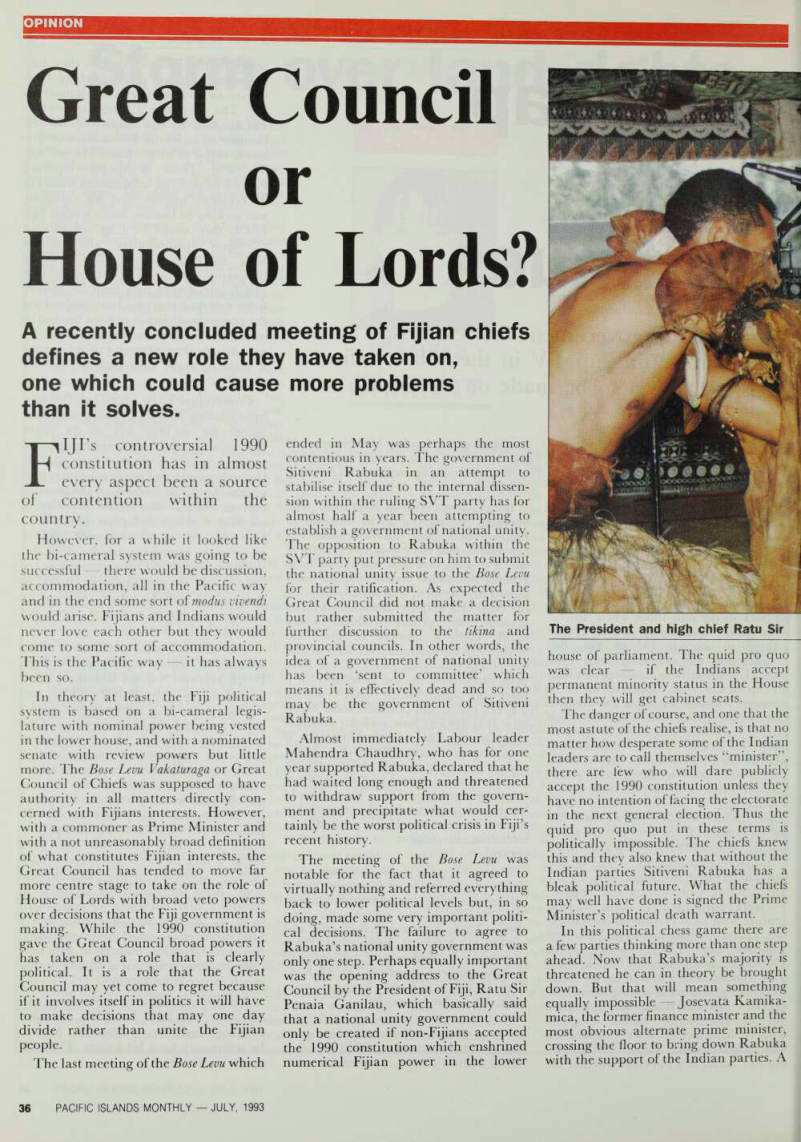
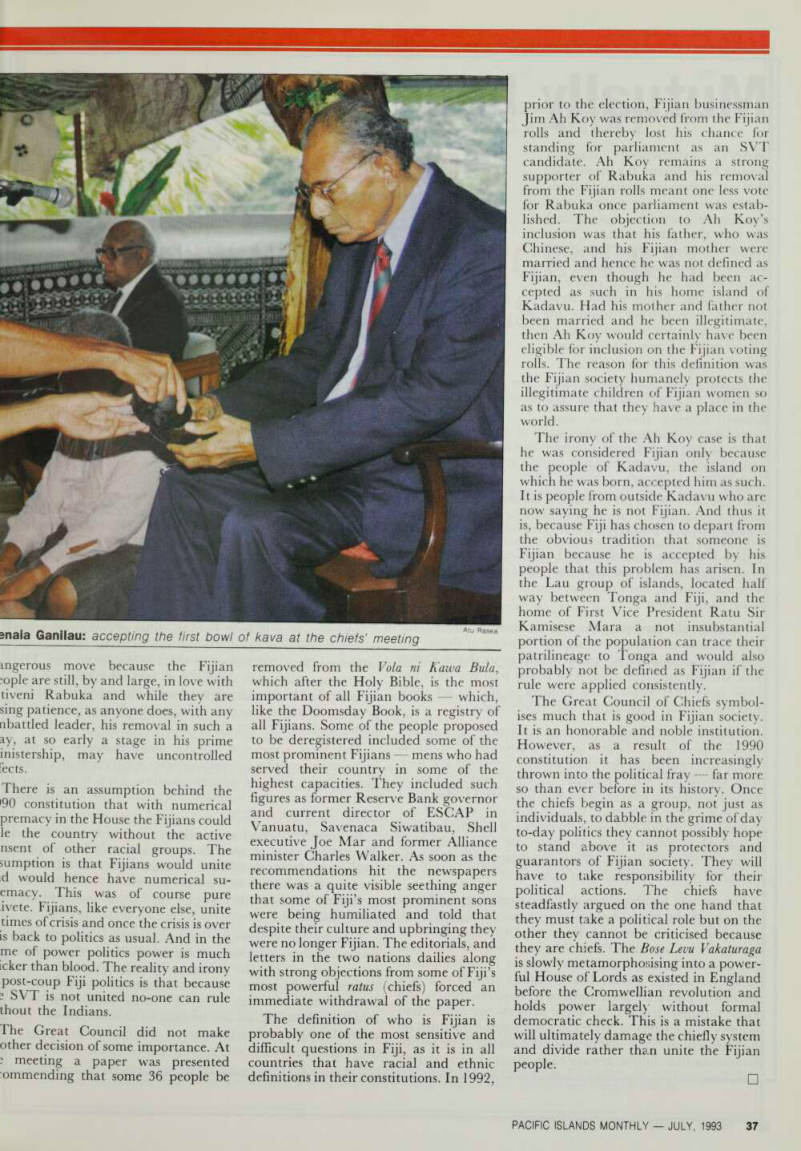
The meeting of the Bose Levu was notable for the fact that it agreed to virtually nothing and referred everything back to lower political levels but, in so doing, made some very important politi cal decisions. The failure to agree to Rabuka’s national unity government was only one step. Perhaps equally important was the opening address to the Great Council by the President of Fiji, Ratu Sir Penaia Ganilau, which basically said that a national unity government could only be created if non-Fijians accepted the 1990 constitution which enshrined numerical Fijian power in the lower
house of parliament. The quid pro quo was clear if the Indians accept permanent minority status in the House then they will get cabinet seats.
The danger of course, and one that the most astute of the chiefs realise, is that no matter how desperate some of the Indian leaders are to call themselves “minister”, there are few who will dare publicly accept the 1990 constitution unless they have no intention effacing the electorate in the next general election. Thus the quid pro quo put in these terms is politically impossible. The chiefs knew this and they also knew that without the Indian parties Sitiveni Rabuka has a bleak political future. What the chiefs may well have done is signed the Prime Minister’s political death warrant.
In this political chess game there are a few parties thinking more than one step ahead. Now that Rabuka’s majority is threatened he can in theory be brought down. But that will mean something
equally impossible —Josevata Kamika
mica, the former finance minister and the most obvious alternate prime minister, crossing the floor to bring down Rabuka with the support of the Indian parties. A
The President and high chief Ratu Sir
mgerous move because the Fijian >ople are still, by and large, in love with tiveni Rabuka and while they are sing patience, as anyone does, with any nbattled leader, his removal in such a ay, at so early a stage in his prime inistership, may have uncontrolled Eects.
There is an assumption behind the '9O constitution that with numerical premacy in the House the Fijians could le the country without the active nsent of other racial groups. The sumption is that Fijians would unite d would hence have numerical su emacy. This was of course pure ivete. Fijians, like everyone else, unite times of crisis and once the crisis is over is back to politics as usual. And in the me of power politics power is much icker than blood. The reality and irony post-coup Fiji politics is that because “ SVT is not united no-one can rule thout the Indians.
The Great Council did not make other decision of some importance. At ' meeting a paper was presented :ommending that some 36 people be
removed from the Void ni Kawa Bula, which after the Holy Bible, is the most important of all Fijian books which, like the Doomsday Book, is a registry of all Fijians. Some of the people proposed to be deregistered included some of the most prominent Fijians mens who had served their country in some of the
highest capacities. They included such
figures as former Reserve Bank governor and current director of ESCAP in Vanuatu, Savenaca Siwatibau, Shell executive Joe Mar and former Alliance minister Charles Walker. As soon as the recommendations hit the newspapers there was a quite visible seething anger that some of Fiji’s most prominent sons were being humiliated and told that
despite their culture and upbringing they
were no longer Fijian. The editorials, and letters in the two nations dailies along with strong objections from some of Fiji’s most powerful ratus (chiefs) forced an immediate withdrawal of the paper.
The definition of who is Fijian is probably one of the most sensitive and difficult questions in Fiji, as it is in all countries that have racial and ethnic definitions in their constitutions. In 1992,
prior to the election, Fijian businessman Jim Ah Koy was removed from the Fijian rolls and thereby lost his chance for standing for parliament as an SVT candidate. Ah Koy remains a strong supporter of Rabuka and his removal from the Fijian rolls meant one less vote for Rabuka once parliament was estab lished. The objection to Ah Koy’s inclusion was that his father, who was Chinese, and his Fijian mother were married and hence he was not defined as Fijian, even though he had been ac cepted as such in his home island of Kadavu. Had his mother and father not been married and he been illegitimate, then Ah Koy would certainly have been eligible for inclusion on the Fijian voting rolls. The reason for this definition was
the Fijian society humanely protects the
illegitimate children of Fijian women so as to assure that they have a place in the world.
The irony of the Ah Koy case is that he was considered Fijian only because the people of Kadavu, the island on which he was born, accepted him as such.
It is people from outside Kadavu who are now saying he is not Fijian. And thus it is, because Fiji has chosen to depart from the obvious tradition that someone is Fijian because he is accepted by his people that this problem has arisen. In the Lau group of islands, located half way between Tonga and Fiji, and the home of First Vice President Ratu Sir Kamisese Mara a not insubstantial portion of the population can trace their patrilineage to Tonga and would also probably not be defined as Fijian if the
rule were applied consistently.
The Great Council of Chiefs symbol ises much that is good in Fijian society.
It is an honorable and noble institution.
However, as a result of the 1990 constitution it has been increasingly thrown into the political fray far more so than ever before in its history. Once the chiefs begin as a group, not just as individuals, to dabble in the grime of day
to-day politics they cannot possibly hope
to stand above it as protectors and guarantors of Fijian society. They will have to take responsibility for their political actions. The chiefs have steadfastly argued on the one hand that they must take a political role but on the other they cannot be criticised because they are chiefs. The Bose Levu Vakaturaga is slowly metamorphosising into a power ful House of Lords as existed in England before the Cromwellian revolution and holds power largely without formal democratic check. This is a mistake that
will ultimately damage the chiefly system
and divide rather than unite the Fijian
people.
enaia Ganilau: accepting the first bowl of kava at the chiefs' meeting
Atu Rasea