housing
pp. 27-29 · Read in the full issue
Focus
‘Decent housing for everyone’
‘How can you describe the Kanaks as squat ters? It is impossible to be a squatter on your own land
By ’Atu Emberson-Bain
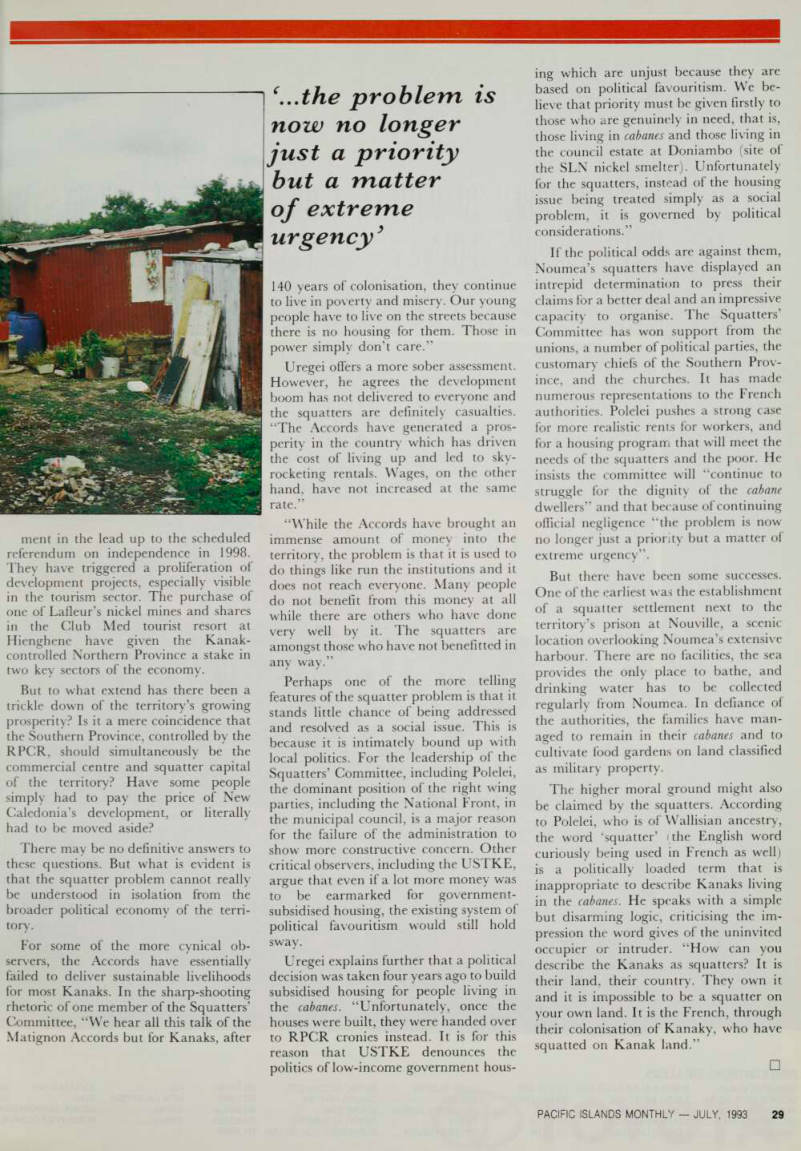
“I have been waiting to get a house for over a year and now my landlord has evicted me from the flat I was renting. I had nowhere else to go but here.” Andre carries his three-year-old daughter on his hip and shrugs his shoulders in despair as he points down to his half-built cabane (shack) nestled in a valley on the suburban fringes of New Caledonia’s capital, Noumea.
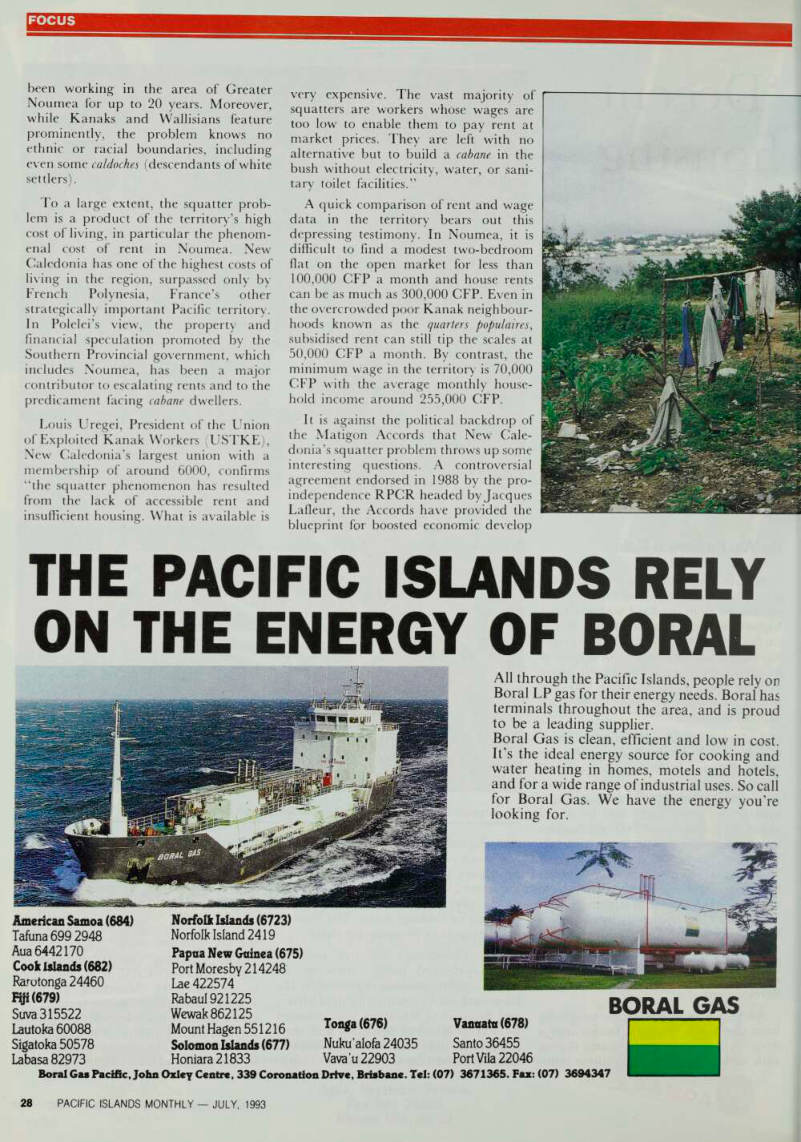
Andre is a Kanak who hails from New Caledonia’s Northern Province, but he has been living in Noumea for over 10 years, supporting his family on earnings as a dockworker. He is now an illegal squatter on state land. And he is not alone. He joins another 300-odd families in one of the many squatter settlements that have mushroomed in and around Noumea in recent years. The families lead a precarious existence. They have no access to electricity or running water.
They are visited frequently by the police intelligence service and they live in fear of eviction or demolition of their house, both of which have been regular occur rences to make way for real estate
development.
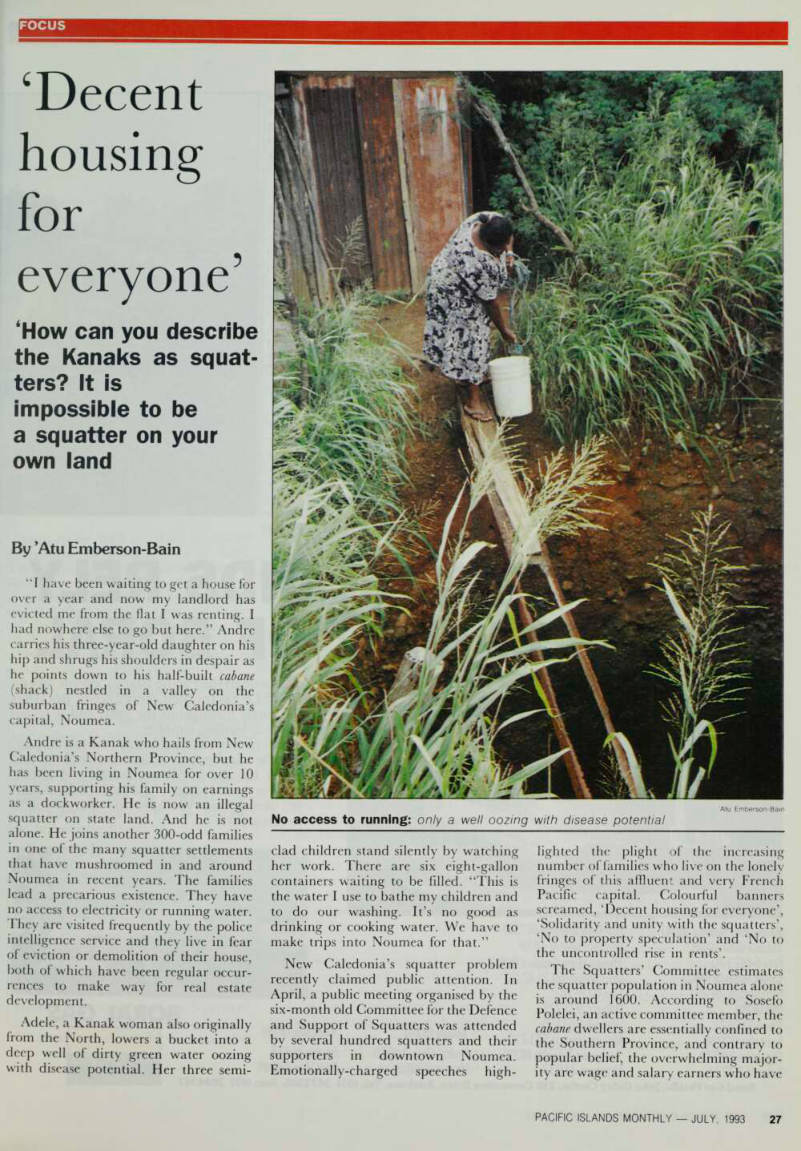
Adele, a Kanak woman also originally from the North, lowers a bucket into a deep well of dirty green water oozing with disease potential. Her three semi-
clad children stand silently by watching her work. There are six eight-gallon containers waiting to be filled. “This is the water I use to bathe my children and to do our washing. It’s no good as drinking or cooking water. We have to make trips into Noumea for that.”
New Caledonia’s squatter problem recently claimed public attention. In April, a public meeting organised by the six-month old Committee for the Defence and Support of Squatters was attended by several hundred squatters and their supporters in downtown Noumea.
Emotionally-charged speeches high-
lighted the plight of the increasing number of families who live on the lonely fringes of this affluent and very French Pacific capital. Colourful banners screamed,‘Decent housing for everyone’, ‘Solidarity and unity with the squatters’, ‘ No to property speculation’ and ‘No to the uncontrolled rise in rents’.
Thc Squatters’ Committee estimates the squatter population in Noumea alone is around 1600 According to Sosefo Polelei, an active committee member, the cabane dwellers are essentially confined to the Southern Province, and contrary to popular belief, the overwhelming major ity are wage and salary earners who have
No access to running: only a well oozing with disease potential
Alu Emberson-Baln
been working in the area of Greater Noumea for up to 20 years. Moreover, while Kanaks and Wallisians feature prominently, the problem knows no ethnic or racial boundaries, including even some caldoches (descendants of white
settlers).
To a large extent, the squatter prob lem is a product of the territory’s high cost of living, in particular the phenom enal cost of rent in Noumea. New Caledonia has one of the highest costs of living in the region, surpassed only by French Polynesia, France’s other strategically important Pacific territory.
In Polelei’s view, the property and financial speculation promoted by the Southern Provincial government, which includes Noumea, has been a major contributor to escalating rents and to the predicament facing cabane dwellers.
Louis Uregei, President of the Union of Exploited Kanak Workers (USTKE), New Caledonia’s largest union with a membership of around 6000, confirms ”the squatter phenomenon has resulted from the lack of accessible rent and insufficient housing. What is available is
very expensive. The vast majority of squatters are workers whose wages are too low to enable them to pay rent at market prices. They are left with no alternative but to build a cabane in the bush without electricity, water, or sani tary toilet facilities.”
A quick comparison of rent and wage data in the territory bears out this depressing testimony. In Noumea, it is difficult to find a modest two-bedroom flat on the open market for less than 100.000 CFP a month and house rents can be as much as 300,000 CFP. Even in the overcrowded poor Kanak neighbour hoods known as the quarters populaires, subsidised rent can still tip the scales at 50.000 CFP a month. By contrast, the minimum wage in the territory is 70,000 CFP with the average monthly house hold income around 255,000 CFP.
It is against the political backdrop of the Matigon Accords that New Cale donia’s squatter problem throws up some interesting questions. A controversial agreement endorsed in 1988 by the pro independence RPCR headed by Jacques Lafleur, the Accords have provided the blueprint for boosted economic develop
ment in the lead up to the scheduled referendum on independence in 1998.
They have triggered a proliferation of
development projects, especially visible
in the tourism sector. The purchase of one of Lafleur’s nickel mines and shares in the Club Med tourist resort at Hienghene have given the Kanak controlled Northern Province a stake in two key sectors of the economy.
But to what extend has there been a trickle down of the territory’s growing prosperity? Is it a mere coincidence that the Southern Province, controlled by the RPCR, should simultaneously be the commercial centre and squatter capital of the territory? Have some people simply had to pay the price of New Caledonia’s development, or literally had to be moved aside?
There may be no definitive answers to these questions. But what is evident is that the squatter problem cannot really be understood in isolation from the broader political economy of the terri tory.
For some of the more cynical ob servers, the Accords have essentially failed to deliver sustainable livelihoods for most Kanaks. In the sharp-shooting rhetoric of one member of the Squatters’
Committee, “We hear all this talk of the Matignon Accords but for Kanaks, after
‘...the problem is now no longer
just a priority
but a matter
of extreme
urgency ’
140 years of colonisation, they continue to live in poverty and misery. Our young people have to live on the streets because there is no housing for them. Those in power simply don’t care.”
Uregei offers a more sober assessment.
However, he agrees the development boom has not delivered to everyone and the squatters are definitely casualties.
“The Accords have generated a pros perity in the country which has driven the cost of living up and led to sky rocketing rentals. Wages, on the other hand, have not increased at the same rate.”
“While the Accords have brought an immense amount of money into the territory, the problem is that it is used to do things like run the institutions and it does not reach everyone. Many people do not benefit from this money at all while there are others who have done very well by it. The squatters are amongst those who have not benefitted in
any way.”
Perhaps one of the more telling features of the squatter problem is that it stands little chance of being addressed and resolved as a social issue. This is because it is intimately bound up with local politics. For the leadership of the Squatters’ Committee, including Polelei, the dominant position of the right wing parties, including the National Front, in the municipal council, is a major reason for the failure of the administration to show more constructive concern. Other critical observers, including the USTKE, argue that even if a lot more money was to be earmarked for government subsidised housing, the existing system of political favouritism would still hold sway.
Uregei explains further that a political decision was taken four years ago to build subsidised housing for people living in the cabanes. “Unfortunately, once the houses were built, they were handed over to RPCR cronies instead. It is for this reason that USTKE denounces the politics of low-income government hous
ing which are unjust because they are based on political favouritism. We be lieve that priority must be given firstly to those who are genuinely in need, that is, those living in cabanes and those living in the council estate at Doniambo (site of the SLN nickel smelter). Unfortunately for the squatters, instead of the housing issue being treated simply as a social
problem, it is governed by political
considerations.”
If the political odds are against them, Noumea’s squatters have displayed an intrepid determination to press their claims for a better deal and an impressive
capacity to organise. The Squatters’
Committee has won support from the unions, a number of political parties, the customary chiefs of the Southern Prov ince, and the churches. It has made numerous representations to the French authorities. Polelei pushes a strong case for more realistic rents for workers, and for a housing program that will meet the needs of the squatters and the poor. He insists the committee will “continue to struggle for the dignity of the cabane dwellers” and that because of continuing official negligence “the problem is now no longer just a priority but a matter of
extreme urgency”.
But there have been some successes.
One of the earliest was the establishment of a squatter settlement next to the territory’s prison at Nouville, a scenic location overlooking Noumea’s extensive harbour. There are no facilities, the sea provides the only place to bathe, and drinking water has to be collected regularly from Noumea. In defiance of the authorities, the families have man aged to remain in their cabanes and to cultivate food gardens on land classified as military property.
The higher moral ground might also be claimed by the squatters. According to Polelei, who is of Wallisian ancestry, the word ‘squatter’ (the English word curiously being used in French as well) is a politically loaded term that is inappropriate to describe Kanaks living in the cabanes. He speaks with a simple but disarming logic, criticising the im pression the word gives of the uninvited occupier or intruder. “How can you describe the Kanaks as squatters? It is their land, their country. They own it and it is impossible to be a squatter on your own land. It is the French, through their colonisation of Kanaky, who have squatted on Kanak land.”