Finding a solution
From The Editor’S Desk
A recent book from Australian
National University, Pacific 2010
Challenging the Future , outlines some grim facts about the where we, as a region, are headed. The outlook is not bright, but at least we are being warned of the pitfalls that lie ahead and can take action now to avoid some of them in the future.
Of major concern to the region is its relatively high rate of population growth. Conservative projections to the year 2010 show, for example, that Papua New Guinea’s population
would be around 5.2 million. On the other hand, it could also be as high as 6.4 million. Other Melanesian countries are no better.
What is distress ing is that with the scarce resources most island countries have and with the trouble they currently face
maintaining basic
standards of, say, health and educa tion, any significant increase in popu lation would only increase the burden A few months ago PIM highlighted problems most
island countries face in providing basic health care. There appear chronic short ages of medical personnel and drugs to combat diseases and infections which could be quite easily avoided. Most countries face shortages of funds to improve medical facilities and buy new equipment.
Imagine the plight of these countries when their populations have increased by up to 40 per cent in less than 20 years.
The same can be said for providing basic education facilities for a growing number of youngsters. In addition, the larger numbers of school leavers have to have jobs to go. There just aren’t enough jobs for school leavers today, leading to
more and more youths getting in trouble with the law.
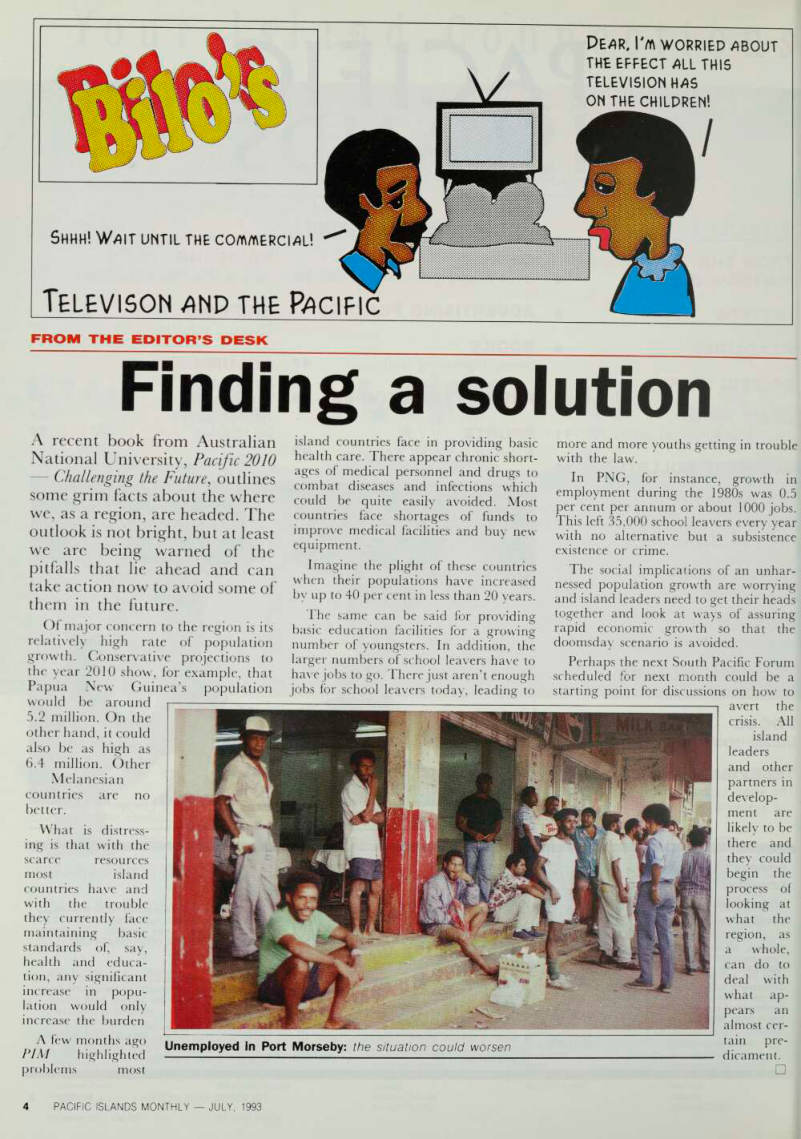
In PNG, for instance, growth in employment during the 1980 s was 0.5 per cent per annum or about 1000 jobs.
This left 35,000 school leavers every year with no alternative but a subsistence existence or crime.
The social implications of an unhar nessed population growth are worrying and island leaders need to get their heads together and look at ways of assuring rapid economic growth so that the doomsday scenario is avoided.
Perhaps the next South Pacific Forum scheduled for next month could be a starting point for discussions on how to
avert the crisis. All island leaders and other partners in
develop
ment are likely to be there and they could
begin the
process of
looking at
what the
region, as
a whole, can do to deal with what ap pears an almost cer tain pre dicament.
Unemployed In Port Morseby: the situation could worsen