good news
pp. 27-29 · Read in the full issue
The
and the bad
A World Bank report forecasts commodity prices for the year 2000 and beyond
By Roman Grynberg
THE recently released World Bank report on the long-term outlook for major primary commodities in general makes depressing reading. However for the South Pacific, commodity prices for its main exports copra, coffee and cocoa are set to rise slightly in the longer term.
The growth however will be modest and it will be an increase from some of the lowest prices in the last 20 years. There
are no predictions of major growth and no real reason for optimism.
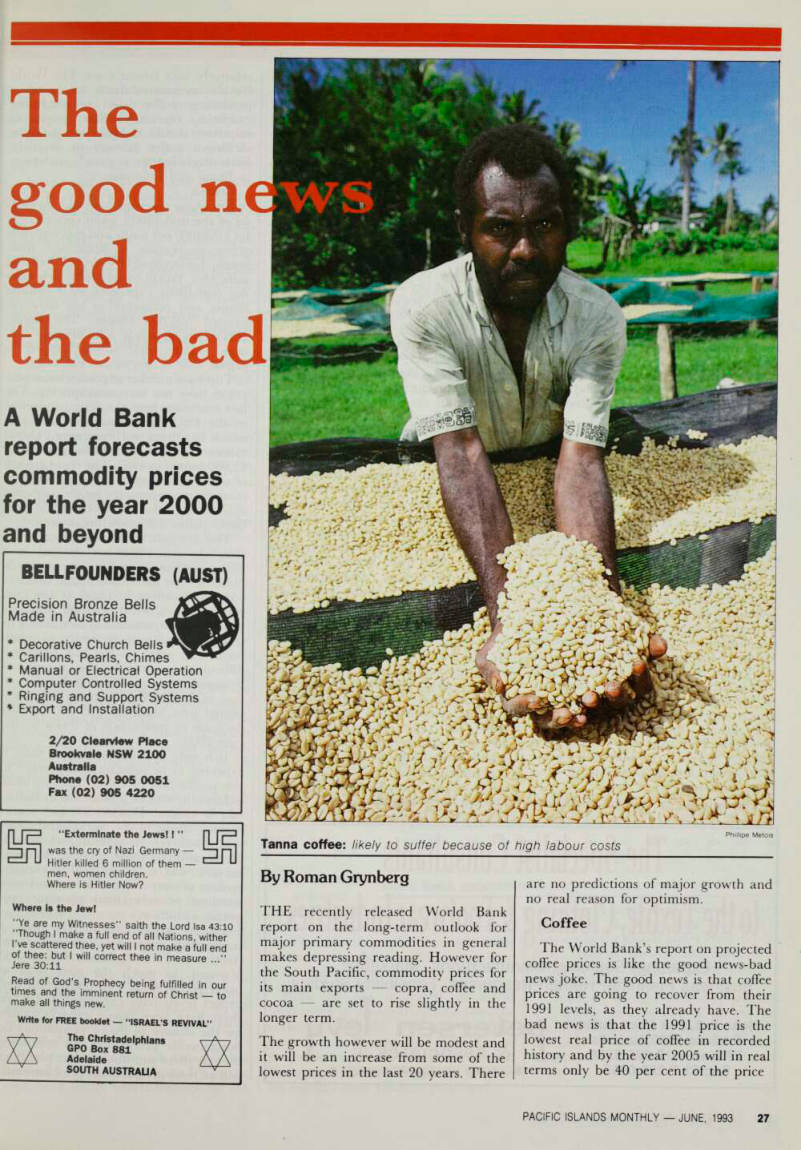
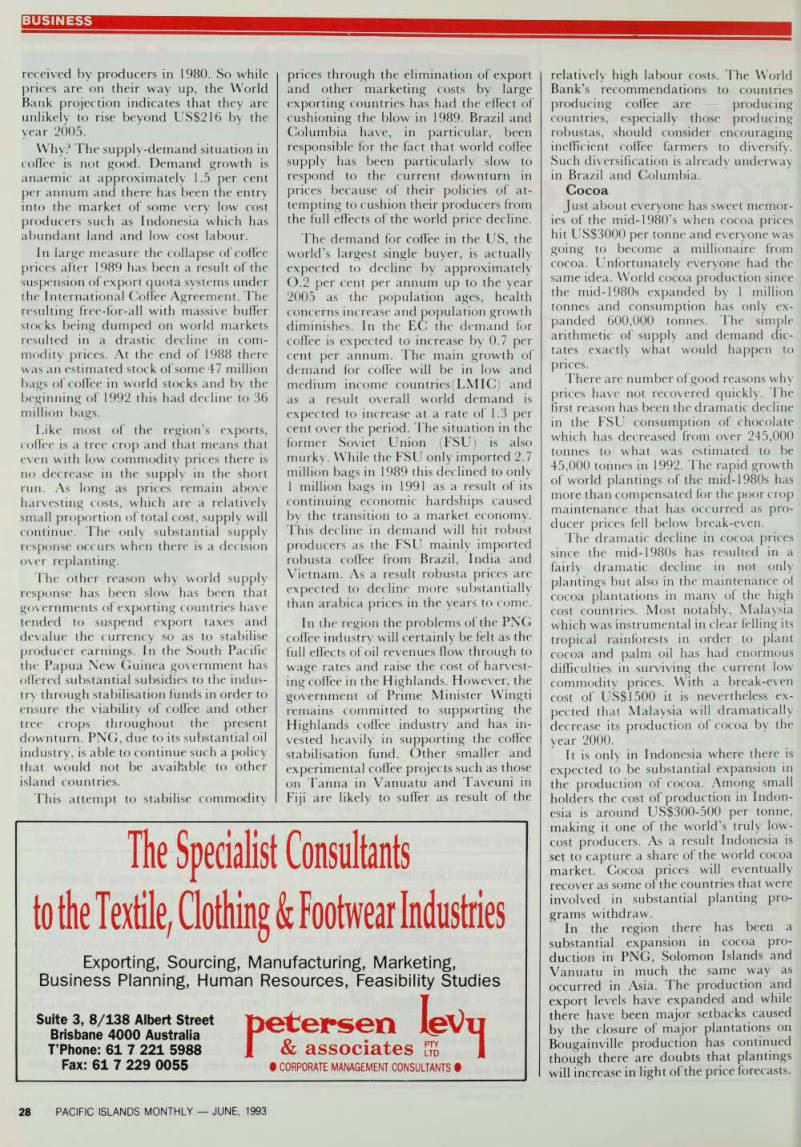
Coffee The World Bank’s report on projected coffee prices is like the good news-bad news joke. The good news is that coffee prices are going to recover from their 1991 levels, as they already have. The bad news is that the 1991 price is the lowest real price of coffee in recorded history and by the year 2005 will in real terms only be 40 per cent of the price
Tanna coffee: likely to suffer because of high labour costs
Phillipe Metois
received by producers in 1980. So while prices are on their way up, the World Bank projection indicates that they are unlikely to rise beyond USS2I6 by the year 2005.
Why? The supply-demand situation in coffee is not good. Demand growth is anaemic at approximately 1.5 per cent per annum and there has been the entry into the market of some very low cost producers such as Indonesia which has abundant land and low cost labour.
In large measure the collapse of coffee prices after 1989 has been a result of the suspension of export quota systems under the International Coffee Agreement. The resulting free-for-all with massive buffer stocks being dumped on world markets resulted in a drastic decline in com modity prices. At the end of 1988 there was an estimated stock of some 47 million bags of coffee in world stocks and by the beginning of 1992 this had decline to 36
million bags.
Like most of the region’s exports, coffee is a tree crop and that means that even with low commodity prices there is no decrease in the supply in the short run. As long as prices remain above harvesting costs, which are a relatively small proportion of total cost, supply will continue. The only substantial supply response occurs when there is a decision
over replanting.
The other reason why world supply response has been slow has been that governments of exporting countries have tended to suspend export taxes and devalue the currency so as to stabilise producer earnings. In the South Pacific the Papua New Guinea government has offered substantial subsidies to the indus try through stabilisation funds in order to ensure the viability of coffee and other tree crops throughout the present downturn. PNG, due to its substantial oil industry, is able to continue such a policy that would not be available to other island countries.
This attempt to stabilise commodity
prices through the elimination of export and other marketing costs by large exporting countries has had the effect of cushioning the blow in 1989. Brazil and Columbia have, in particular, been responsible for the fact that world coffee supply has been particularly slow to respond to the current downturn in prices because of their policies of at tempting to cushion their producers from the full effects of the world price decline.
The demand for coffee in the US, the world’s largest single buyer, is actually
expected to decline by approximately
0.2 per cent per annum up to the year 2005 as the population ages, health concerns increase and population grow th diminishes. In the EC the demand for coffee is expected to increase by 0.7 per cent per annum. The main growth of demand for coffee will be in low and medium income countries(LMlC) and as a result overall world demand is expected to increase at a rate of 1.3 per cent over the period. The situation in the former Soviet Union (FSU) is also murky. While the FSU only imported 2.7 million bags in 1989 this declined to only 1 million bags in 1991 as a result of its
continuing economic hardships caused
by the transition to a market economy.
This decline in demand will hit robust
producers as the FSU mainly imported
robusta coffee from Brazil, India and Vietnam. As a result robusta prices are expected to decline more substantially than arabica prices in the years to come.
In the region the problems of the PNG coffee industry will certainly be felt as the full effects of oil revenues flow' through to wage rates and raise the cost of harvest ing coffee in the Highlands. However, the government of Prime Minister Wingti remains committed to supporting the Highlands coffee industry and has in vested heavily in supporting the coffee stabilisation fund. Other smaller and experimental coffee projects such as those on Tanna in Vanuatu and Taveuni in Fiji are likely to suffer as result of the
relatively high labour costs. The World Bank’s recommendations to countries
producing coflee are producing
countries, especially those producing
robustas, should consider encouraging inefficient coffee farmers to diversify.
Such diversification is already underway in Brazil and Columbia.
Cocoa Just about everyone has sweet memor ies of the mid-1980’s when cocoa prices hit USS3OOO per tonne and everyone was going to become a millionaire from cocoa. Unfortunately everyone had the same idea. World cocoa production since the mid-1980s expanded by 1 million tonnes and consumption has only ex panded 600,000 tonnes. The simple arithmetic of supply and demand dic tates exactly what would happen to
prices.
There are number of good reasons why prices have not recovered quickly. The first reason has been the dramatic decline in the FSU consumption of chocolate which has decreased from over 245,000 tonnes to what was estimated to be 45,000 tonnes in 1992. The rapid growth of world plantings of the mid-1980s has more than compensated for the poor crop maintenance that has occurred as pro ducer prices fell below break-even.
The dramatic decline in cocoa prices since the mid-1980s has resulted in a fairly dramatic decline in not only plantings but also in the maintenance of cocoa plantations in many of the high cost countries. Most notably, Malaysia which was instrumental in clear felling its tropical rainforests in order to plant cocoa and palm oil has had enormous difficulties in surviving the current low commodity prices. With a break-even cost of USSISOO it is nevertheless ex pected that Malaysia will dramatically decrease its production of cocoa by the year 2000.
It is only in Indonesia where there is expected to be substantial expansion in the production of cocoa. Among small holders the cost of production in Indon esia is around USS3OO-500 per tonne, making it one of the world’s truly low cost producers. As a result Indonesia is set to capture a share of the world cocoa market. Cocoa prices will eventually recover as some of the countries that were involved in substantial planting pro grams withdraw.
In the region there has been a substantial expansion in cocoa pro duction in PNG, Solomon Islands and Vanuatu in much the same way as occurred in Asia. The production and export levels have expanded and while there have been major setbacks caused by the closure of major plantations on
Bougainville production has continued
though there are doubts that plantings will increase in light of the price forecasts.
It is often hard to understand how countries can be drawn into what, in retrospect, appears to be an absurd expansion of production on the expec tation that prices will stay at or near the peaks when the price boom is occurring.
In the mid-1980s the massive expan sion in cocoa plantings that occurred world-wide as well as in the South Pacific was a result of the assumption that China and the other LMIC will become major consumers of cocoa as they develop and their citizens begin to reach the middle income level where chocolate consump tion begins to rise rapidly. As a result,
many producers expected the price levels
to be maintained by increasing demand from China and other LMIC.
What has happened is that despite increased concern over health, high income countries still are the largest consumers of cocoa and maintain their share of approximately 80 per cent of world imports and the growth of income in LMIC could not maintain prices because of the massive expansion in
world supply.
Edible Oils In copra, and to a lesser degree palm oil, the situation has been quite depress ing for many years. The situation confronting copra is that of secular price decline with long term prices set to continue to decline into the early part of the next century. In large measure this is a result of the decline in demand for copra and coconut oil as an edible product.
Fortunately for coconut oil approximately half the demand for the product stems from the industrial uses of the oil in the production of soap as well as other non-edible uses. However, in this segment of the market coconut oil has suffered from the penetration of its traditional domain by palm oil.
There are a number of difficulties with copra and the market for edible oils that have made the situation confronting Pacific island countries difficult. The most difficult problem is that in the market for edible oils it confronts stiff competition from perennials such as soyabean and corn oil where farmers in temperate countries are able to respond rapidly to changes in market conditions.
In the production of copra and palm oil this is not the case.
Production has to be planned with long term prices in mind as trees sometimes do not reach maturity for 10 years and production can continue for as long as 50 years.
The tropical edible oil industry has been under the hammer in the US by the soya bean lobby which throughout the
1980 s has waged a long and very successful media campaign against trop ical oils emphasising their high saturated fat content and quite erroneously that products such as copra contain high levels of cholesterol. While coconut oil is high in saturated fat, it contains no cholesterol.
On top of the attack by the American competitors these competitors as well as the very large EC producers have received substantial subsidies from their respective governments so that they can effectively compete on world markets. As a result EC production of edible oils has increased 10-fold from 1970 under a regime where
the price that farmers receive is often twice the world price. This
depresses
prices of all ed ible oils includ ing tropical oils such as coconut and palm oil which are by and large very cost efficient by comparison to temperate oils.
What has happened is in large measure a result of the onslaught by temperate oils as well as the massive expan sion in oil palm production in Malaysia.
Copra and coconut oil production are being squeezed world-wide.
Copra pro
duction be tween 1979-81 averaged
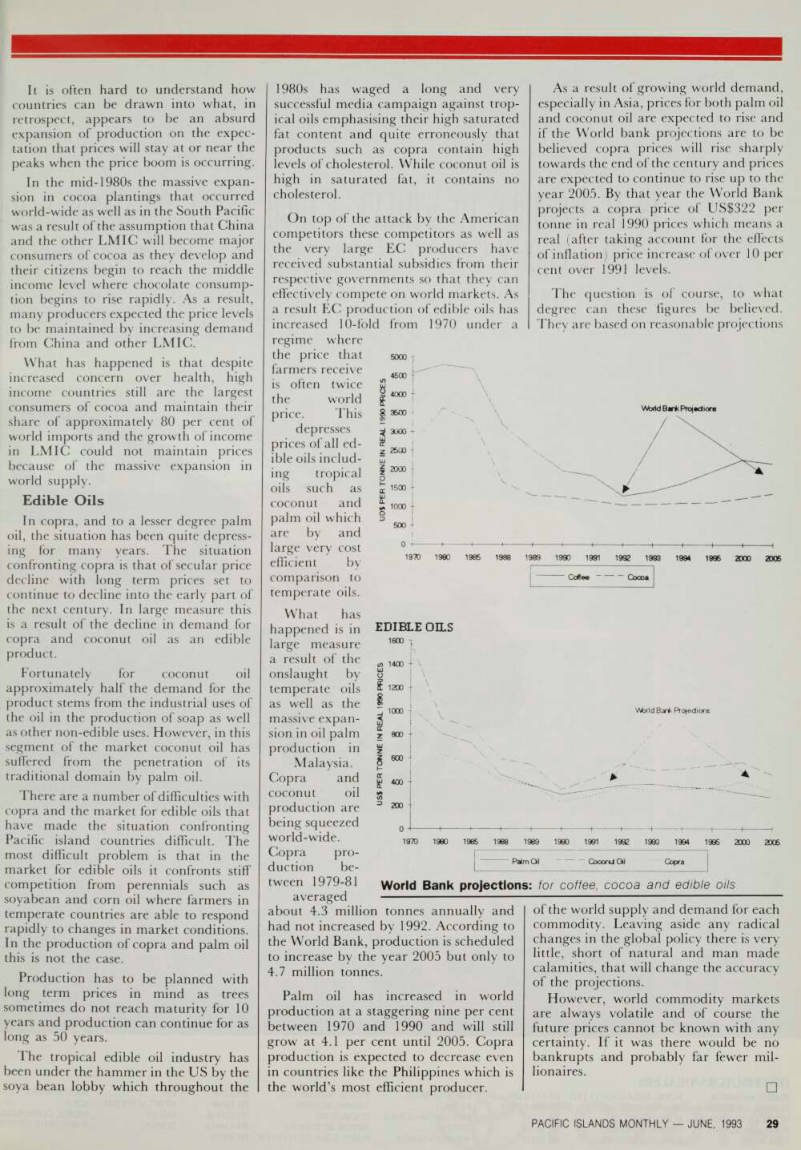
about 4.3 million tonnes annually and had not increased by 1992. According to the World Bank, production is scheduled to increase by the year 2005 but only to 4.7 million tonnes.
Palm oil has increased in world production at a staggering nine per cent between 1970 and 1990 and will still grow at 4.1 per cent until 2005. Copra production is expected to decrease even in countries like the Philippines which is the world’s most efficient producer.
As a result of growing world demand, especially in Asia, prices for both palm oil and coconut oil are expected to rise and if the World bank projections are to be believed copra prices will rise sharply towards the end of the century and prices are expected to continue to rise up to the year 2005. By that year the World Bank projects a copra price of US$322 per tonne in real 1990 prices which means a real (after taking account for the effects of inflation) price increase of over 10 per cent over 1991 levels.
The question is of course, to what degree can these figures be believed.
They are based on reasonable projections
of the world supply and demand for each commodity. Leaving aside any radical changes in the global policy there is very little, short of natural and man made calamities, that will change the accuracy of the projections.
However, world commodity markets are always volatile and of course the future prices cannot be known with any certainty. If it was there would be no bankrupts and probably far fewer mil lionaires.
World Bank projections: for coffee, cocoa and edible oils