Border patrol
pp. 20-21 · Read in the full issue
Conflict
By Wally Hiambohn
ON the Royal Solomon Islands Patrol Vessel (RSIPV) Auki the 18-man crew are friendly, respectful and courteous.
Each night after dinner they sit around to watch video or tell jokfs, and one of the jokes I liked best is about a colleague on the Auki’s sister boat, Lata.
The story goes that after spending a stint at the border, Lata’s crew called in for a break in Honiara. On arrival this crewman was asked to pray to thank the Almighty for their safe-keeping and return home.
So the sailor bows his head and utters, “Big man, we thank you for bringing us safely home. You realise this is the first time we prayed to you in a long while because we know you are here in Honiara where your home is. We never pray at the border because you are never there.”
But as funny as it may seem the point is, with their experience at the border, members of the Solomon Islands surveil lance unit and the police field forces
(PFF) feel their God has forsaken them.
Th{ . Bougainville spill-over effect into thc Shortland Islands and the repeated jncursions b PNG securit forces into these islands is their first rea] experience r ... r , of military confirmation - and they are For the flrst tlme the y are out m the fleld for two weeks keeping guard and natrolinsr well into the nierht While r auuilll 6 wcu llllu lllc Himc man y are g ettin g used to the s,tuatlon and building up courage, most were, from the start, quite frightened of what their tour of duty would be.
Fighting a war with PNG soldiers was th e least of their considerations because they had heard enough tales of the war between PNG troops and Bougainville rebels.
During the machine-gun shoot-out I witnessed between PNG and Solomon Island forces at Tuluve on April 24, the police photographer kept insisting to his superior to stop the shooting because of
what the PNG Defence Force may do.
He told me, “This is it, I’m heading back home. I will become a missionary.”
Sure enough, two days later he was heading back to Honiara with my police escort (his superior) and me after convincing the boss that both his chil dren were down with malaria. He said he was planning to join a Christian fellow ship group travelling to Port Moresby to pray for the Bougainville crisis and its effect on the Solomons.
There are about 70 PFF and patrol boat crew based on the border. In all islands with human habitation there is PFF presence to provide security and comfort and to restore the confidence of
the people.
In Honiara the top echelon of the police force have anxious moments about what may happen on the border.
One senior office told me frankly they try their best to avoid any confrontation because it would have wide implications; the obvious injuries and loss of lives, further strains in relations between PNG
Wally Hiambohn
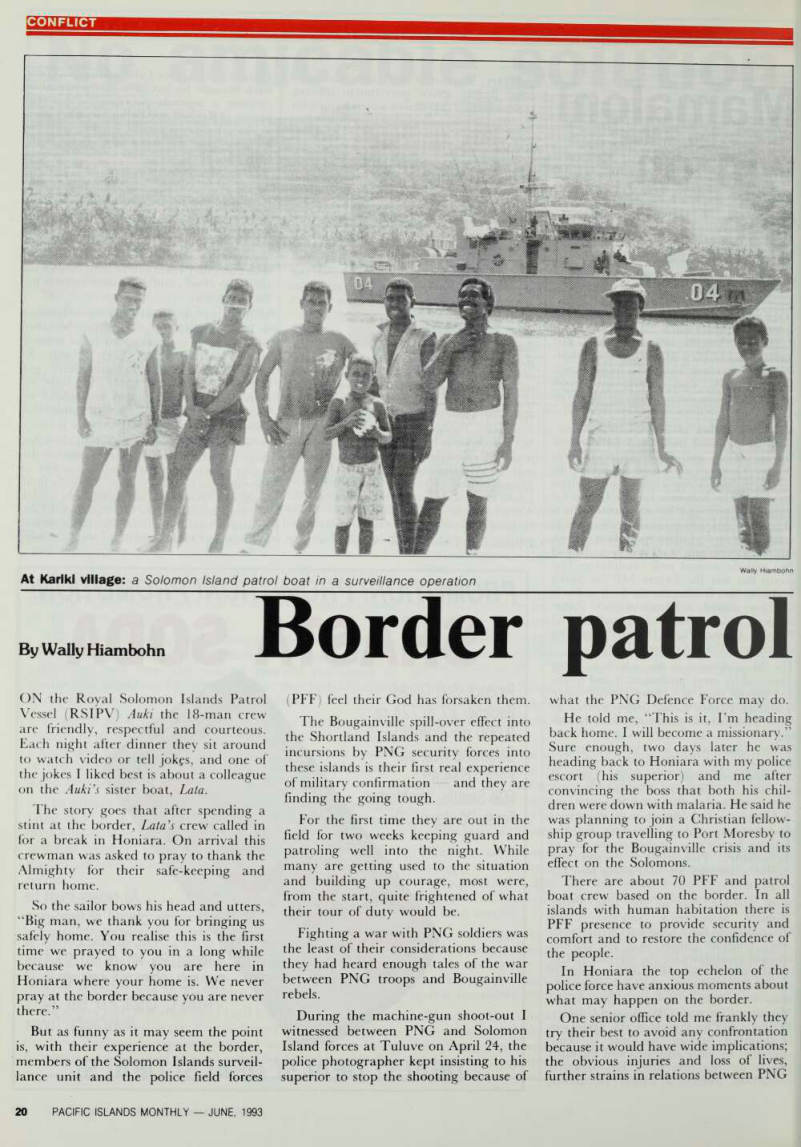
At Kariki village: a Solomon Island patrol boat in a surveillance operation
and the Solomons, and the financial costs of such a situation.
While there have been no casualties on either side, PNG’s repeated intrusions into the Shortland Islands have created tension in relations and cost the Solomon Islands police a great deal financially.
According to the officer some Sls4 million has been spent on its border surveillance operations a considerable amount in terms of the Solomon Islands
government’s public expenditure and
economy. Simply put, it is money the Solomon Islands cannot afford with the state its economy is in and the pressing need for improvements in vital areas such as health, education, roads and bridges.
There certainly is no need for “war” between Papua New Guinea and the Solomon Islands. Firstly, the two are the same people, Melanesian brothers and sisters, and neither can afford it in whatever shape or form it comes. The opposite would be ideal for them to work together for the two countries and
people.
What created this recent stand-off between the two sides is the Bougainville crisis and its “spill-over effects” into the Solomons. This is an issue which the two sides could easily to deal with. Both have have been dragging their feet over the issue.
With the imposition of a blockade around the island three years ago, Bougainvilleans, both civilians and el ements of the Bougainville Revolution ary Army, crossed over into the Shortlands and other parts of the West ern Province through the narrow span of water separating the two countries in search of “supplies”.
PNG security forces have crossed repeatedly into the Shortlands and there is sufficient evidence to prove this in pursuit of BRA elements who cross back and forth. Recent accusations, which have yet to be proven, about an arms traffic route from the Solomons into Boungainville and an arms build-up on the border is well known.
What has further miffed the PNG government is Solomon Islands facilitat ing operations and movement of BRA as well as pro-secessionist activists and sympathisers on its soil. Among them Martin Miriori, the Bougainville interim government representative in Honiara, and his propaganda activities, the likes of
BRA sympathiser Rosemarie Gillespie
and other foreign operatives in the Solomons and who go on to Bougainville to assist the BRA, and also the illegal
entry into Bougainville of foreign jour
nalists through the Solomon Islands.
The first major incident on the border was in early 1992 when PNG security forces raided Kairiki village in the Shortland Groups’ Fauro Island and
blew up a fuel depot they claimed was run for the rebels. While the government apologised over the “unauthorised” inci dent, it warned the Solomons to respect PNG’s sovereignty by not facilitating any activities against it. However, this did not seem to stop as suspected BRA elements and associates kept moving about at will between the two countries.
PNG security forces came up with another shock-horror when they raided Komaleai village, fired shots and killed two people.
People in the Shortlands told me on my recent tour of the islands they were living in constant fear of the security forces, and had restricted their move ments.
Unless Port Moresby or Honiara are in the Shortlands, neither would under stand and appreciate the difficulties these people are facing.
Four thousand human beings who through no fault of theirs are going through this “punishment”. They admit their origin and relationship to Bouganvilleans but say they had only tried to assist those in need of humani tarian aid. A well organised system for procurement of goods was in place where Bougainvilleans in need of food and fuel supplies had to get written approval from both the Bougainville Interim Govern ment and the Shortland Council of Chiefs before receiving these goods.
A black market operation at Komaleai village threw this organisation into chaos. Because Bougainvilleans were loaded with the precious Kina and desperate for supplies, the owners were ripping them off by charging goods in Solomon dollars but accepting payment in Kina.
For example, a store item that cost Sls3 would cost Bougainvilleans K 3, making an extra K 2 because the exchange rate for the two currencies is K 1 to SIS 3.
The operators of this outlet paid for it with the lives of two of their relatives when the PNG security forces stormed the village and pounded bullets into it.
Shortland chiefs who spoke to me expressed disappointment that this par ticular operation had jeopardised their arrangements. They said they weren’t surprised when the PNG security forces moved in and raided Komalaie village.
The attitude and possible involvement of certain Solomon Islands politicians was another area of concern to PNG.
There were claims that a few of these politicians were in contact with the BRA leadership and had on one occasion invited and entertained rebel military leader Sam Kauona.
PNG government officials also claim these politicians were present in Arawa in April 1990 when pro-secessionists
made the unilateral declaration of inde
pendence for Bougainville.
Prime Minister Solomon Mamaloni’s attitude has not helped the situation either. His letter, first to Manus Premier Stephen Pokawin discussing PNG’s internal issues, and later to deputy Prime Minister Sir Julius Chan about Bougain ville wasn’t received too well by Port
Moresby. Sir Julius’ terse reply made
quite obvious the manner in which the letter was received.
Mamaloni’s defence of Martin Miriori’s presence in Honiara contra dicted the undertaking he made to Prime Minister Paias Wingti to close Miriori’s office and remove him from the country.
Instead Honiara issued him two-year residential permit. Its treatment of Mike Foster and Rosemary Gillespie, con sidered foreign agents of the BRA, has
repeatedly angered Port Moresby. These
agents had passed through Honiara to get to Bougainville and vice versa and had for long irked the PNG government.
So it was not surprising when PNG made the claim in April that the Solomons government was assisting the BRA build-up allowing them to take delivery of arms.
For its part the Solomon Islands has accused the PNG government of failing to honour the understanding reached on border surveillance. Continuous in cursions by security forces at the border has angered the Solomon Islands. It is costing the Solomons huge sums of money to maintain police presence at the border. A senior policeman said they were being stretched to the limit.
The arrogant attitude of PNG military personnel at the border has aggravated the situation.
Solomon police personnel spoke fondly
of a certain Captain Philip who was in charge of the PNG base on Tuarato
Island. He helped in creating good
relationship between the two sides. This good relationship soured when he was replaced, they say.
Recent attempts at restoring PNG- Solomons relations is welcome. While bureaucrats have reached a deep and common understanding, it is to be hoped the politicians on both sides would take it further and sanction some of the issues agreed to. Otherwise it would have been a waste of time, going back to square one.
It is in the interest of both sides that there is a strong political will to solve the impasse in relations.
While both Mamaloni and Wingti have agreed on this new dialogue, they should take definite practical measures in addressing the issue.