stripped, indecently as
pp. 16-17 · Read in the full issue
Cover Story
In the country there were calls, even from deep within Wingti’s cabinet and government, for the immediate use of the death penalty, flogging, declaration of a state of emergency and an imposition of a curfew in the worst-hit centres.
John Nilkare, regarded as the third man down the rank from the prime minister, said he wanted a state of emergency declared to combat the grow ing lawlessness and restore investor confidence. He said there was too much talk on law and order by the prime minister and cabinet but little done to enforce measures.
And he added, “There is just too much freedom. Freedom to do what? Certain freedoms have to be curtailed to protect the rights of at least 97 per cent of the population the peace-loving major
ity.”
Opposition leader Jack Genia in calling for the imposition of a curfew and for criminals to be publicly flogged said the reaction of police to crime was “far too little, far too late”.
“Women who are going about their business or shopping for their families are
being attacked, stripped, indecently as
saulted and treated with contempt,” he said. Later, as the situation worsened he
Women who are going about their business or shopping for their fam ilies are being attacked\ stripped, indecently as saulted and treated with contempt... Vicious and barbaric killings must be punishable by death.
Why should a people who take take the life of another person in such a manner be allowed to live?
said, “V icious and barbaric killings must be punishable by death. Why should people who take the life of another person in such manner be allowed to live.
Our system of administering justice must
change.”
National Council of Women President Maria Kopkop said women’s rights and freedom were no longer respected by youths. “What is the law and what are the law agencies doing to protect us,” she asked. “It has now come to a point where our women’s security cannot be guaran teed any longer by the very people whose profession it is to guarantee safety.”
In a strong editorial, the Post Courier daily wrote of the situation “Declining discipline within the ranks of the ‘disci plined forces’ coupled with the inereas in serious crime, are further signs of PNG moving towards a state of anarchy. No citizen today is free to move about because criminals appear to have gained control of this society, and their violent actions against citizens are not counter acted with equal force from the law.”
But Wingti did not believe the situ ation required any of the drastic measures suggested. Instead, he said what was required was a “well co ordinated attack on crime from all
angles”. In the first week of May when parliament was in its last week of the April-May session, the government pushed through several major legis lations seen as the main weapons for its long-term battle against crime. These were changes to the Summary Offences Act. the Bail Act, the Danger ous Drugs Act and the introduction and passage of two new laws known as the Internal Securities Act and the Repatri ation Act.
The effect of all these changes would enable authorities to refuse bail to people charged with committing serious crimes; enable quicker arrests of suspects; pro vide for stiller penalties for carrying and using firearms and dangerous drugs. And except for the' national court, local and district courts no longer have power to grant bail.
The State has also placed the' onus of proof on the accused so a person charged with an offence has to prove his or her innocence instead of the State, as at present. In other words when arrested and charged, a person is automatically guiltv until they prove their innocence, not innocent until proven guilty.
Wingti also promised to improve terms and conditions of serv ice of members of the polite force; boosted their LSS7I.B million budget this year by another USSIO million. In return he asked there be strict discipline in the force and there be positive results in clamping down on lawlessness. To ensure discipline is main tained the government passed another law disallowing any appeal, except through the national court, by police personnel convicted and either sus pended or dismissed by the force.
Wingti instructed four maximum se curity jails be constructed to ensure the hard-core criminals were kept in. A major problem in fighting crime has been the high number of escapes from jail of hard-core criminals, many of whom continue to be responsible for most of these serious crimes.
To assist the government, Port Moresby’s National Capital District Commission agreed to fund USSSOO,OOO for boom gates at the two main roads leading out of the city, and to be manned 24 hours by police to keep a tight check on everyone leaving or coming into the
city.
“We all want to see an end to rape, murder and robberies,” Wingti said when announcing his crime-fight strat- DW- He said he believed crime was on the rise in PNC because the people had an “ attitude problem”. “Papua New Guin eans must be willing to build, not tear down,” he told a meeting attended by women and church leaders. Our people's attitude must change. They must work
and learn to make wise use of resources, including time/' He said the spate oferimes in the weeks preceding were the sign of a “sick society whose members had no respect for society, whose members had no respect for the individual. It has lost its sense of direction of direction. People have ever begun to lose self-respect, he said But while supporting his earnest at tempts to quash lawlessness, those he invited to the meeting, threw the ball back into his court, calling on leaders themselves to set standards and lead bv
example. The prosecution of politicians involved in corruption and the moral conduct of some leaders were cases in point.
United church moderate Sioni Kami said leaders should examine themselves and clean their own backyard first before they expected the public to follow suit.
Both leaders and the public should ensure the continuing law and order problem in the country is seriously addressed.
Without this cooperation neither can be guaranteed a future.
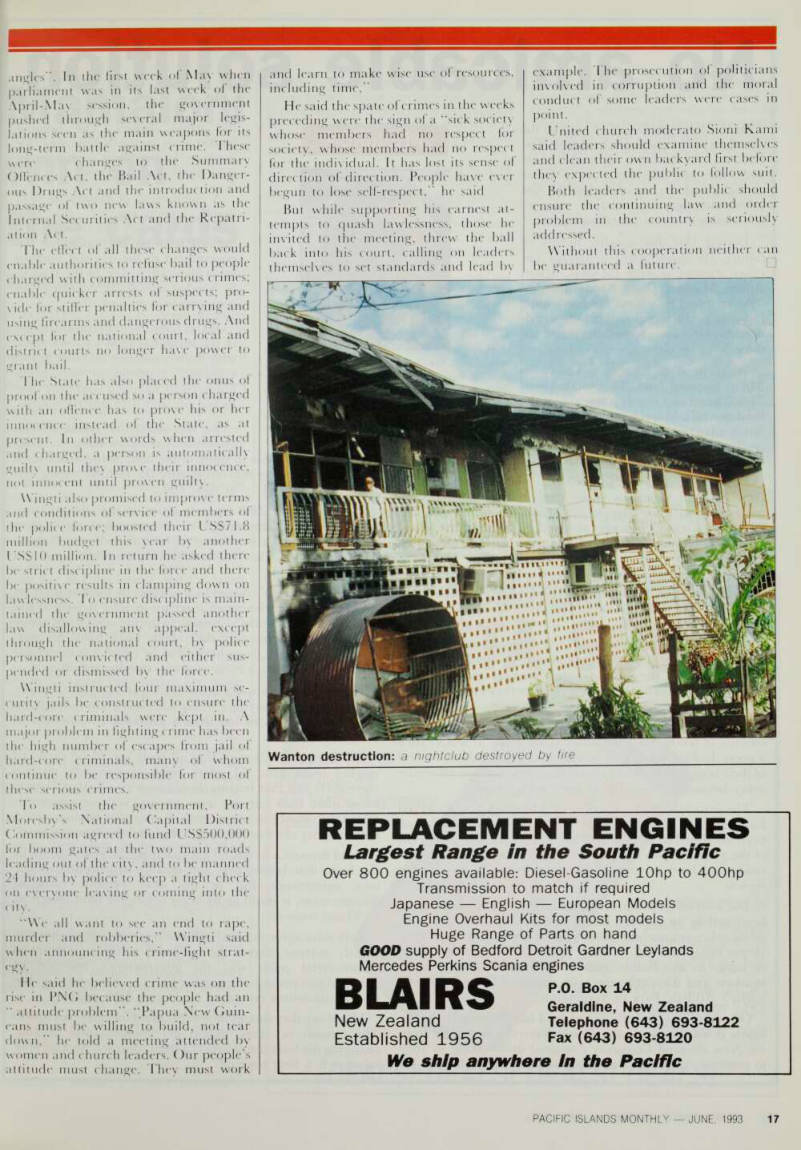
Wanton destruction: a nightclub destroyed by fire