future?
pp. 12-13 · Read in the full issue
Opinion
What of Fiji’s
By A Special Correspondent
In the last two months Sakeasi Buta droka, leader of the Fijian Nationalist Party, has appeared almost as often on the front page of Fiji’s daily newspapers as the nation’s Prime Minister, his performance in parliament and the debates he has sparked in the country have been one of the few pieces of political theatre the newspapers have found worthy of viewing. Over the period he has championed numerous controversial proposals over such issues as diverse as land tenure, an alternative Great Council of Chiefs and a Land Bank. The theme is, of course, vintage Butadroka an unbending support for what he sees as the rights of indigenous Fijians. For 20 years Buta has not been taken terribly seriously, yet suddenly, since Fiji’s return to democracy, his policies and voice ring out loud and clear from parliament. The most interesting questions is, why? How is a man like Buta able to so clearly capture the minds of the media and, to a painful degree, the views of an increasing number of Fijians? The reason for his success stems in large part from the fact that the government of Sitiveni Rabuka has for the past six months been utterly preoccupied with the formation of a government of na tional unity.
The reasons for Rabuka’s desire for a government of national unity are com plex. On the one level he appears to be operating out of a desire to come to terms with Fiji’s Indian minority and it is now statistically a minority. The second reason is somewhat more Machiavellian.
Waiting in the wings is Josevata Kami kamica, whom Prime Minister Rabuka has asked on more than one occasion to take over the Finance portfolio currently held by Rotuman Paul Manueli. The presence and power within cabinet of Rotumans and mixed race ministers of the General Voters Party have linked more than a few of Rabuka’s cabinet colleagues in the SVT, but more import antly is the fact that Kamikamica is waiting to replace not Manueli, but Rabuka himself.
Kamikamica to a large degree rep resents the power of and has the support of some of most powerful traditional chiefs within the Great Council of Chiefs and is clearly a long term (possibly even a short term) threat to Rabuka’s survival
a short term threat to Rabuka’s survival a threat that Rabuka would dearly like to neutralise or co-opt if necessary.
The internal dissension within his own SVT party has made it necessary for him to look to the Indian parties for support.
In so doing he has had at least verbally softened his position on Indian and minority rights in Fiji and appears to be willing to appease the Indian parties on a number of issues.
The appeasement thus far has been more apparent rather than real. There has been no revocation of the contro versial labour decrees, no substantive review of Value Added Tax and no full review of the constitution. Mahendra Chaudhry, leader of Fiji’s Indian dominated Labour Party has stood for election on a platform of not even sitting in parliament, and subsequently not only sat in parliament but supported Rabuka on a promise of electoral labour and tax reform, is now courting Rabuka to form a government of national unity and is beginning to look very much like Shakespeare’s proverbial ‘‘wench who doth protest too much”.
But what of Buta? It is precisely the apparent shift in policy to the political center by Rabuka in the last year that has given Buta his entree - an entree he had never had in 20 years of Fiji politics.
Rabuka is being out-flanked from his extreme right and as a good general he had better watch out before he loses the battle due to what mistakenly appears to be a minor tactical shift.
Is that all? Is it only the fact that Rabuka is making overtures to the Indians that accounts for Buta’s PR success in parliament. This is not just a game of appearances. The reality of the situation is that one year ago Rabuka was swept to power because he had the support of the vanua of the Fijian people.
He had their support'in part because of the coup, but also because he represented dare one say it a charismatic commoner and a departure from the old Lauan dominated elite. The chiefs were astute enough to know that they had better give the man his rope no matter how much they preferred Kamikamica who was and remains “their commoner”.
Rabuka will stay in power as long as he holds what the Chinese call “the man date from heaven” or the Fijian equivalent the vanua. But the chiefs and Kamikamica can read the vanua just as well as Rabuka.
Buta has succeeded in large measure because he has presented a clear and consistent policy to the vanua and this is getting back to village. The problem lies fairly and squarely with Rabuka and the SVT. Rather than out-flanking Buta, the
government of Rabuka has reacted to him. Cabinet has recently approved a S2-million loan scheme to fund the purchase of foreign owned land largely as a result of pressure from Buta.
Thus it appears that Buta is increasingly
being seen as setting Fiji’s political
agenda rather than the government.
Rather than presenting a coherent policy of Fijianistion that would sell to the vanua, Cabinet has simply reacted.
There is a real and substantive danger about what Buta is advocating especially in the area of returning land to Fijian owners. In 1997 the land leases under the Agricultural Landlord and Tenant Act come up for renewal. Buta wants this land returned to the Fijian land owners. It is not difficult to paint a quite realistic disaster scenario. In the year 2000 the Lome Convention which is the basis of Fiji’s sugar industry comes up for review and given that the EC now exports over 4 million tonnes of sugar and no longer needs sugar from Fiji, there is every likelihood that the conven tion will come to an end. (Contract sugar accounts for 40 per cent of Fiji’s available
land).
When the Convention was originally negotiated in 1974-5 the UK was still a major importer of sugar and AGP sugar was in demand. It is quite possible that under increasing pressure from Buta the Fiji government may attempt to develop a policy of returning land to its Fijian land owners just at the very time when that land will decrease in value. In order to do this the Fiji government would have to borrow massively in order to assist landowners to repay tenants for the value of the improvements. It may actually suit the interest of Indian landowners to have Fijians buy their land and pay for improvements just at the peak of its value. Thus the Fijian people may as a result of Buta’s pressure
be left with land that is of little commercial value but straddled with massive debts for the value of the
improvements.
Rabuka has made the cardinal mis take of politics. He has not presented his constituency with something concrete that makes him clearly different from his predecessors or his competitors. No matter how dangerous his ideas may be, that certainly cannot be said of Buta. His
policies are clear and quite unequivocal
and he is the only politician who knows he has nothing to gain from a govern ment of national unity.
The recent gagging of Buta over his attack of former Prime Minister and Vice-President Ratu Sir Kamisese Mara in parliament and his subsequent and
legally questionable ejection from the
house for almost three months has also struck a chord among many Fijians who, while deeply respecting Mara, at the same time pray the president Ratu Sir Penaia Ganilau will live to be a 120 years. Rabuka’s nightly prayers also go out for the continued good health of the
president. However gagging Buta by
ejectiing him from parliament only goes
to strengthen him.
In the final analysis Buta will not succeed even if the Prime Minister continues his current policy because what Buta says stands so fundamentally at odds with everything that is Christian and decent about Fiji. Buta has publicly said he wishes to ethnically cleanse Fiji Fiji only for the Fijians no Indians, no Europeans, no others. That is quite different from upholding the rights of the Fijian people. It is a simple message that rings of Bosnia and Croatia and while it might sell to some, to thinking Fijians who understand what sort of ugly society would need to be created to fulfil Buta’s nightmare this will almost certainly be
rejected. □
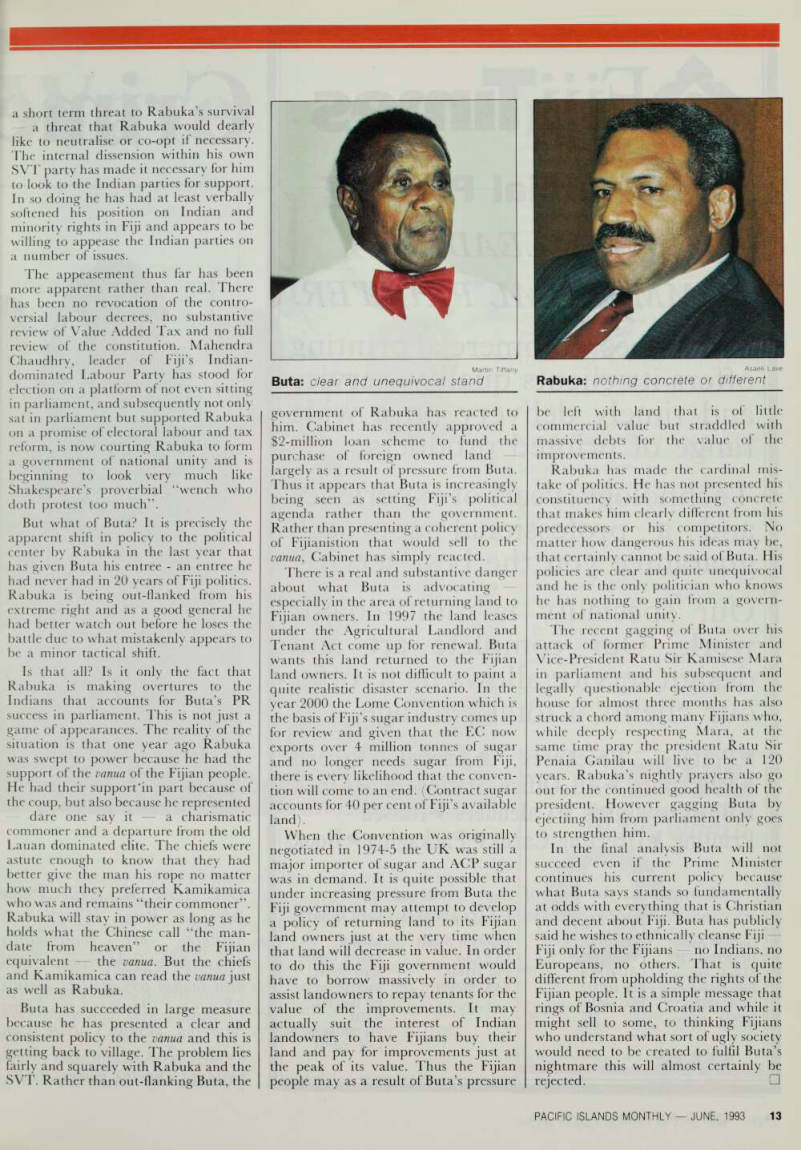
Martin Tiffany Buta: clear and unequivocal stand
Asaeli Lave Rabuka: nothing concrete or different