Pacific gallivanter
pp. 55-56 · Read in the full issue
Yachting
By Sally Andrew
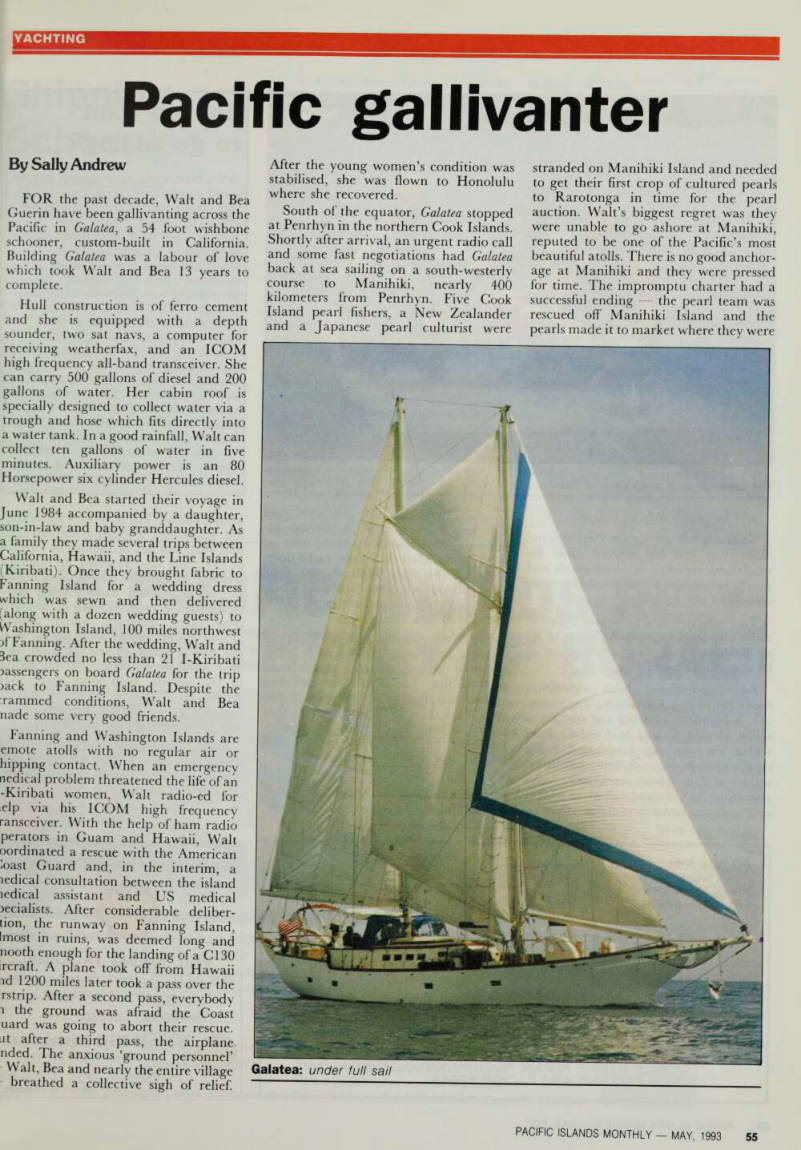
FOR the past decade, Walt and Bea Guerin have been gallivanting across the Pacific in Galatea , a 54 foot wishbone schooner, custom-built in California.
Building Galatea was a labour of love which took Walt and Bea 13 years to complete.
Hull construction is of ferro cement and she is equipped with a depth sounder, two sat navs, a computer for receiving weatherfax, and an ICOM high frequency all-band transceiver. She can carry 500 gallons of diesel and 200 gallons of water. Her cabin roof is specially designed to collect water via a trough and hose which fits directly into a water tank. In a good rainfall, Walt can collect ten gallons of water in five minutes. Auxiliary power is an 80 Horsepower six cylinder Hercules diesel.
Walt and Bea started their voyage in June 1984 accompanied by a daughter,
son-in-law and baby granddaughter. As
a family they made several trips between California, Hawaii, and the Line Islands
(Kiribati). Once they brought fabric to
Fanning Island for a wedding dress which was sewn and then delivered (along with a dozen wedding guests) to Washington Island, 100 miles northwest pf Fanning. After the wedding, Walt and Sea crowded no less than 21 I-Kiribati passengers on board Galatea for the trip
pack to Fanning Island. Despite the
:rammed conditions, Walt and Bea nade some very good friends.
Fanning and Washington Islands are emote atolls with no regular air or hipping contact. When an emergency nedical problem threatened the life of an -Kiribati women, Walt radio-ed for
elp via his ICOM high frequency
ransceiver. With the help of ham radio perators in Guam and Hawaii, Walt oordinated a rescue with the American Guard and, in the interim, a tedical consultation between the island icdical assistant and US medical pecialists. After considerable deliber tion, the runway on Fanning Island, Imost in ruins, was deemed long and nooth enough for the landing of a Cl 30 ircraft. A plane took off from Hawaii id 1200 miles later took a pass over the rstrip. After a second pass, everybody i the ground was afraid the Coast uard was going to abort their rescue, it after a third pass, the airplane nded. The anxious ‘ground personnel’
Walt, Bea and nearly the entire village breathed a collective sigh of relief.
After the young women’s condition was stabilised, she was flown to Honolulu where she recovered.
South of the equator, Galatea stopped at Penrhyn in the northern Cook Islands.
Shortly after arrival, an urgent radio call and some fast negotiations had Galatea back at sea sailing on a south-westerly course to Manihiki, nearly 400 kilometers from Penrhyn. Five Cook Island pearl fishers, a New Zealander and a Japanese pearl culturist were
stranded on Manihiki Island and needed to get their first crop of cultured pearls to Rarotonga in time for the pearl auction. Walt’s biggest regret was they were unable to go ashore at Manihiki, reputed to be one of the Pacific’s most beautiful atolls. There is no good anchor age at Manihiki and they were pressed for time. The impromptu charter had a successful ending the pearl team was rescued off Manihiki Island and the pearls made it to market where they were
Galatea: under full sail
sold for a few million dollars!
Galatea is not set up for conventional chartering, but has proved ideal for specialised expeditions where goods and people need to be transported to remote corners of the Pacific.
Two international groups of amateur radio operators have used Galatea to set up field ham radio communications at hard-to-reach locations.
An international ham expedition made up of two Canadians, an Ameri can, a Japanese, a Swede and two Finns sailed aboard Galatea to Conway Reef where they set up land-based radio equipment in the remote southwest waters of Fiji. These seven ham radio operators “DX’d” and talked to 47,000 people during seven days of operations
i.e. each radio operator contacted over 950 people each day! A second ex pedition to isolated Banaba west of Kiribati included three ham radio oper ators one from Finland, one from Sweden and one from Iceland. These three Scandanavians made over 35,000 contacts in two weeks.
For Walt and Bea, the best part of cruising has been meeting and sailing with so many diverse people and personalities. Initially Walt and Bea cruised as a three generation family, but these days they “pick up” crew as they travel around the Pacific. Most crew members have been gregarious and helpful, but not all have been perfect.
In Port Vila this season, Galatea arrived with three crew members: Tetra, a beautiful tall German girl who sailed
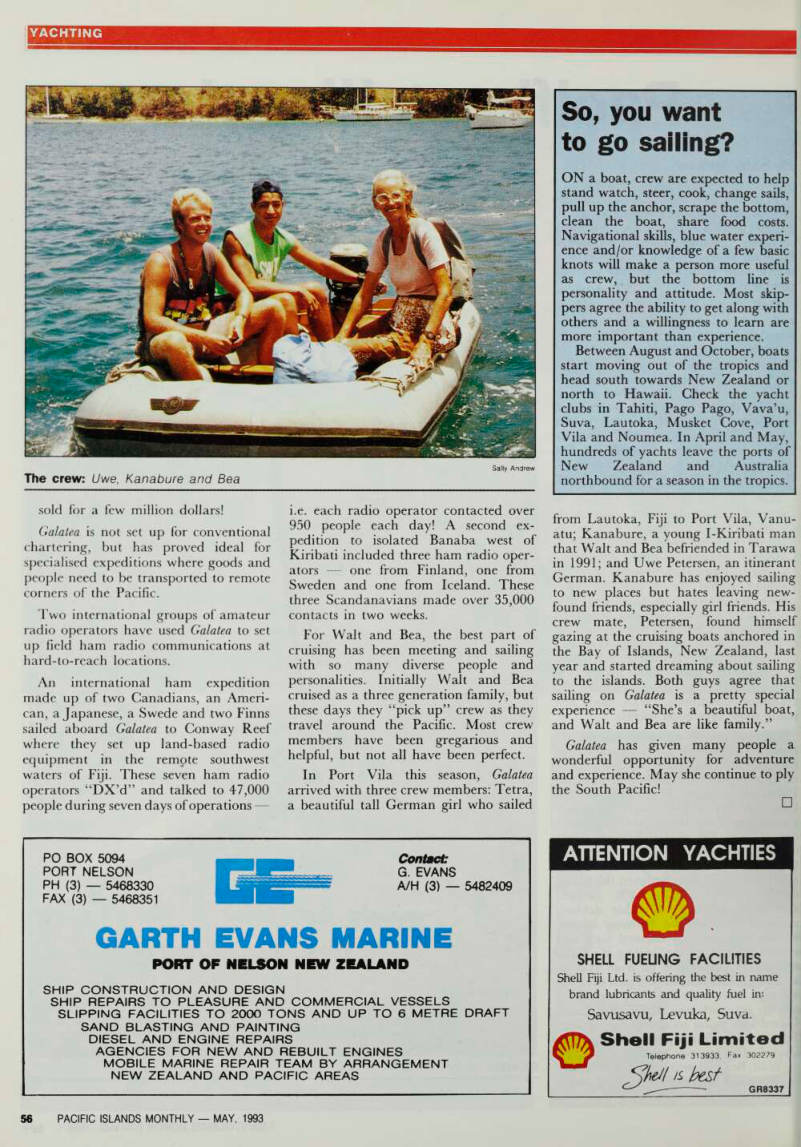
from Lautoka, Fiji to Port Vila, Vanu atu; Kanabure, a young I-Kiribati man that Walt and Bea befriended in Tarawa in 1991; and Uwe Petersen, an itinerant German. Kanabure has enjoyed sailing to new places but hates leaving new found friends, especially girl friends. His crew mate, Petersen, found himself gazing at the cruising boats anchored in the Bay of Islands, New Zealand, last year and started dreaming about sailing to the islands. Both guys agree that sailing on Galatea is a pretty special experience “She’s a beautiful boat, and Walt and Bea are like family.”
Galatea has given many people a wonderful opportunity for adventure and experience. May she continue to ply the South Pacific!
The crew: Uwe, Kanabure and Bea
Sally Andrew