Capital value on property
p. 51 · Read in the full issue
THE heady days of the middle and late 1980 s are well and truly over. Those were the days when legendary Japanese buyers would pick up properties in Port Vila for hundreds of thousands of dollars without even having seen them or without ever having visited Vanuatu.
Worldwide, those who abandoned the stock market in 1987 after the crash for the supposed safety of bricks and mortar were bitterly disappointed after 1990.
While Vanuatu has not entirely escaped the slaughter in real estate markets it certainly has not been as badly effected as other countries. There is always a certain up-matket clientele who want to buy there and even though the Japanese are out of the market there are other, often Asian, buyers who are still buying.
Buying real estate in Vanuatu is not a simple matter and is complicated by the fact freehold land was abolished at independence in 1980 and replaced with 50-year leases. It is useful to note the measure had devastating effect on buyer confidence in the real estate market for the the first half of the 1980 s. The market did recover from the post-independence shock but it took almost five years. Now, in municipal areas, the lessor of all property is the government which acts on behalf of the people.
When you look for a property in Vanuatu certain costs have to be con sidered. You pay five per cent stamp duty and two per cent registration fee to government and the solicitor’s costs of one per cent of the transaction cost.
However, the buyer does not pay the agent’s commission. There are on-going expenses as well. There are municipal taxes which in Vila run to about US$22O per annum for a three-bedroom house.
Because there is no freehold the same property would pay an annual property "ent to the government of approximated
&Usi2O. 7
If you are purchasing property outside he urban configurations of Vila and property acquisition gets nore difficult, especially if no lease exists, lefore you can obtain a lease you must irst seek permission from the Minister of Natural Resources who will issue what is ailed a ‘negotiator certificate’ which Hows you to negotiate with the custom er landowners. This is to ensure no ther parties are negotiating with land wners over the same land.
If you want to build in Port Vila or Isewhere you will have to acquire land ffiich, especially around Vila harbour, is ecoming more difficult to obtain and lore expensive. The construction cost
for an up-market property is about 80,000 (US$7OO) vatu per square metre.
A quality property on the first or second lagoon in Port Vila now costs about US$2OO,OOO and as much as
US$3OO,OOO, though cheaper properties
are available.
As Vanuatu is a tax haven there are no capital gains tax nor any taxes on inheritance so a trust can hold the property without any tax implications.
What has actually happened to the value of properties? Vanuatu real estate was hit fairly hard by the effects of the global recession. Property values leveled out but, according to real estate agent Douglas Patterson, the number of sales declined but prices have tended to remain stable. While real estate values peaked in 1988, in Port Vila properties with water frontage along the harbour still continue to rise in price according to Patterson, “by approximately 15 per cent per annum”.
What can you expect as a gross return on a property if you buy in Vila? Some agents will tell you that the best you can expect is in the vicinity of 12 per cent gross return but others feel 15 per cent is still achievable on rental properties. In part the aid agencies and international banks which are the market leaders have tended to lower the amount they are willing to pay in rent for their staff in Port Vila. The Asian Development Bank which runs its regional program for the South Pacific in Vila used to give its staff a housing allowance of about $2,200 per month but has now lowered it to around $1,600 and this had the effect of capping
rents in the town.
The best returns on rental property in Vanuatu are not at the top end in large part because the country does not have the very large diplomatic service needed to support this market segment.
The best returns are gained on medium priced property. The very best rents that can be obtained in Vila are now in the vicinity U 552,500 per month. This will give a poor rate of return on a US$3OO,OOO property. The rates of return are higher for slightly lower cost properties according to Patterson. But there is a trade off. At the top end the rents are not that good but the capital gains potential is higher.
On the commercial property market there is a definite shortage of street level properties in Vila and good rates of return in the vicinity of 12 per cent gross per annum are available. However because there is a surplus of property available above street level overall re turns are not that good. Vila commercial real market has peculiarity. Normally you pay more rent for commercial property the higher up you go. It seems in Port Vila people do not want to walk up stairs and as a result rents actually decrease 10-15 per cent with every floor you go up.
Despite its oddities and peculiarities the Vila market still is yielding decent returns to judicious investors. The days when you could buy anything and make money are over. Good returns are still possible but investors must now be much more careful about where and what they
buy. □
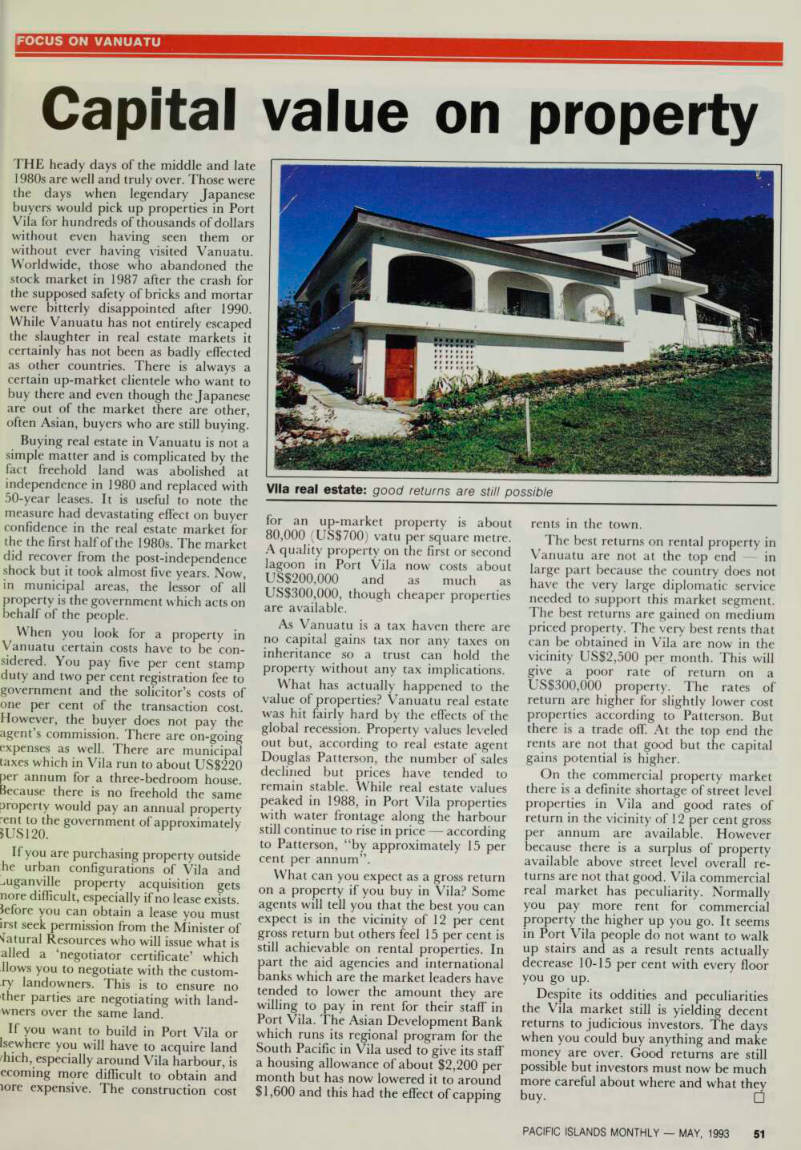
Vila real estate: good returns are still possible