Tax Paradise?
p. 47 · Read in the full issue
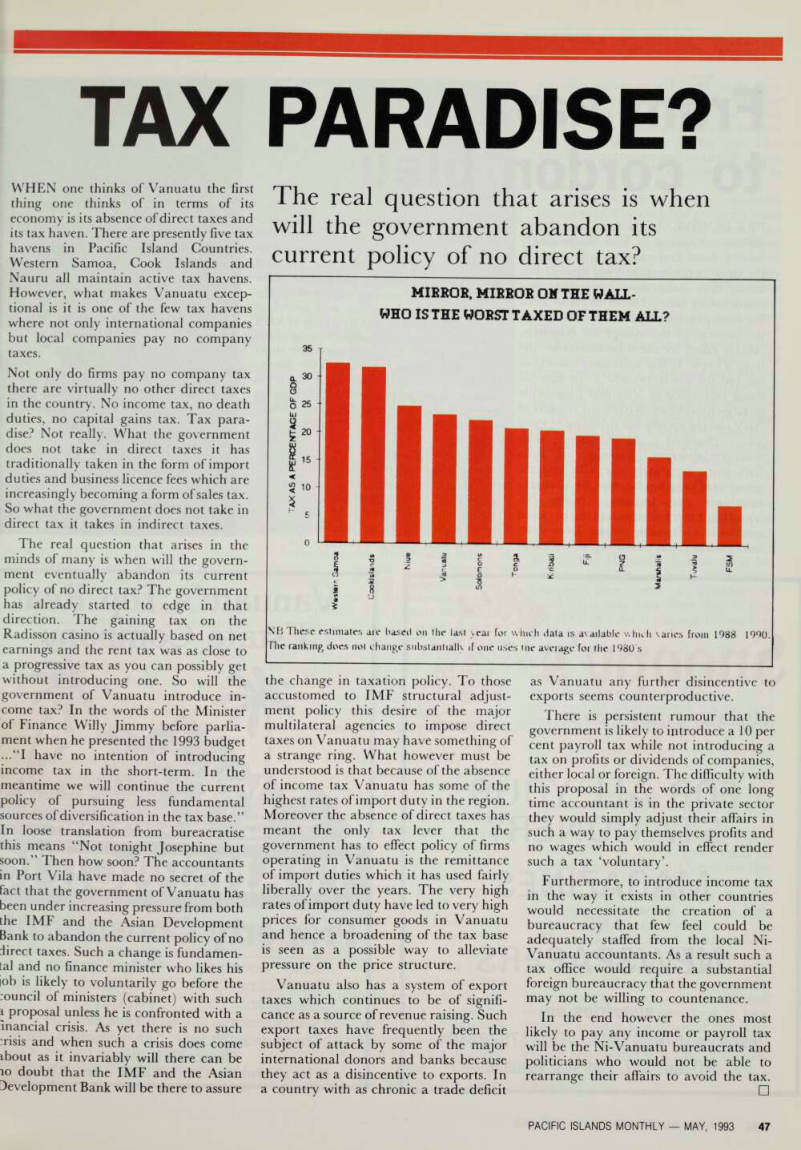
The real question that arises is when will the government abandon its current policy of no direct tax?
WHEN one thinks of Vanuatu the first thing one thinks of in terms of its economy is its absence of direct taxes and its tax haven. There are presently five tax havens in Pacific Island Countries.
Western Samoa, Cook Islands and Nauru all maintain active tax havens.
However, what makes Vanuatu excep tional is it is one of the few tax havens where not only international companies but local companies pay no company taxes.
Not only do firms pay no company tax there are virtually no other direct taxes in the country. No income tax, no death duties, no capital gains tax. Tax para dise? Not really. What the government does not take in direct taxes it has traditionally taken in the form of import duties and business licence fees which are increasingly becoming a form of sales tax.
So what the government does not take in direct tax it takes in indirect taxes.
The real question that arises in the minds of many is when will the govern ment eventually abandon its current policy of no direct tax? The government has already started to edge in that direction. The gaining tax on the Radisson casino is actually based on net earnings and the rent tax was as close to a progressive tax as you can possibly get without introducing one. So will the government of Vanuatu introduce in come tax? In the words of the Minister of Finance Willy Jimmy before parlia ment when he presented the 1993 budget ...“I have no intention of introducing income tax in the short-term. In the meantime we will continue the current policy of pursuing less fundamental sources of diversification in the tax base.”
In loose translation from bureacratise
this means “Not tonight Josephine but
soon.” Then how soon? The accountants in Port Vila have made no secret of the fact that the government of Vanuatu has been under increasing pressure from both the IMF and the Asian Development Bank to abandon the current policy of no direct taxes. Such a change is fundamen tal and no finance minister who likes his job is likely to voluntarily go before the :ouncil of ministers (cabinet) with such i proposal unless he is confronted with a mancial crisis. As yet there is no such :risis and when such a crisis does come ibout as it invariably will there can be 10 doubt that the IMF and the Asian Development Bank will be there to assure
the change in taxation policy. To those accustomed to IMF structural adjust ment policy this desire of the major multilateral agencies to impose direct taxes on Vanuatu may have something of a strange ring. What however must be understood is that because of the absence of income tax Vanuatu has some of the highest rates of import duty in the region.
Moreover the absence of direct taxes has meant the only tax lever that the government has to effect policy of firms operating in Vanuatu is the remittance of import duties which it has used fairly liberally over the years. The very high rates of import duty have led to very high prices for consumer goods in Vanuatu and hence a broadening of the tax base is seen as a possible way to alleviate pressure on the price structure.
Vanuatu also has a system of export taxes which continues to be of signifi cance as a source of revenue raising. Such export taxes have frequently been the subject of attack by some of the major international donors and banks because they act as a disincentive to exports. In a country with as chronic a trade deficit
as Vanuatu any further disincentive to exports seems counterproductive.
There is persistent rumour that the government is likely to introduce a 10 per cent payroll tax while not introducing a tax on profits or dividends of companies, either local or foreign. The difficulty with this proposal in the words of one long time accountant is in the private sector they would simply adjust their affairs in such a way to pay themselves profits and no wages which would in effect render such a tax ‘voluntary’.
Furthermore, to introduce income tax in the way it exists in other countries would necessitate the creation of a bureaucracy that few feel could be adequately staffed from the local Ni- Vanuatu accountants. As a result such a tax office would require a substantial foreign bureaucracy that the government may not be willing to countenance.
In the end however the ones most likely to pay any income or payroll tax will be the Ni-Vanuatu bureaucrats and politicians who would not be able to rearrange their affairs to avoid the tax. □