The Education War
p. 33 · Read in the full issue
Education
Big money is being spent as universities and colleges battle for students.
By Martin Tiffany
A AUSTRALIAN Fosters larger and New Zealand lamb chops are familiar sights in South Pacific countries.
As are countless other commodities from building materials to butter which are imported from these two countries. But another item, not listed in their rows of trade figures, is fast becoming a saleable item.
The hallowed institutions of education seem to be turning into just another commodity and into battle grounds as colleges and universities vie for students.
The situation in New Zealand can only be described as cut-throat. Poly technic and universities in that country get government grants according to their student roll the more the students; the larger the grant. The number of teachers too depends on the roll. There have been cases of institutions getting grants based on predicted student numbers, then failing to get the numbers and having to pay the grant back.
A fine example of the fierce compe tition is Massey University building a big lew campus (in record time) in West ~nd to enable it to compete head )n with the University of Auckland.
Otago University recently spent big noney on a marketing video as it idopted the hard-sell approach taken by nany other institutions to woo students.
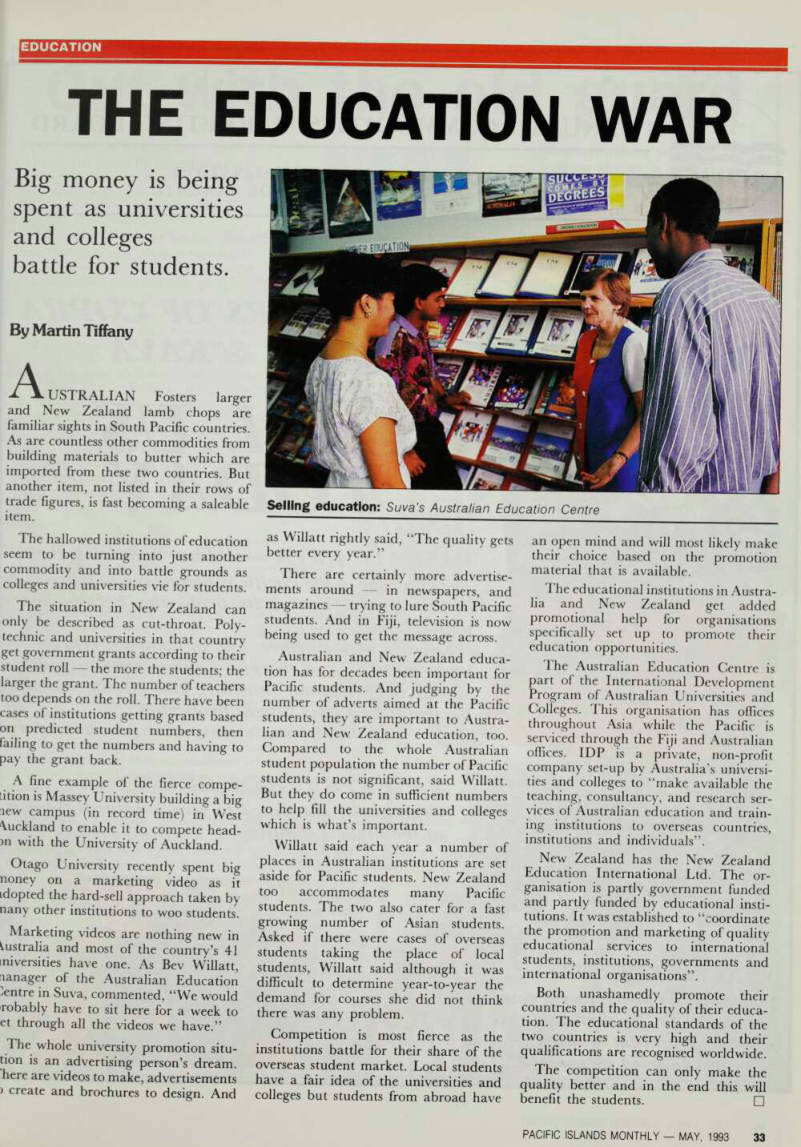
Marketing videos are nothing new in Australia and most of the country’s 41 iniversities have one. As Bev Willatt, lanager of the Australian Education Centre in Suva, commented, “We would robably have to sit here for a week to et through all the videos we have.”
The whole university promotion situ tion is an advertising person’s dream, here are videos to make, advertisements ) create and brochures to design. And
as Willatt rightly said, “The quality gets better every year.”
There are certainly more advertise ments around in newspapers, and magazines trying to lure South Pacific students. And in Fiji, television is now being used to get the message across.
Australian and New Zealand educa tion has for decades been important for Pacific students. And judging by the number of adverts aimed at the Pacific students, they are important to Austra lian and New Zealand education, too.
Compared to the whole Australian student population the number of Pacific students is not significant, said Willatt.
But they do come in sufficient numbers to help fill the universities and colleges which is what’s important.
Willatt said each year a number of places in Australian institutions are set aside for Pacific students. New Zealand too accommodates many Pacific students. The two also cater for a fast growing number of Asian students.
Asked if there were cases of overseas students taking the place of local students, Willatt said although it was difficult to determine year-to-year the demand for courses she did not think there was any problem.
Competition is most fierce as the institutions battle for their share of the overseas student market. Local students have a fair idea of the universities and colleges but students from abroad have
an open mind and will most likely make their choice based on the promotion material that is available.
The educational institutions in Austra lia and New Zealand get added promotional help for organisations specifically set up to promote their education opportunities.
The Australian Education Centre is part of the International Development Program of Australian Universities and Colleges. This organisation has offices throughout Asia while the Pacific is serviced through the Fiji and Australian offices. IDP is a private, non-profit company set-up by Australia’s universi ties and colleges to “make available the teaching, consultancy, and research ser vices of Australian education and train ing institutions to overseas countries, institutions and individuals”.
New Zealand has the New Zealand Education International Ltd. The or ganisation is partly government funded and partly funded by educational insti tutions. It was established to “coordinate the promotion and marketing of quality educational services to international students, institutions, governments and international organisations”.
Both unashamedly promote their countries and the quality of their educa tion. The educational standards of the two countries is very high and their qualifications are recognised worldwide.
The competition can only make the quality better and in the end this will benefit the students. □
Selling education: Suva's Australian Education Centre