Going an extra mile
p. 39 · Read in the full issue
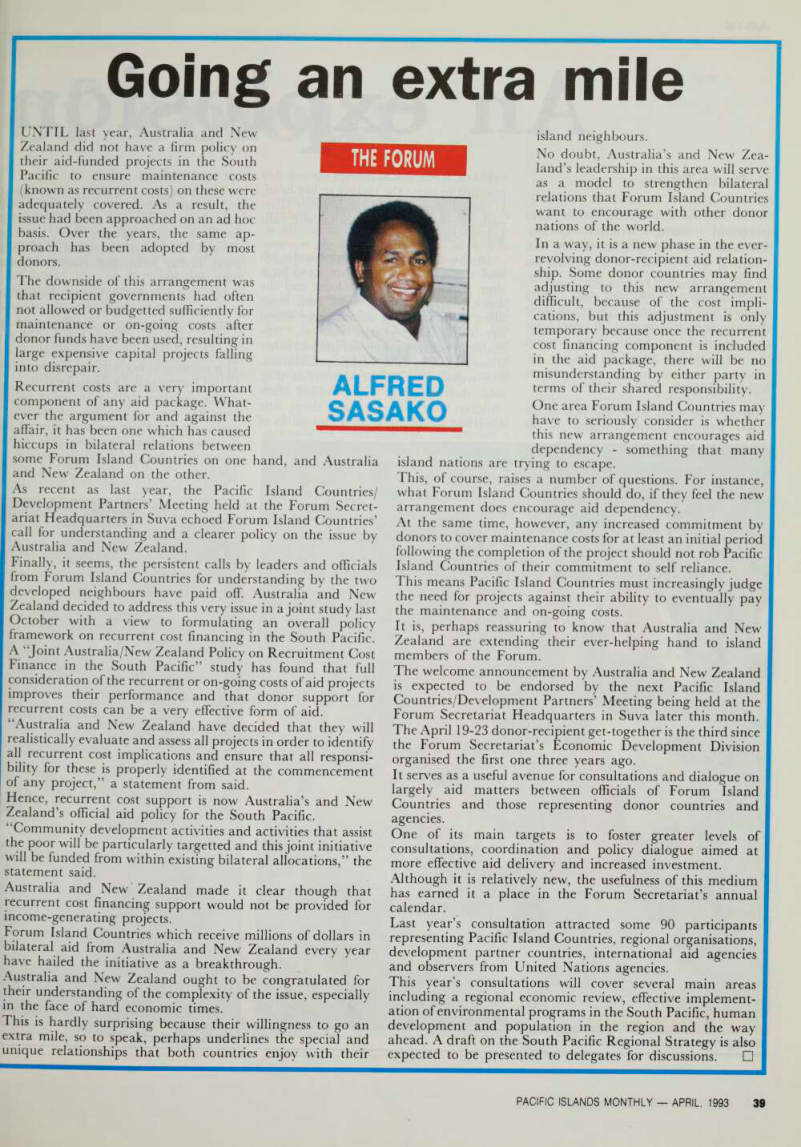
UNTIL last year, Australia and New Zealand did not have a firm policy on their aid-funded projects in the South Pacific to ensure maintenance costs (known as recurrent costs) on these were adequately covered. As a result, the issue had been approached on an ad hoc basis. Over the years, the same ap proach has been adopted by most donors.
The downside of this arrangement was that recipient governments had often not allowed or budgetted sufficiently for maintenance or on-going costs after donor funds have been used, resulting in large expensive capital projects falling
into disrepair.
Recurrent costs are a very important component of any aid package. What ever the argument for and against the affair, it has been one which has caused hiccups in bilateral relations between
some Forum Island Countries on one hand, and Australia and New Zealand on the other.
As recent as last year, the Pacific Island Countries/ Development Partners’ Meeting held at the Forum Secret ariat Headquarters in Suva echoed Forum Island Countries’ call for understanding and a clearer policy on the issue by Australia and New Zealand.
Finally, it seems, the persistent calls by leaders and officials from Forum Island Countries for understanding by the two developed neighbours have paid off. Australia and New Zealand decided to address this very issue in a joint study last October with a view to formulating an overall policy framework on recurrent,cost financing in the South Pacific.
A “Joint Australia/New Zealand Policy on Recruitment Cost Finance in the South Pacific” study has found that full consideration of the recurrent or on-going costs of aid projects improves their performance and that donor support for recurrent costs can be a very effective form of aid.
Australia and New Zealand have decided that they will realistically evaluate and assess all projects in order to identify all recurrent cost implications and ensure that all responsi bility for these is properly identified at the commencement of any project,” a statement from said.
Hence, recurrent cost support is now Australia’s and New Zealand’s official aid policy for the South Pacific.
Community development activities and activities that assist the poor will be particularly targetted and this joint initiative will be funded from within existing bilateral allocations,” the statement said.
Australia and New Zealand made it clear though that recurrent cost financing support would not be provided for
income-generating projects.
Forum Island Countries which receive millions of dollars in bilateral aid from Australia and New Zealand every year have hailed the initiative as a breakthrough.
Australia and New Zealand ought to be congratulated for their understanding of the complexity of the issue, especially in the face of hard economic times.
This is hardly surprising because their willingness to go an extra mile, so to speak, perhaps underlines the special and unique relationships that both countries enjoy with their
island neighbours.
No doubt, Australia’s and New Zea land’s leadership in this area will serve as a model to strengthen bilateral relations that Forum Island Countries want to encourage with other donor nations of the world.
In a way, it is a new phase in the ever revolving donor-recipient aid relation ship. Some donor countries may find adjusting to this new arrangement difficult, because of the cost impli cations, but this adjustment is only temporary because once the recurrent cost financing component is included in the aid package, there will be no misunderstanding by either party in terms of their shared responsibility.
One area Forum Island Countries may have to seriously consider is whether this new arrangement encourages aid dependency - something that many
island nations are trying to escape.
This, of course, raises a number of questions. For instance, what Forum Island Countries should do, if they feel the new arrangement does encourage aid dependency.
At the same time, however, any increased commitment by donors to cover maintenance costs for at least an initial period following the completion of the project should not rob Pacific Island Countries of their commitment to self reliance.
This means Pacific Island Countries must increasingly judge the need for projects against their ability to eventually pay the maintenance and on-going costs.
It is, perhaps reassuring to know that Australia and New Zealand are extending their ever-helping hand to island members of the Forum.
The welcome announcement by Australia and New Zealand is expected to be endorsed by the next Pacific Island Countries/Development Partners’ Meeting being held at the Forum Secretariat Headquarters in Suva later this month.
The April 19-23 donor-recipient get-together is the third since the Forum Secretariat’s Economic Development Division organised the first one three years ago.
It serves as a useful avenue for consultations and dialogue on largely aid matters between officials of Forum Island Countries and those representing donor countries and
agencies.
One of its main targets is to foster greater levels of consultations, coordination and policy dialogue aimed at more effective aid delivery and increased investment.
Although it is relatively new, the usefulness of this medium has earned it a place in the Forum Secretariat’s annual calendar.
Last year’s consultation attracted some 90 participants representing Pacific Island Countries, regional organisations, development partner countries, international aid agencies and observers from United Nations agencies.
This year’s consultations will cover several main areas including a regional economic review, effective implement ation of environmental programs in the South Pacific, human development and population in the region and the way ahead. A draft on the South Pacific Regional Strategy is also expected to be presented to delegates for discussions. □