What is the media
p. 29 · Read in the full issue
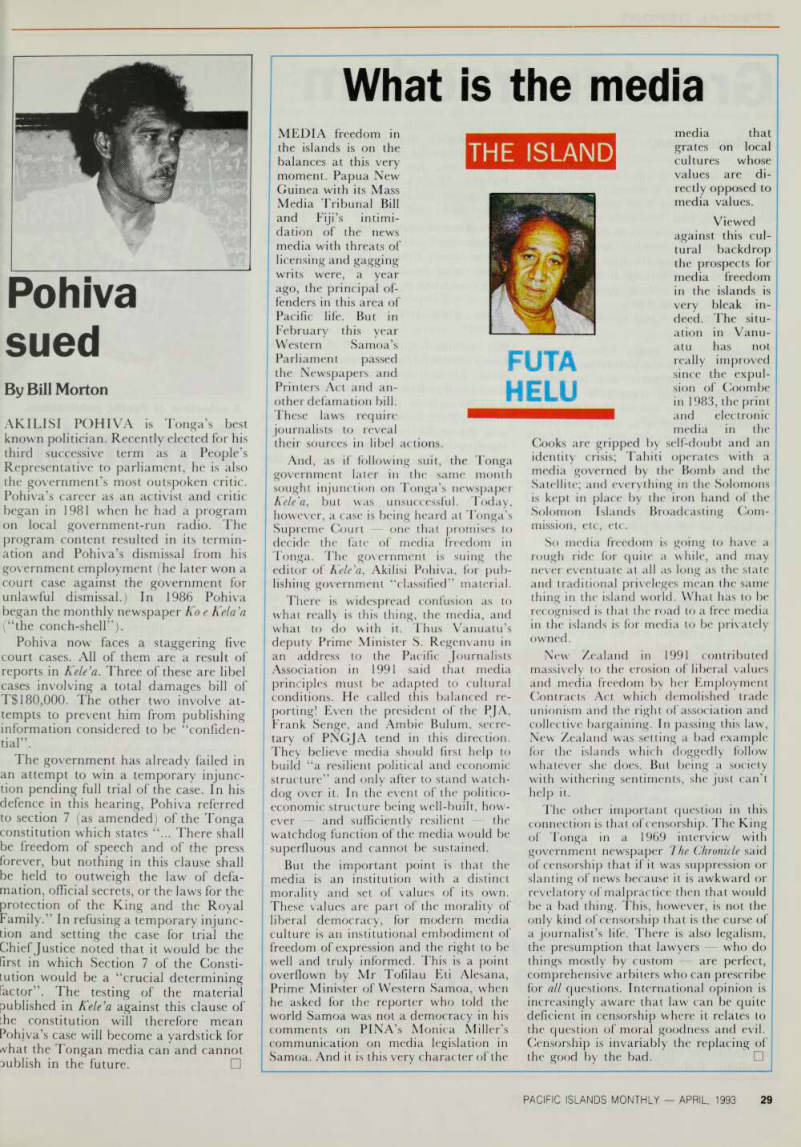
MEDIA freedom in the islands is on the balances at this very moment. Papua New Guinea with its Mass Media Tribunal Bill and Fiji’s intimi dation of the news media with threats of
licensing and gagging
writs were, a year ago, the principal of fenders in this area of Pacific life. But in February this year Western Samoa’s
Parliament passed
the Newspapers and Printers Act and an other defamation bill.
These laws require journalists to reveal
their sources in libel actions.
And, as if following suit, the Tonga government later in the same month
sought injunction on Tonga’s newspaper
Kele'a, but was unsuccessful. Today, however, a case is being heard at Tonga’s Supreme Court one that promises to decide the fate of media freedom in Tonga. The government is suing the editor of Kele'a , Akilisi Pohiva, for pub lishing government ‘“classified” material.
There is widespread confusion as to what really is this thing, the media, and what to do with it. Thus Vanuatu’s deputy Prime Minister S. Rcgenvanu in an address to the Pacific Journalists Association in 1991 said that media principles must be adapted to cultural conditions. He called this balanced re porting! Even the president of the PJA, Frank Senge, and Ambie Bulum, secre tary of PNGJA tend in this direction.
They believe media should first help to build “a resilient political and economic structure” and only after to stand watch dog over it. In the event of the politico economic structure being well-built, how ever and sufficiently resilient the watchdog function of the media would be superfluous and cannot be sustained.
But the important point is that the media is an institution with a distinct morality and set of values of its own.
These values are part of the morality of liberal democracy, for modern media culture is an institutional embodiment of freedom of expression and the right to be well and truly informed. This is a point overflown by Mr Tofilau Eti Alesana, Prime Minister of Western Samoa, when he asked for the reporter who told the world Samoa was not a democracy in his comments on PINA’s Monica Miller’s communication on media legislation in Samoa. And it is this very character of the
media that grates on local cultures whose values are di
rectly opposed to
media values.
Viewed against this cul
tural backdrop
the prospects for media freedom in the islands is very bleak in deed. The situ ation in Vanu atu has not
really improved
since the expul sion of Coombe in 1983, the print and electronic media in the
Cooks are gripped by self-doubt and an identity crisis; Tahiti operates with a media governed by the Bomb and the Satellite; and everything in the Solomons is kept in place by the iron hand of the Solomon Islands Broadcasting Com mission, etc, etc.
So media freedom is going to have a rough ride for quite a while, and may never eventuate at all as long as the state and traditional priveleges mean the same thing in the island world. What has to be recognised is that the road to a free media in the islands is for media to be privately owned.
New Zealand in 1991 contributed massively to the erosion of liberal values and media freedom by her Employment Contracts Act which demolished trade unionism and the right of association and collective bargaining. In passing this law, New Zealand was setting a bad example for the islands which doggedly follow whatever she docs. But being a society with withering sentiments, she just can’t
help it.
The other important question in this connection is that of censorship. The King of Tonga in a 1969 interview with government newspaper The Chronicle said of censorship that if it was suppression or slanting of news because it is awkward or revelatory of malpractice then that would be a bad thing. This, however, is not the only kind of censorship that is the curse of a journalist’s life. There is also legalism, the presumption that lawyers who do
things mostly by custom are perfect,
comprehensive arbiters who can prescribe for all questions. International opinion is increasingly aware that law can be quite deficient in censorship where it relates to the question of moral goodness and evil.
Censorship is invariably the replacing of
the good by the bad. □