rumbling
pp. 13-16 · Read in the full issue
The mines are rumbling
By Wally Hiambohn
As cyclones were ripping through parts of the Pacific over Christmas and New Year, a storm of a different kind was brewing in the region’s west, threatening to cause irreparable damage. Fortu nately, it has lulled and is made to look more like a “storm in a teacup”.
This concerned resource development in Papua New Guinea the lucrative mining and petroleum projects which have boomed over the last four years.
Hopefully the calm remains, or the much prided “mountain of gold floating on a sea of oil" land might blow its top and boil over. The lull was mainly due to the main players in this resources controversy who raised the storm have now receded to boardrooms to fight it DUt.
A conference in Sydney mid-February discussed key issues which concern the government and industry and their relationship.
Top ranking government and industry officials talked on such issues as PNG government’s direction in equity partici
pation, key developments and impli
:ations of a proposed Gas Act; impli ations of PNG legislative changes on the mplementation of projects; resource axation in PNG; and understanding the ritical issues of the landowners.
Having learnt and recovered from the lightmare of losing revenue from the iougainville mine, the government and he resource sector had till then been leafing delicately and respectfully with ach other.
In every project from the billion-dollar old mine and Porgera and the Kutubu il to the humble Misima gold mine, isues of sensitivity were thrashed out in ill and involved every necessarry party from the prime minister and the chief ompany executives to the provincial overnments and landowners.
Apart from the controversies that arrounded the small but promising fount Kare alluvial gold mine (see 'parate story), all was rolling along well ntil the new government of Prime
linister Paias Wingti dropped a bomb
lell in December.
He wanted to review and increase state quity and local participation in resource
Papua New Guinea’s proposed changes to resource development threaten ‘the mountain of gold on a sea of oil’ to blow its top
projects so that Papua New Guineans were “owners of their resources” and playing a major role in their develop ment.
It is a long established government policy that it be granted an option of up to 30 per cent fully paid up equity in mining projects and 22.5 per cent carried equity in petroleum and gas projects.
The new move, which to some amounted to likely expropriation, shocked investors and tested their confi dence. VVingti also moved fast to attract and try and bring in investors from the fast-growing Asian region (see separate story).
Many existing investors until then had apart from the nagging law and order problems no reason to fear for their investment.
The government preceded its an nouncement with a serious allegation against developers of the giant Porgera gold mine.
Minerals and Energy Minister Masket langalio announced publicly that Placer Pacific, operators of the giant Porgera mine had misled the state into buying only 10 per cent equity instead of the full 30 per cent it was entitled to. He said the state was misled on the ore reserves at Porgera which only in November were revised and increased by 27 million ounces.
The other partners in the project Placer, Highlands Gold and Rennison Goldfields Consolidated each holds 30 per cent shares.
The claim, made following the an nouncement of the discovery of increased reserves at the mine, was denied by the other partners. Soon after, VVingti said in an Australian television interview that his government wanted to “break away” from a “club” of Australian investors and attract new resource from North Ame rica and Europe.
“This is Australia’s territory as far as they’re concerned. There is a club which wants to see PNG as a country that comes under the Australian mining influence ...” he told Channel Nine’s
Business Sunday.
langalio said in Australia the PNG government would review “some of the more questionable arrangements”.
In a more recent address Wingti told an oil and gas conference in Singapore in January there was still widespread dissat isfaction among landowners, although they received royalties, some compen sation and took part in spin-off benefits from resource projects.
“The state will endeavour to see that the people of Papua New Guinea gain maximum benefit from the development of its renewable resources. At the same
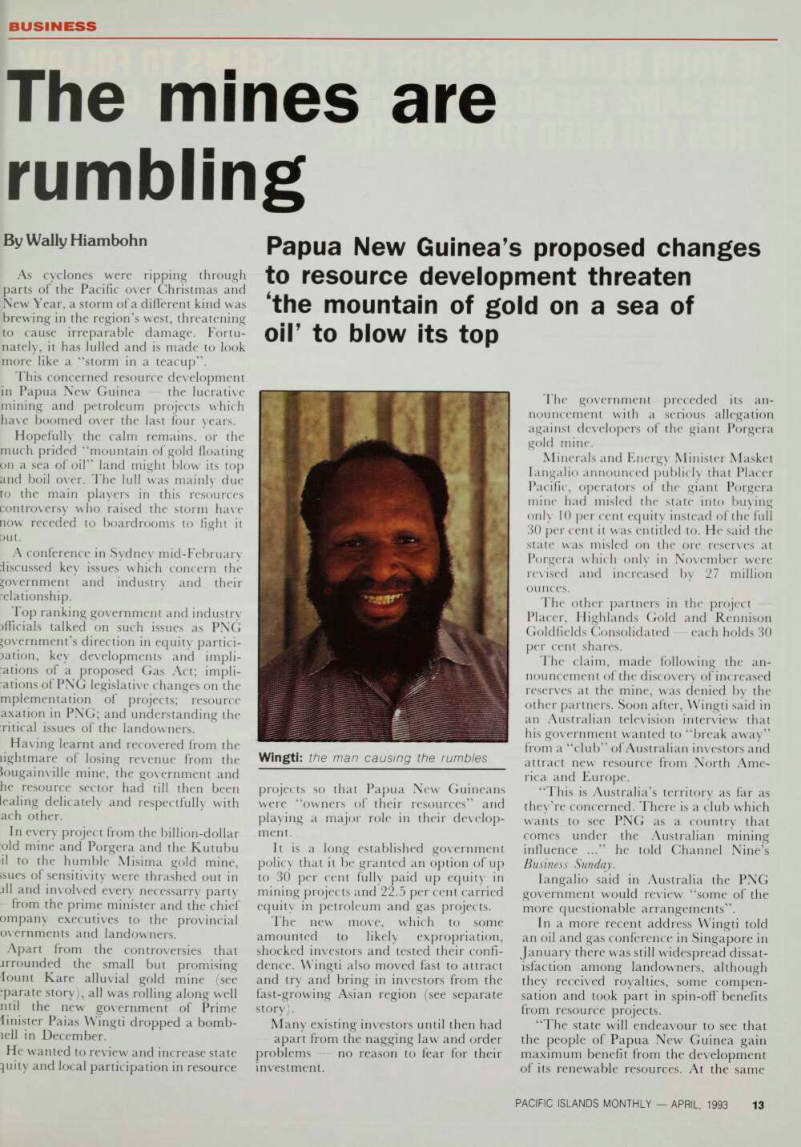
Wingti: the man causing the rumbles
time the state will ensure the investors enjoy a stable investment climate and get a reasonable return on investment. “I do not wish to see my beautiful country become another one of those countries that have lost out when their resources were exploited. I refuse to submit my country to be part of historical statistics.
The last thing I would want for my nation is to be left without a huge hole in the ground and a population spoilt by money after all the mineral and pet roleum has been drained from the land.
“Our landowners do receive royalties, some compensation and partake in certain spin-off business activities but still there is wide-spread landowner dissatis faction.” Wingti said his government was directing its energies towards other means and ways of ensuring the nation benefits from resource development other than taxation revenue. The government was now actively pursuing equity partici pation in major projects, either by the •state but preferably by individuals and
corporations owned by Papua New
Guineans.
He said the government was also looking very seriously at downstream processing of raw materials. “It is quite understandable that a consortium that has just completed a SI billion oil production facility will be somewhat uneasy about developing a further billion dollar refinery,” he said. “Still the state would like to invite and enter into partnerships with other firms which can build and operate a refinery profitably.
“The intrinsic benefits to the nation of such an arrangement are obvious jobs, more money retained on-shore and the development of our industrial base. At the end of the day it is not a question of whether we can squeeze 90 per cent tax out of a barrel of oil but what we do with
the money.”
At the conclusion of his Indonesia visit
in February Wingti foreshadowed major
rhanges to the petroleum equity share holding where the government currently is entitled to 22.5 per cent in any Detroleum project. He hinted the state nay increase its equity participation, ifter studying Indonesia’s highly success ul state-owned oil company, Pertamina.
Debate raged on the resource owner
;hip question.
“There is no doubt things are getting vorse,” a senior mining executive was quoted as saying at the time. “It is a good ;>lace to tread gently.” The executive lescribed Wingti as a “man in a hurry” vho would get into trouble sooner or ater.
In an analysis of the issue, director of he private sector funded Institute of National Affairs, John Millet summed, ’All of this matters not only because of he international principles of fair-play vhich are at stake but also because the
country’s future development depends crucially on what happens in the mining and petroleum sectors.”
He had earlier recommended the state sell rather than buy equity in resource projects. “All of this makes the sell option look increasingly attractive. The prime minister could proclaim victory for the broad national interest, for imaginative and pragmatic policy and for decisive leadership,” he wrote another time.
To Millet’s reference to “international fair-play ’ one Papuan New Guinean wrote describing it as “more fatuous nonsense”. The so-called Third World has been bled, suppressed and dictated to by the north for a very long time. If Papua New Guinea lied through its collective teeth for the next 200 years that wouldn’t balance past (and present) errors”.
To coincide with the controversy, Finance and Planning Minister Sir Julius Chan commissioned a review of the government’s equity and tax regime. The review, begun in January by the Inter national Monetary Fund and govern ment officials and expected to last several mmonths, was welcomed by mining companies. Sir Julius has said he does not expect to make any important new decisions on particular taxation or equity matters until the study is finished.
Industry sources say the review will clear the air, even though few concrete decisions are expected. But government officials say the review is designed primarily to provide an independent evaluation of the tax/equity regime covering the mining and oil sectors and to establish the basis for a separate policy for gas.
One industry official says the review should show the present regime compares well internationally, and will be especi ally valuable because it will be indepen dent. “It would be very beneficial to us because it would show from an indepen dent body that the state gets a fair share.
It does very well out of us,” he says.
As well as the equity issue, the petroleum sector is involved in an argument about the basis on which tax is calculated, and industry in general would like a more liberal regime for writing off exploration costs.
There are also indications the result of the survey may be to provide the basis for creating a gas equity and tax policy. At present gas comes under the country’s petroleum policy, which is entirely un suited to the long-term, multi-billion dollar investments required for pro duction that the country hopes to attract.
The Department of Minerals and Energy estimates the country has recoverable reserves of about 22 trillion cubic feet, almost all within a region stretching from the central Gulf of Papua New Guinea to the Highlands. □