Measuring up debts
p. 11 · Read in the full issue
Business
By David North
WESTERN Samoa is rapidly heading into
deeper debt.
The independent nations of the Pacific have far fewer debt problems than most of the rest of the developing world.
Both of these conclusions can be drawn from the most recent burst of debt statistics from the World Bank.
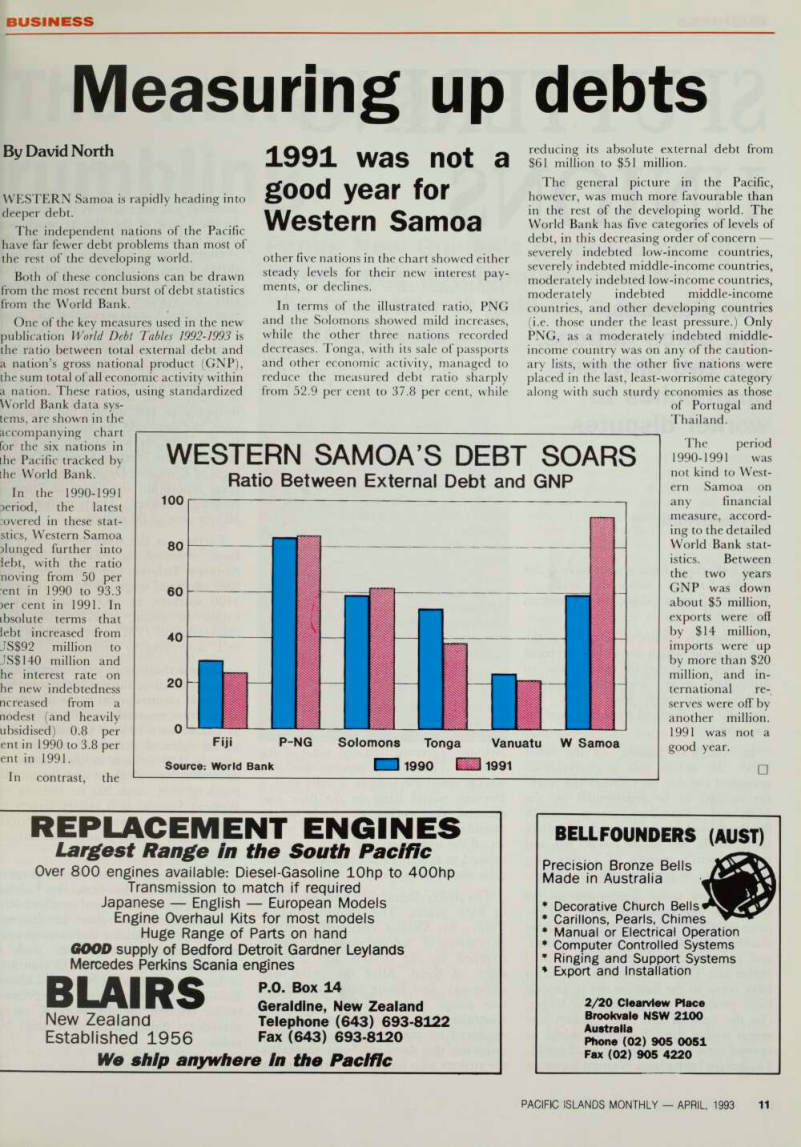
One of the key measures used in the new publication World Debt Tables 1992-1993 is the ratio between total external debt and
a nation’s gross national product (GNP),
the sum total of all economic activity within a nation. These ratios, using standardized
World Bank data sys tems, are shown in the
accompanying chart
for the six nations in
the Pacific tracked by
the World Bank.
In the 1990-1991 aeriod, the latest :overed in these stat stics, Western Samoa alunged further into lebt, with the ratio noving from 50 per ent in 1990 to 93.3 >er cent in 1991. In ibsolute terms that lebt increased from JS$92 million to JS$l4O million and he interest rate on he new indebtedness ncreased from a
nodest (and heavily
übsidised) 0.8 per ent in 1990 to 3.8 per ent in 1991.
In contrast, the
1991 was not a good year for Western Samoa
other five nations in the chart showed either steady levels for their new interest pay ments, or declines.
In terms of the illustrated ratio, PNG and the Solomons showed mild increases, while the other three nations recorded decreases. Tonga, with its sale of passports and other economic activity, managed to reduce the measured debt ratio sharply from 52.9 per cent to 37.8 per cent, while
reducing its absolute external debt from $61 million to $51 million.
The general picture in the Pacific, however, was much more favourable than in the rest of the developing world. The World Bank has five categories of levels of debt, in this decreasing order of concern — severely indebted low-income countries, severely indebted middle-income countries, moderately indebted low-income countries, moderately indebted middle-income countries, and other developing countries (i.e. those under the least pressure.) Only PNG, as a moderately indebted middle income country was on any of the caution ary lists, with the other five nations were placed in the last, least-worrisome category along with such sturdy economies as those
of Portugal and Thailand.
The period
1990-1991 was not kind to West ern Samoa on any financial measure, accord ing to the detailed World Bank stat istics. Between the two years GNP was down about $5 million, exports were off by sl4 million, imports were up by more than S2O million, and in ternational re-, serves were off by another million. 1991 was not a
good year.