Growing pains for the media
From The Editor’S Desk
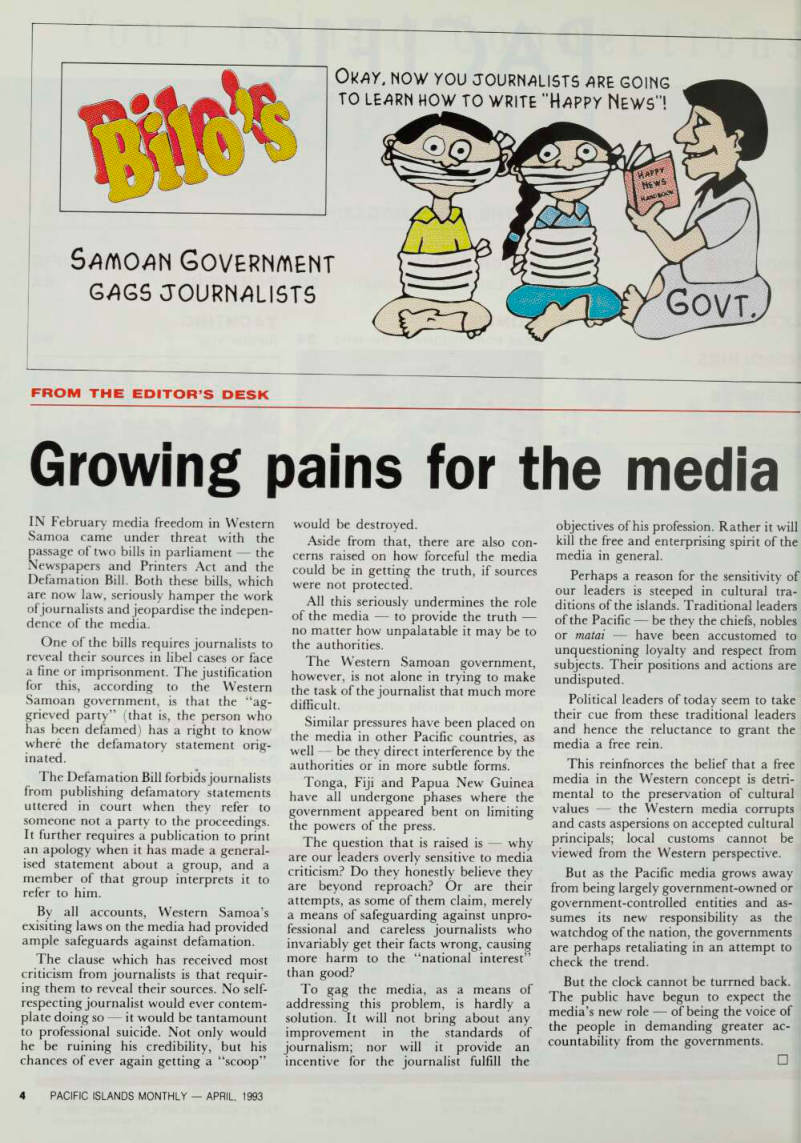
IN February media freedom in Western Samoa came under threat with the passage of two bills in parliament the Newspapers and Printers Act and the Defamation Bill. Both these bills, which are now law, seriously hamper the work
of journalists and jeopardise the indepen
dence of the media.
One of the bills requires journalists to reveal their sources in libel cases or face a fine or imprisonment. The justification for this, according to the Western Samoan government, is that the “ag grieved party” (that is, the person who has been defamed) has a right to know where the defamatory statement orig inated.
The Defamation Bill forbids journalists from publishing defamatory statements uttered in court when they refer to someone not a party to the proceedings.
It further requires a publication to print an apology when it has made a general ised statement about a group, and a member of that group interprets it to refer to him.
By all accounts, Western Samoa’s exisiting laws on the media had provided
ample safeguards against defamation.
The clause which has received most criticism from journalists is that requir ing them to reveal their sources. No self respecting journalist would ever contem plate doing so it would be tantamount to professional suicide. Not only would he be ruining his credibility, but his chances of ever again getting a “scoop”
would be destroyed.
Aside from that, there are also con cerns raised on how forceful the media could be in getting the truth, if sources were not protected.
All this seriously undermines the role of the media to provide the truth no matter how unpalatable it may be to the authorities.
The Western Samoan government, however, is not alone in trying to make the task of the journalist that much more difficult.
Similar pressures have been placed on the media in other Pacific countries, as well be they direct interference by the authorities or in more subtle forms.
Tonga, Fiji and Papua New Guinea
have all undergone phases where the government appeared bent on limiting the powers of the press.
The question that is raised is why are our leaders overly sensitive to media criticism? Do they honestly believe they are beyond reproach? Or are their attempts, as some of them claim, merely a means of safeguarding against unpro fessional and careless journalists who invariably get their facts wrong, causing more harm to the “national interest” than good?
To gag the media, as a means of addressing this problem, is hardly a solution. It will not bring about any improvement in the standards of journalism; nor will it provide an incentive for the journalist fulfill the
objectives of his profession. Rather it will kill the free and enterprising spirit of the media in general.
Perhaps a reason for the sensitivity of our leaders is steeped in cultural tra ditions of the islands. Traditional leaders of the Pacific be they the chiefs, nobles or matai have been accustomed to unquestioning loyalty and respect from subjects. Their positions and actions are
undisputed.
Political leaders of today seem to take their cue from these traditional leaders and hence the reluctance to grant the media a free rein.
This reinfnorces the belief that a free media in the Western concept is detri mental to the preservation of cultural values the Western media corrupts and casts aspersions on accepted cultural principals; local customs cannot be viewed from the Western perspective.
But as the Pacific media grows away from being largely government-owned or government-controlled entities and as sumes its new responsibility as the watchdog of the nation, the governments are perhaps retaliating in an attempt to check the trend.
But the clock cannot be turrned back.
The public have begun to expect the media’s new role of being the voice of the people in demanding greater ac countability from the governments.