The Pacific Drug
pp. 26-27 · Read in the full issue
Books
By lan Williams
The islands’ national drink, kava, comes under scientific scrutiny and emerges as anything but the demon drink
KAVA does not kill, as some newspaper headlines have it. On the contrary it is a benign drug which is beneficial to society and the Pacific islands econ omy. These are the conclusions of Kava, the Pacific Drug, a book published this month by Yale University Press, writ ten by three researchers who have looked at the chemistry, botany and anthropology of the Pacific’s most distinctive product. Co-authors Vin cent Lebot and Mark Lament of the University of Hawai’i, and Lament Lindstrom of the University of Arizona are no ivory tower academics; they all admit they themselves also carried out extensive first-hand consumer research of kava.
Perhaps their most interesting con clusion is that the cultivated kava plant began as a cutting from the wild species in Vanuatu, some 2500 to 3000 years ago. In the past, botanists saw cultivated kava, or Piper Methysticum and the wild variety, Piper Wickmanii as two separate species, of the pepper family, but the authors claim kava began as a cutting from the wild plant, and a hundred generations of Pacific farmers have since been selecting cuttings that gave roots strong in the chemical cocktail that gives the drink its effect.
During their travels around the ocean, it seems Pacific islanders were careful to take their cuttings with them, growing them wherever they settled.
Studying the chemical composition of the different wild and cultivated plants, they came to the conclusion that Vanu atu has so many different varieties of kava plants, and so many clearly trace able similarities between the cultivated and wild varieties, that Kava is almost
certainly the Melanesian Republic’s
most distinctive contribution to the
Pacific Way.
That conclusion is, they say, reinforced by the evidence of the words used for Kava in various Pacific languages. Far from dying out, the tradition is growing.
In Vanuatu, alcohol sales are only 60 per cent of what they were at the time of independence as locals prefer kava to beer, wine and spirits. Vila now has many kava bars. “It’s a big improvement over the older alcoholic, social atmos phere,” Lament Lindstrom comments.
Lindstrom told PIM he suspected it
was the absence of major mammalian plant-eaters in the islands which led the kava plant to concentrate its active chemicals in the roots and stump, in order to protect against the fungi and microbes in the soil. These chemicals, the kavalactones do have an anti-fungal effect - in addition to making people
happy.
For the moment, kava is safe from artificial, synthesised competition. The drink seems to need all its six major chemical ingredients working together to have its effect on humans. The different varieties developed by growers mostly differ in the balance of substances, some of which hit the bloodstream very quickly, and others which, less soluble, take hours to cross the stomach wall.
Hence the notorious Vanuatu variety Tudei that keeps the drinker in the air for two days.
Most of the kavalactones do not dissolve well in water which is why the traditional method of chewing the root produces such good results. In Victorian days scientists theorised the saliva had a chemical effect, inducing fermentation in the kava bowl. However, “Saliva has no effect whatsoever on the active molecules in kava,” Lindstrom told PIM. It is the mechanical effect of chewing which is so effective.
The resinous substances have to be extracted from the plant and then dispersed into tiny droplets in the water to form an emulsion that will cross the stomach wall into the bloodstream. It is almost disappointing to record that they discovered no evidence that the chewing by virgins, as mandated in many islands, produces any better effect than more experienced chews. And many commer cial kava bars now use a meat-grinder which is not in the slightest bit romantic.
So what does kava do? According to the researchers it induces a form of narcosis, reduces pain, and acts as a local
anaesthetic; it relaxes the muscles and counters fungus growths. But drinkers use it despite the numbing effects on mouth and throat, aiming instead for what the book calls the “excellent pschopharmacological activity” of pro ducing “emotional and muscular relax ation, stabilisation of the feelings and stimulation of the ability to think and act.”
Researchers have suggested that, as well as its recreational use, it could have uses in countering schizophrenia, epi lepsy and as a muscle relaxant. In the past it has been used in treatments of gonorrhea, and other infective agents. It has been suggested that it may have a role as a food preservative because of its
anti-fungal effect.
In fact, it could even be an answer to overpopulation. Many islanders report that kava diminishes interest in sex.
Asked about this aspect, Lindstrom speculated to PIM that in many islands it may have helped maintain the tra dition of couples abstaining from sex until the child was weaned several years in most cases.
It is this mix of properties which has led to pharmaceutical companies in France and Germany being major pur chasers of kava from the region.
However, for anthropologists and soci ologists, perhaps the most significant aspects of kava drinking has been its role in maintaining social structures. In many island societies, hierarchy is emphasised by the order in which the kava is drunk, while the drink itself tends to make people less aggressive and more amen able to reasoned discussion.
It is those traditional ritual aspects with their pre-Christian overtones which made the missionaries oppose Kava use, but the wheel has now turned. In some areas, the Roman Catholics have incor porated kava into their rituals, while Fijian Methodist missionaries to Austra lian Aborigines have tried to promote it
as a substitute for alcohol abuse. From “?™ a ca , me the horror stories about killer kava , and there have been moves to ban its use there. These stories may owe more to the sensationalism of the Australian press than to sound medical research. 1 he studies showed that Ab- Drigmes using Kava suffered from poor tiealth gwrng nse to lund headlines like .an Kava Kill? However the authors point out that m the countries where
lave beenno Zh
\borimnes in gS ’h wl “if
>oor health re/ord™ “
• r record and often have a " well °-«S V o e m r ; U on " baCCO r d alCOh °J n a cocktail with md other things,” warned Lindstrom u. i u- ii , . he Padt kavi 3d eS ?r tOU V 'i" ems the vi T a :™ ld ; ■ }T ’“Tlf prob ‘ md whh hl r and all-health assoc-
uoterin o d I
T hC
be man who drinks r S * a man ’ but east » h d ks llc l uor becomes a ' there is great export potential for ava, but while there is a great reservoir t traditional skills m growing and reparation for consumption, quality
control is a problem. Commercial sellers are now accused of diluting the product, and the best kava is still made from fresh rootstock. So the Vanuatu government has been toying with the idea of
introducing freeze-drying processes that
would preserve the freshness of the product. The authors suggest that the active contents of the leaves, too low to exploit by traditional methods, could be extracted through distillation.
The plant is ideally suited both for the climate and the economy of the South Pacific - For sample, the authors estimate t h a t Fiji’s kava crop was worth 840 4tllion in 19 P 85 so U is alrCady a economic factor in the "T 7 ' Around 'he globe, people pay untold amounts for mild stimulants like tea ’ Coffee and colas ' What the overstressed world really needs is a mild re l a xant like kava which is less addictive than any ° f them ' As a hi S h value cro P’ not labour intensive, it can be grown in conjunction with other food plants so that, unlike most cash crops, it need not displace local food production. Apart from pharmaceutical exports to Europe, most exports now are to Pacific communities in places like the West Coast of America. But the fact that the US
government allows it to be imported suggests that there is a huge potential market among stressed Americans, sold as they are on health foods like ginseng “It’s a great drug after all, very benign/’ comments Lindstrom. “It has a subtle effect, producing a feeling of peacefulness and well-being. I’d hate to have it blown up as the ‘new cocaine’ or anything silly like that.” But what about the taste even devoted kava drinkers have hardly been flattering about the flavour?
Lindstrom points out that the world is ™ of drinks whose taste is acquired w b° would drink coffee or beer if their effect had not led people to try them again after the first sips?
In fact, the authors find little but good to say about kava and its use. However they do warn that most of these rituals exclude women from consumption of kava and so that could help exclude women from the Political an£ decision making processes In these days of pressure for women’s equality, it remains to be seen how long such exclusion can be tolerated, DKava the Pacific Drug 255 pages, Yale University Press, $45 by Vincent Lebot, Mark Merlin and Lamont Lindstrom.
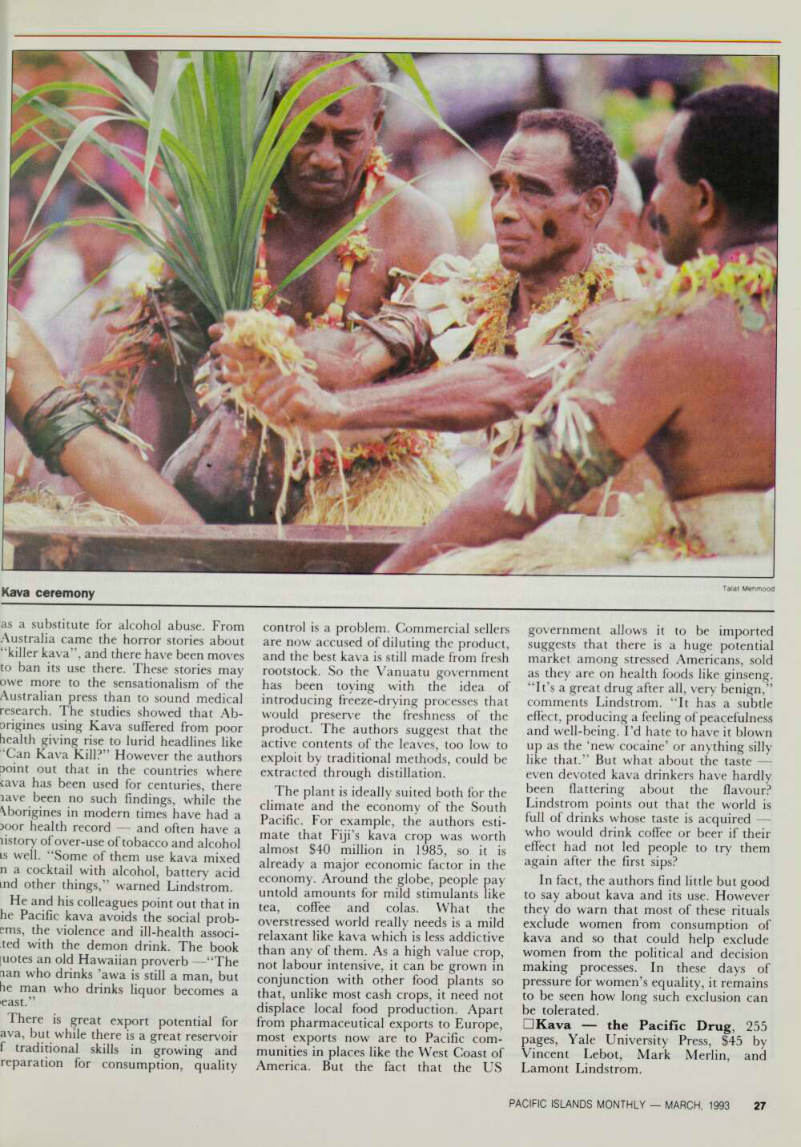
Kava ceremony
Talal Mehmood