Shaking up
pp. 54-55 · Read in the full issue
Yachting
By Sally Andrew
Being prepared for the contingencies of maritime emergencies means not losing your head in a stressful situation
A THOUSAND miles south of Ha waii, Gary and his girl-friend, Nini,
were sailing along, grooving to the
sound of Jeff Beck’s wild guitar play ing. Suddenly there was a strange creak-creeaak-creak noise in the back
ground.
“Gary, does the cd sound weird to 9 your “Yeah, do you think we’ve broken the cd player?”
Gary reached up and turned the music off. The squeaks continued.
Creak-creeaak-crreak, “Strange, it sounds like bulkheads
working.” Gary got up to investigate
and discovered the sound coming up out of the toilet bowl.
“Gary, it can’t be coming from the head. Why don’t you get some rest.
We’ll figure it out when we get to
Fanning.
So Gary tried to rest again, minus Jeff Beck. Seconds later, the reassuring sound of water passing along the hull stopped.
So did all forward motion. There was a sickening thud - as Nini describes it, the same kind of loud noise you’d expect to hear if you were in a car and had run smack into a tree. But Shakola was in the middle of the Pacific Ocean, hundreds of miles from any land. A sinking feeling of disbelief filled the air and both their hearts.
Gary leaped up and screamed. “We’ve hit something!”. In an instant he was on deck. Shakola was surrounded by a pod of whales with large square-shaped heads.
They were easy to identify - sperm whales. Nearly 15 of them, each twice the size of Shakola , took turns exhaling a putrid mix of saltwater and dead plank ton. The oblique trajectory of their blow was spot on. One by one they came alongside, exhaled, then made room so the other whales could have a try spitting on Shakola.
Being prepared for the contingencies of maritime emergencies means not losing your head in a stressful situation. When Nini moaned, “Why in the whole Pacific do they have to be here?”, Gary lifted his head out of the bilge and got straight to the point. “Get the canned goods and the emergency bag in case we have to abandon ship.” He finished checking the bilge to see if Shakola was taking on any water nothing, not a drop.
Gary and Nini stood on deck alter nately begging the whales to go away and cussing them. After 45 minutes that seemed like hours, the behemoths swam off to another corner of the Pacific. The whale-watching had ended.
Gary and Nini made landfall at Fanning Island the next day. Surveying the damage after the arrival, Gary discovered the bulkhead supporting the forward berth had been jarred loose, causing cosmetic rather than structural damage. Not so obvious, Shakola’s two part hull had sustained structural dam age where the bow had collided with the
giant whale. Repair work on the boau was finished in Australia.
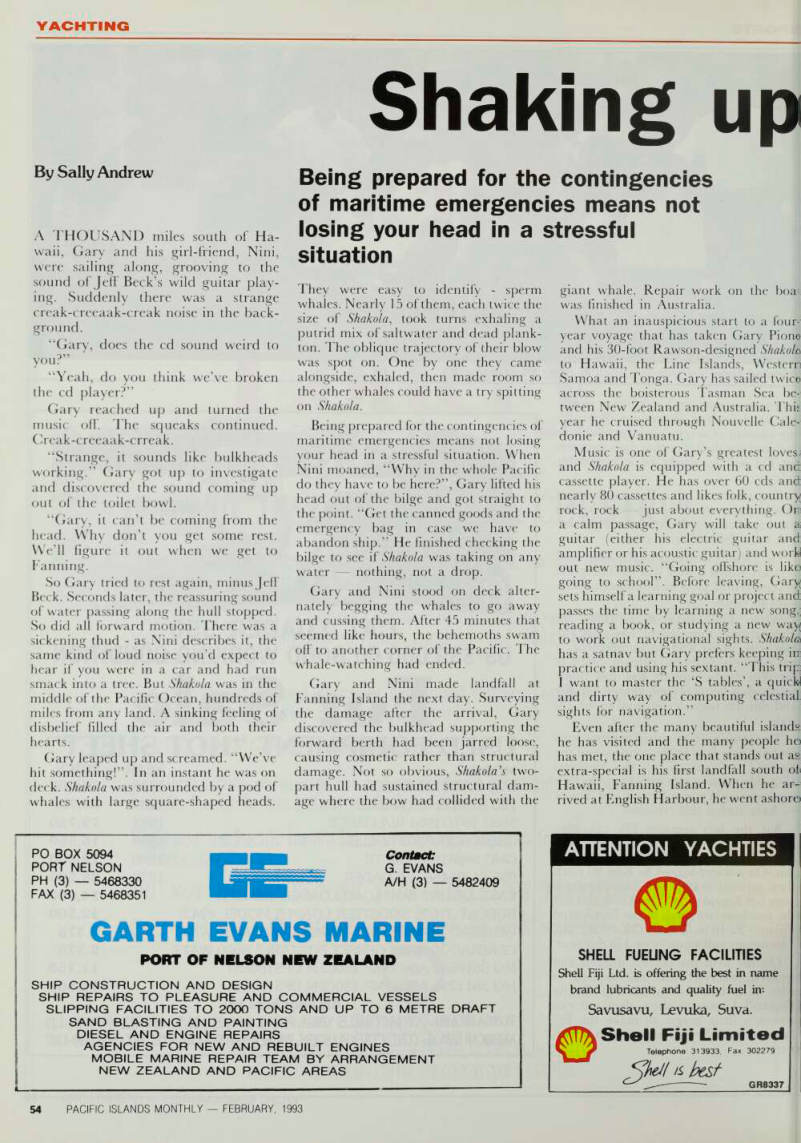
What an inauspicious start to a four-' year voyage that has taken Gary Pione and his 30-foot Rawson-designed Shakolcs to Hawaii, the Line Islands, Western Samoa and Tonga. Gary has sailed twice across the boisterous Tasman Sea be-' tween New Zealand and Australia. This year he cruised through Nouvelle Cale donie and Vanuatu.
Music is one of Gary’s greatest loves.; and Shakola is equipped with a cd and cassette player. He has over 60 cds and nearly 80 cassettes and likes folk, country rock, rock just about everything. Orn a calm passage, Gary will take out as
guitar (either his electric guitar and
amplifier or his acoustic guitar) and workl out new music. “Going offshore is like going to school”. Before leaving, Gary sets himself a learning goal or project and passes the time by learning a new song.; reading a book, or studying a new way to work out navigational sights. Shakola has a satnav but Gary prefers keeping ini practice and using his sextant. “This trip] I want to master the ‘S tables’, a quick! and dirty way of computing celestial sights for navigation.”
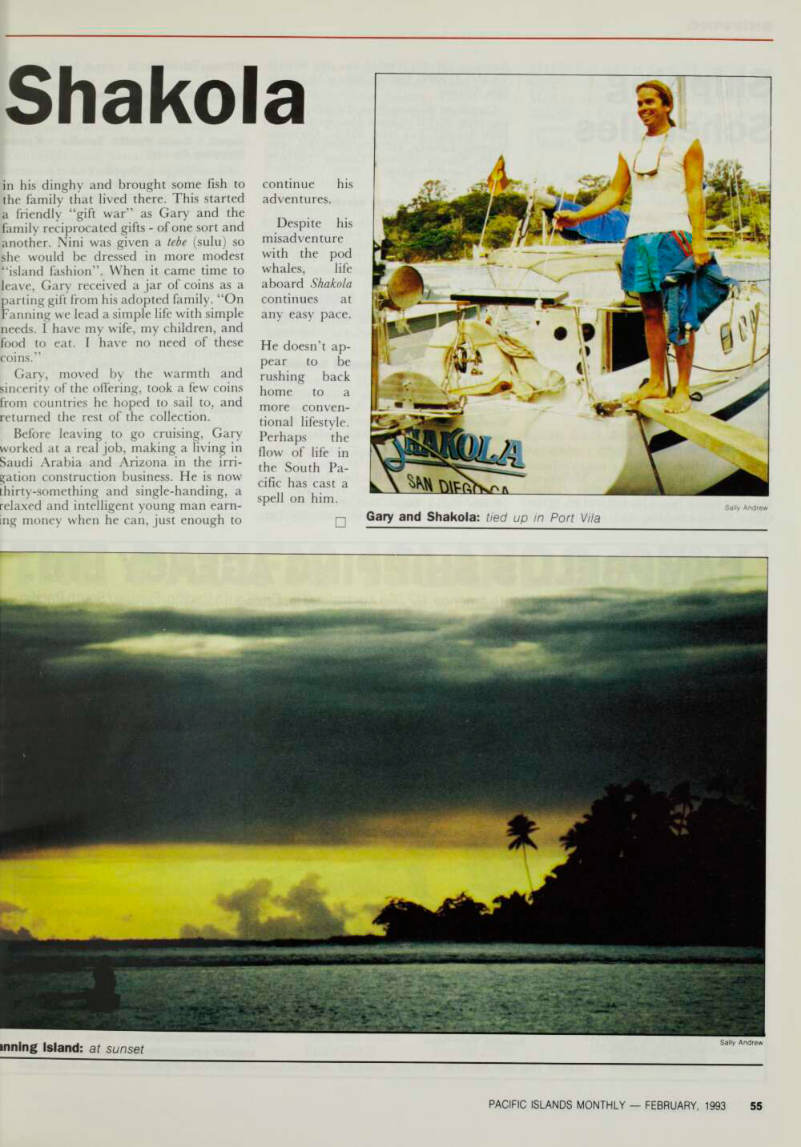
Even after the many beautiful islands he has visited and the many people ho has met, the one place that stands out as extra-special is his first landfall south of Hawaii, Fanning Island. When he ar rived at English Harbour, he went ashoro
in his dinghy and brought some fish to the family that lived there. This started a friendly “gift war” as Gary and the family reciprocated gifts - of one sort and another. Nini was given a tebe (sulu) so she would be dressed in more modest “island fashion”. When it came time to leave, Gary received a jar of coins as a parting gift from his adopted family. “On Fanning we lead a simple life with simple needs. I have my wife, my children, and food to eat. I have no need of these coins.”
Gary, moved by the warmth and sincerity of the offering, took a few coins from countries he hoped to sail to, and returned the rest of the collection.
Before leaving to go cruising, Gary worked at a real job, making a living in Saudi Arabia and Arizona in the irri gation construction business. He is now thirty-something and single-handing, a relaxed and intelligent young man earn ing money when he can, just enough to
continue his adventures.
Despite his
misadventure with the pod whales, life aboard Shakola continues at any easy pace.
He doesn’t ap pear to be rushing back home to a more conven
tional lifestyle.
Perhaps the
flow of life in the South Pa cific has cast a spell on him. □
Sally Andrew
Gary and Shakola: tied up in Port Vila
Sally Andrew
[?]inning Island: at sunset