Conserving forests
pp. 48-49 · Read in the full issue
Environment
By Sean Weaver
Can environmental protection with a human face be achieved in tribal lands in the Pacific?
THE natural sciences such as ecology, geology or chemistry are useful in helping us understand, the physical and technical aspects of environmental degradation. But to understand the causes of human-induced environmental damage and to cure those ills environ mental managers must, of course, learn about people. This is because the causes, and necessary solutions, to environ mental problems are usually social and economic. Nowhere is this more obvious than in the case of indigenous forest depletion on tribal land in the rural Pacific.
A common scenario of this kind might be the loss of a rare type of indigenous forest due to logging activities carried out by the landowners or, on behalf of the owners, by a logging company. Most of my experience of this kind relates to environmental management programs in rural Fiji where almost all of the land in question is tribally owned.
Let’s take a look at the situation from the perspective of the landowners them selves and work up from there. The owners of areas of indigenous forest in Fiji will generally have a set of needs and aspirations which partly related to socio economic development. They own a resource a natural forest, which happens to be rather rare and of national or international significance in terms of bio-diversity. In the absence of outside assistance of some form, an obvious way to make an income from their private or tribal resource is to log the forest. No big deal, people have been logging forests for millennia.
The situation for the forest owner changes very rapidly when a team of environmental managers come to visit and inform the landowner the forest they are logging or planning to log is a special area and one that should be placed into a reserve.
To put it another way, imagine you are a city-dweller and you own a suburban property. Times are tough, you have lost your job and it appears you will have no choice but to dig up the lawn to plant vegetables as you can no longer afford the food bills. There is a pervasive short term need that can be satisfied using your own resources. You start to dig over the garden and some clean-cut brightly dressed ecologist comes to visit. They proceed to inform you that an extremely rare species of worm dwells beneath your lawn. It lives
in the roots of the grass and so will die if the lawn is removed and cannot be transferred to another locality as it is too sensitive. The situation is not unlike that experienced by a Fijian landowner.
“This is my back yard.” you say, and, “I do not have much money and need vegetables to stay healthy. If I grow them here I will not need to buy them and an immediate need will be satisfied.”
This is rather similar to Fiiian land owners who say, “This is our forest. We need cash to pay for our children’s school fees, to improve our houses, to pay for health care, and for our general daily needs.
“If we can’t cut this forest down our immediate needs will not be satisfied after all it is our resource. Unless you present us with an alternative means of gaining an equivalent income we will have to say no to forest conservation on this land.”
The ball is now in the court of the environmental managers who must find a socio-economic solution to what at first appeared to be an ecological problem. It is at this point that many natural scientists throw up their hands and say, “This is no longer any of my business.
Untangling socio-economic issues is out side my area of professional expertise.
Someone else must sort it out as it is not
my responsibility.”
This is where we depart from natural science and enter into the realm of disciplines such as social geography,
sociology, political science, anthro
pology, and economics. We are now talking about the valuation of natural areas, and finding socio-economic sol utions to socio-economic problems.
In an intact state a natural forest will undoubtedly provide benefits to the landowners and the wider community.
However, these benefits are often far less tangible than cash, or are lower down in the landowner’s list of priorities than other needs and wants. A standing native forest will not sprout dollar bills and pay for the children’s school fees. And until it does the landowners will use their resource in such a way that it satisfies their immediate needs and aspirations.
Dealing with issues relating to the
socio-economic well being of rural peoples begins to sound more like the kind ofl work carried out by development] agencies and not an environmental! protection organisation. Bio-diversity is? no longer the principal focus of our activities it is community develop ment. And this is where it begins to get] very interesting. Many, many people! from many different backgrounds are! involved in development issues of some! form. This ranges from the pleated-suit] brigade of the big business, the economic: policy analysts of the government] treasury, government development plan ners within different economic sectors,, various levels of the private sector, t development and environmental non
government groups, political parties,*
and, not to forget, the local people. Alll will have different things to say about the! best development recipe to use. They are! often in total contradiction to each othen and each speak a different dialect. Bud perhaps the most important experts? worth consulting, who are indeed the: original clients, are the landowners.
Negotiate with the landowners first) and build up from there. Go to the: people on the land, find out what theys really need and want, and find out their available resources may be able toe cater for those needs and wants. Remem ber logging may only appear to be the! single most viable option for at predominantly forested area. There ares likely to be many others. It is important) at this stage to see how the full spectrumr of development options might be able toe cater for the aspirations of the owners. It) would be a mistake to simply hand the! problem over to any one particular secton to solve.
If we are talking about a forest, fon example, many people will assume the! forest is the most appropriate groupc worth consulting. If this is done then the!) entire process of negotiations will be! dictated by the philosophies and the! language games of that discipline. The! best solution the forest sector can offeri may be greatly inferior to what is in fact) possible. We are dealing with a forest inn this example yes, but we are not)' necessarily talking about forestry. The! approach must be multidisciplinary andfc
ross-sectoral to allow for all possibilities o be considered. In many cases we can nly offer different viable possibilities to he landowners and cannot force a ecision on them.
To give an example of how a solution light be found, consider a proposal I ave prepared for a place called the hmivia catchment in Fiji. The land is dbally owned by a single mataqali (clan), he natural forest of this catchment
onsists of Fiji’s last remaining lowland
ry-zone forest. It is a very special atural area. The owners have a set of
needs and aspirations concerning econ omic development. Some of these include an education for their children, health care, installing piped water, and improv ing their houses. The landowners under stand the need for the conservation of this unique area. But they also need to reconcile this with their legitimate desire for economic development. One possible way of protecting the forest and catering for the needs of the landowners could involve a combination of things, includ
ing
• Assisting the landowners to im
prove the use of existing agricultural lands within the catchment which are already non-forested. • Assisting them in utilising an inshore fishery resource which they have title to but is currently under-utilised. • Allocating certain parts of their forest for timber extraction to cater for their own building needs. • Assisting them to undertake non land based economic activities such as general retail outlet or the sale of services. • Lowering their costs of living by building a government school in their part of the island, justified through existing educational funding allocations based on census information. • Establish a controlled nature adventure tourism operation that takes people down the spectacular rivers and visit coastal mangrove and swamp land areas on a boat safari, • Provide them with extension ser vices in the form of training so that they can better manager their own develop ment projects.
Conservation programs in the rural Pacific, to be successful, must be synony mous with effective community develop ment for rural landowners. Rural devel opment need not be dictated by any one sector in order to provide the landowners with access to ecologically sustainable economic opportunities and self determi nation.
It is also essential to place any environmental situation in an appropri ate context. In the case of a natural forest we may be dealing with the last of its kind left on the planet as is the case with Vunivia. Areas of such uniqueness should command more attention by the government of the country or indeed the international community, and the land owners treated with appropriate respect.
What is to stop a government or a foreign conservation agent from leasing the timber from the landowners, when log ging was going to be, at best, marginal?
What about resource exchanges? There are many options, but it requires a cross sectoral approach to finding them.
There are many, many ways of solving environmental problems that, admit tedly, are not laissez-faire. Some of the benefits of environmental protection will feed back into the market, some will be expressed at the macroeconomic level, or be enjoyed by future generations. Others still lie far beyond the reach of the price system. But as we have seen, environ mental protection with a human face can be achieved on tribal land in the Pacific, or on any land in any country. However, it will certainly require a deliberate fusion of many disciplines, a focus on the real needs of people, and no less than an open mind. □
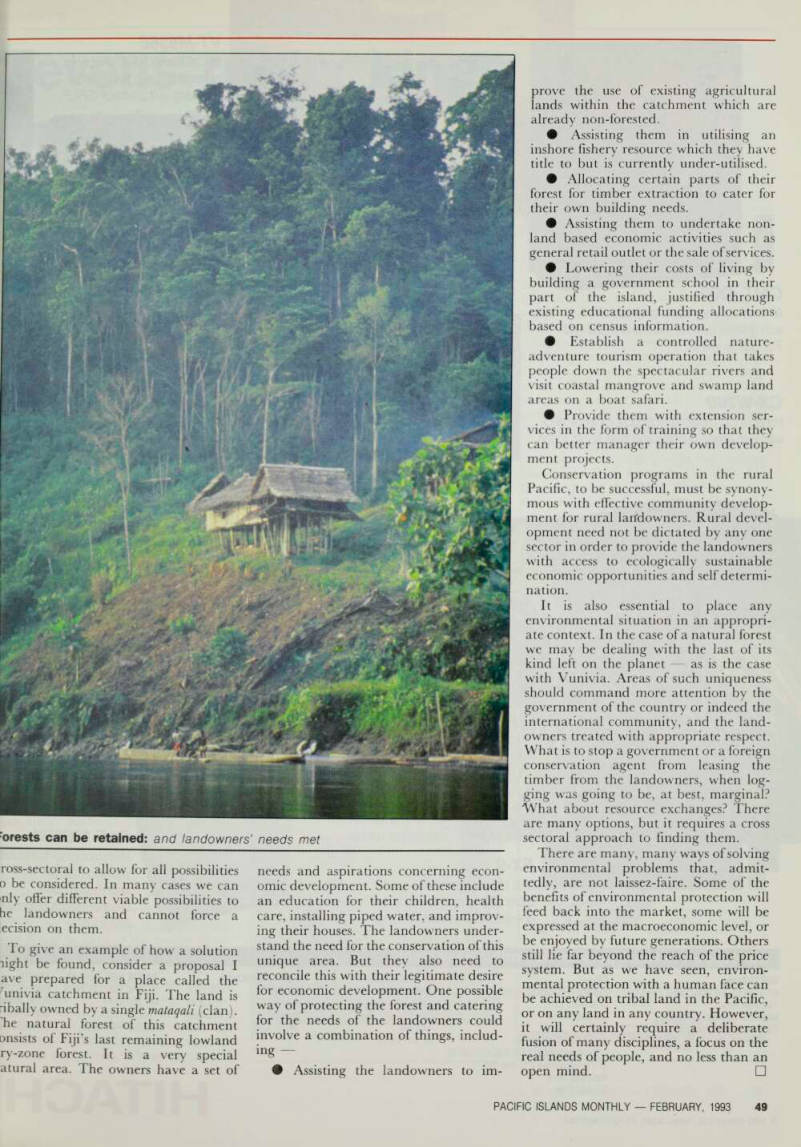
Forests can be retained: and landowners’ needs met