Linguists
pp. 40-41 · Read in the full issue
Health
By David North
THE battle against AIDS in the South Pacific requires not only doctors and nurses, but linguists as well.
The South Pacific Commission has launched a poly-lingual attack on the lack of information and the abun dance of mis-information which can only lead to the spread of AIDS, and its pre-cursor, HIV positive status. (AIDS is the stage in which the victim suffers from a weakening of the normal immune systems, inevitably leading to death; a person with a positive HIV test, while symptom-free at the moment, is on the way to AIDS.) It is not easy, even for health profes sionals, to talk in an unoffensive yet understandable way about sexually transmitted diseases (STDs) in their own languages; when the conversation moves into a new language, the difficulties multiply.
The health advocate wants to convey a message, which is often quite explicit, about a sensitive subject, in such a way as to be understood, without uncon sciously saying something that is per ceived by the listener as either funny or obscene. And all this in a context where, tragically, many people do not under stand the need, for example, to use condoms during intercourse to avoid exposure to AIDS and other STDs.
A partial answer to this linguistic problem can be seen in the publications produced and/or distributed by the South Pacific Commission on the subject.
First, there was a need to work out the basic sexual health vocabulary in a number of island languages. The Family Planning Federation of Australia has put together a booklet, distributed by SPC and others, called South Pacific Repro ductive Health Words and Phrases ; it shows these words in English, Fijian, Hindi, Pidgin, Tongan and Samoan. There was, PIM was told, much consultation among the authors and health professionals speaking the various languages before the little book went to press. They wanted to get each word right in each language; where it is a swear word the writers have put it in brackets.
As a sample of the health words in the Australian-produced dictionary take condom. It is rapa in Fijian, founga ta’ofi feitama or founga fakakaukau’i ’o e familli in Tongan and pau faiusuga in Samoan. It is gumi bilong kok in Pidgin.
SPC then took the AIDS education process one step further; it made use of
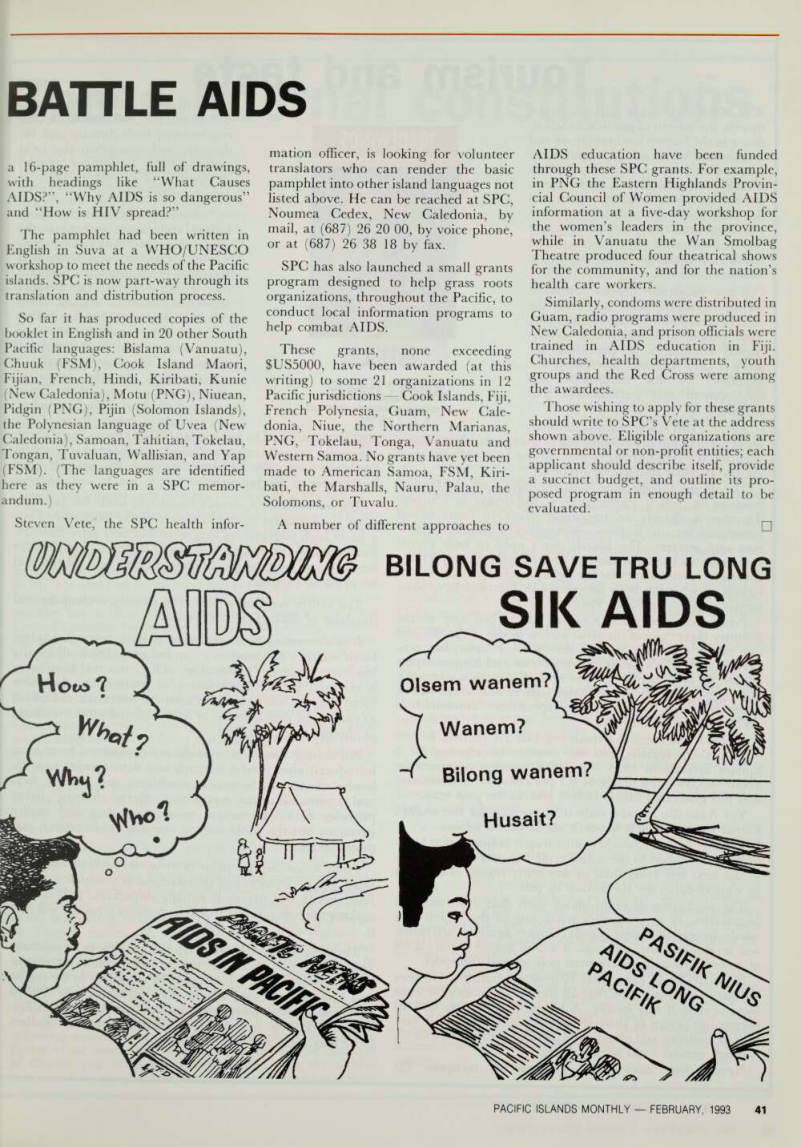
a 16-page pamphlet, full of drawings, with headings like “What Causes AIDS?”, “Why AIDS is so dangerous” and “How is HIV spread?”
The pamphlet had been written in English in Suva at a WHO/UNESCO workshop to meet the needs of the Pacific islands. SPC is now part-way through its translation and distribution process.
So far it has produced copies of the booklet in English and in 20 other South Pacific languages: Bislama (Vanuatu), Chuuk (FSM), Cook Island Maori, Fijian, French, Hindi, Kiribati, Kunie (New Caledonia), Motu (PNG), Niuean, Pidgin (PNG), Pijin (Solomon Islands), the Polynesian language of Uvea (New Caledonia), Samoan, Tahitian, Tokelau, Tongan, Tuvaluan, Wallisian, and Yap (FSM). (The languages are identified here as they were in a SPC memor andum.) Steven Vete, the SPC health infor
mation officer, is looking for volunteer translators who can render the basic pamphlet into other island languages not listed above. He can be reached at SPC, Noumea Cedex, New Caledonia, by mail, at (687) 26 20 00, by voice phone, or at (687) 26 38 18 by fax.
SPC has also launched a small grants program designed to help grass roots organizations, throughout the Pacific, to conduct local information programs to help combat AIDS.
These grants, none exceeding SUSSOOO, have been awarded (at this writing) to some 21 organizations in 12 Pacific jurisdictions Cook Islands, Fiji, French Polynesia, Guam, New Cale donia, Niue, the Northern Marianas, PNG, Tokelau, Tonga, Vanuatu and Western Samoa. No grants have yet been made to American Samoa, FSM, Kiri bati, the Marshalls, Nauru, Palau, the Solomons, or Tuvalu.
A number of different approaches to
AIDS education have been funded through these SPC grants. For example, in PNG the Eastern Highlands Provin cial Council of Women provided AIDS information at a five-day workshop for the women’s leaders in the province, while in Vanuatu the Wan Smolbag Theatre produced four theatrical shows for the community, and for the nation's health care workers.
Similarly, condoms were distributed in Guam, radio programs were produced in New Caledonia, and prison officials were trained in AIDS education in Fiji.
Churches > health departments, youth grou P s a " d the Red Cross were amon « tbe awardees ' Those wishing to apply for these grants should write to SPC’s Vete at the address shown above ’ Eli S ible organizations are governmental non-profit entities; each a PP bcant sb °nld describe itself, provide a SU T budget ’ and f. P T posed program m enough detail to be