indigenous
pp. 26-29 · Read in the full issue
Special Report
Lament of the indigenous people
1993 is intended to mark a partnership between governments and the indigenous peoples. But it remains to be seen just how enthusiastic governments will be of one of the key demands land rights
By lan Williams
GOVERNMENT by the people, for the people and of the people, the old saying has it. But many of the “First Nations” gathered in New York for the opening of the United Nations Year
for Indigenous Peoples were already
in dispute about the title which they resolutely called the Year of the
Indigenous Peoples.
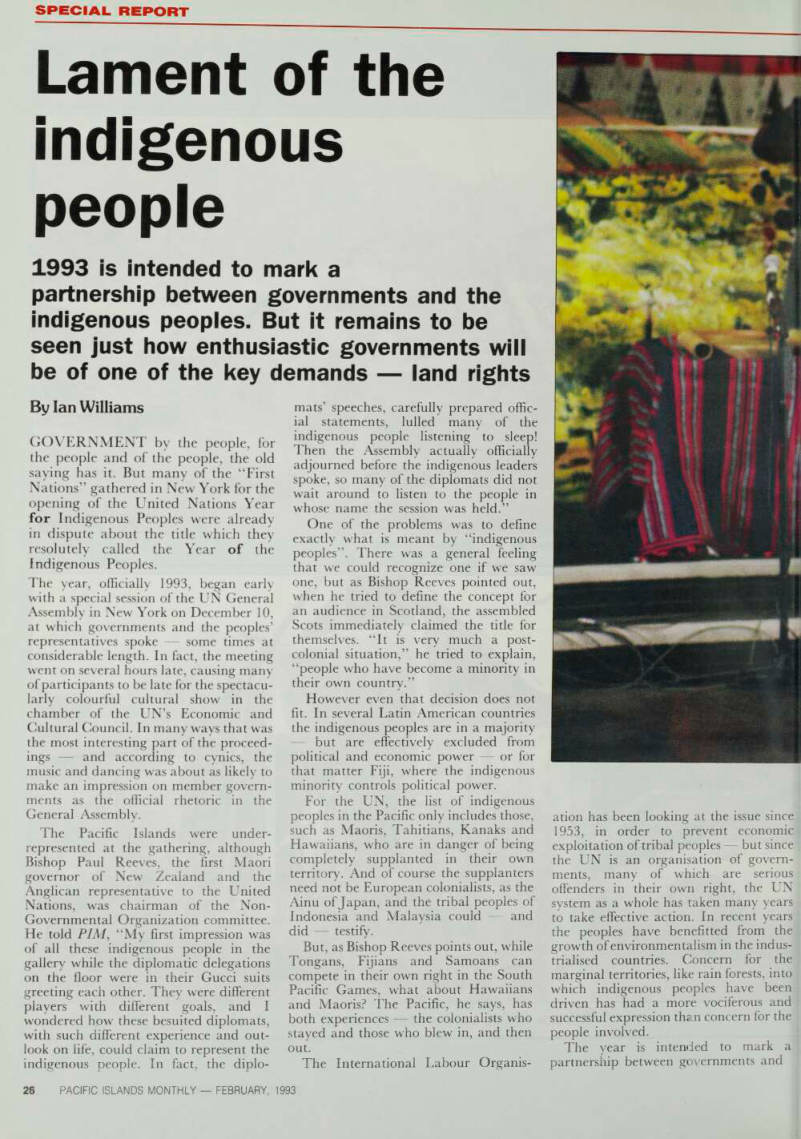
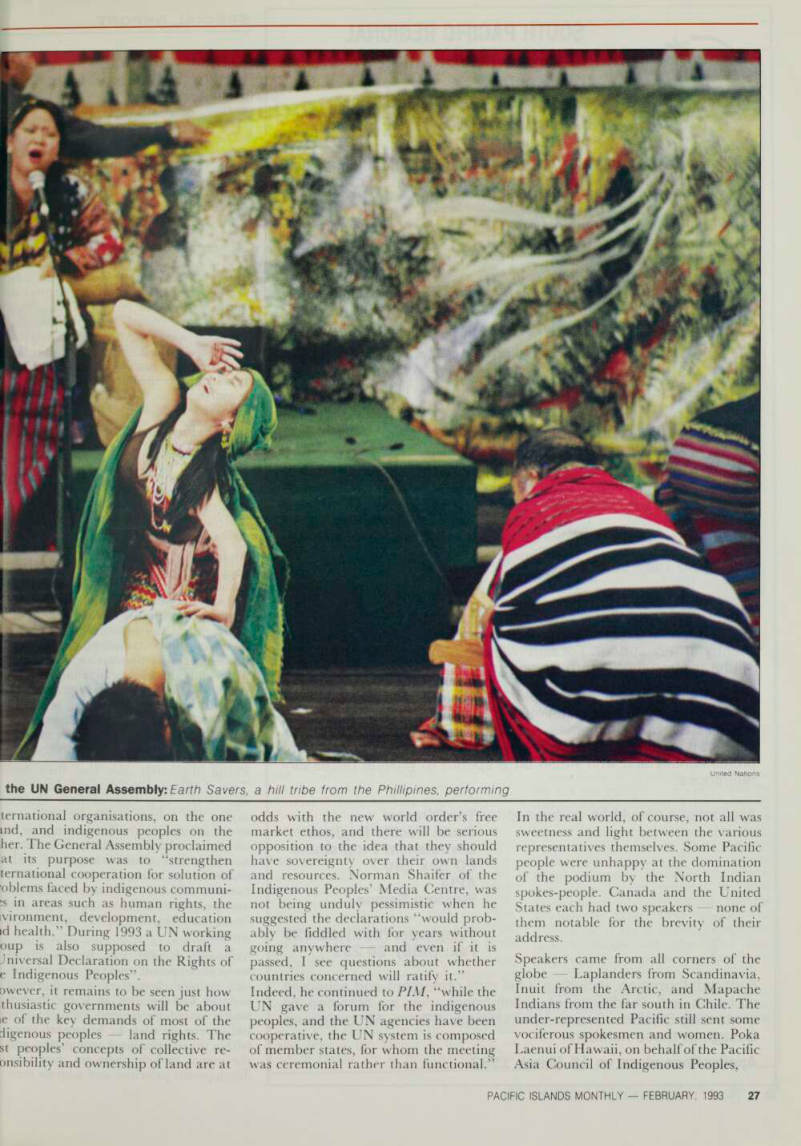
The year, officially 1993, began early with a special session of the UN General Assembly in New York on December 10, at which governments and the peoples’ representatives spoke some times at considerable length. In fact, the meeting went on several hours late, causing many of participants to be late for the spectacu larly colourful cultural show in the chamber of the UN’s Economic and Cultural Council. In many ways that was the most interesting part of the proceed ings and according to cynics, the music and dancing was about as likely to make an impression on member govern ments as the official rhetoric in the General Assembly.
The Pacific Islands were under represented at the gathering, although Bishop Paul Reeves, the first Maori governor of New Zealand and the Anglican representative to the United Nations, was chairman of the Non- Governmental Organization committee.
He told PIM , “My first impression was of all these indigenous people in the gallery while the diplomatic delegations on the floor were in their Gucci suits greeting each other. They were different players with different goals, and I wondered how these besuited diplomats, with such different experience and out look on life, could claim to represent the indigenous people. In fact, the diplo
mats’ speeches, carefully prepared offic ial statements, lulled many of the indigenous people listening to sleep!
Then the Assembly actually officially adjourned before the indigenous leaders spoke, so many of the diplomats did not wait around to listen to the people in whose name the session was held.”
One of the problems was to define exactly what is meant by “indigenous peoples”. There was a general feeling that we could recognize one if we saw one, but as Bishop Reeves pointed out, when he tried to define the concept for an audience in Scotland, the assembled Scots immediately claimed the title for themselves. “It is very much a post colonial situation,” he tried to explain, “people who have become a minority in their own country.”
However even that decision does not fit. In several Latin American countries the indigenous peoples are in a majority - but are effectively excluded from political and economic power or for that matter Fiji, where the indigenous minority controls political power.
For the UN, the list of indigenous peoples in the Pacific only includes those, such as Maoris, Tahitians, Kanaks and Hawaiians, who are in danger of being completely supplanted in their own territory. And of course the supplanters need not be European colonialists, as the Ainu of Japan, and the tribal peoples of Indonesia and Malaysia could and did testify.
But, as Bishop Reeves points out, while Tongans, Fijians and Samoans can compete in their own right in the South Pacific Games, what about Hawaiians and Maoris? The Pacific, he says, has both experiences the colonialists who stayed and those who blew in, and then out.
The International Labour Organis-
ation has been looking at the issue since 1953, in order to prevent economic exploitation of tribal peoples but since the UN is an organisation of govern ments, many of which are serious offenders in their own right, the UN system as a whole has taken many years to take effective action. In recent years the peoples have benefitted from the growth of environmentalism in the indus trialised countries. Concern for the marginal territories, like rain forests, into which indigenous peoples have been driven has had a more vociferous and successful expression than concern for the
people involved.
The year is intended to mark a partnership between governments and
ternational organisations, on the one md, and indigenous peoples on the her. The General Assembly proclaimed at its purpose was to “strengthen ternational cooperation for solution of oblems faced by indigenous communi -s in areas such as human rights, the vironment, development, education id health.” During 1993 a UN working oup is also supposed to draft a Jniversal Declaration on the Rights of
e Indigenous Peoples”,
owever, it remains to be seen just how thusiastic governments will be about ie of the key demands of most of the digenous peoples land rights. The st peoples’ concepts of collective re onsibility and ownership of land are at
odds with the new world order’s free market ethos, and there will be serious opposition to the idea that they should have sovereignty over their own lands and resources. Norman Shaifer of the Indigenous Peoples’ Media Centre, was not being unduly pessimistic when he suggested the declarations “would prob ably be fiddled with for years without going anywhere and even if it is passed, I see questions about whether countries concerned will ratify it.”
Indeed, he continued to PIM, “while the UN gave a forum for the indigenous peoples, and the UN agencies have been cooperative, the UN system is composed of member states, for whom the meeting was ceremonial rather than functional.”
In the real world, of course, not all was sweetness and light between the various representatives themselves. Some Pacific people were unhappy at the domination of the podium by the North Indian spokes-people. Canada and the United States each had two speakers none of them notable for the brevity of their address.
Speakers came from all corners of the globe Laplanders from Scandinavia, Inuit from the Arctic, and Mapache Indians from the far south in Chile. The under-represented Pacific still sent some vociferous spokesmen and women. Poka Laenui of Hawaii, on behalf of the Pacific Asia Council of Indigenous Peoples,
United Nations
the UN General Assembly: Earth Savers, a hill tribe from the Phillipines, performing
contrasted the UN’s high moral stand with the behaviour of member states, pointing out that there were atrocities against indigenous people in East Timor.
West Papua, and the Moluccas Island.
“There must be an end to such hypocrisy and firm action must be taken by the United Nations to end such atrocities,” he told the General Assembly.
A similar theme was taken up by William Means, President of the International Treaty Council, who addressed his comments on the treatment meted out to Native Americans. “We are the Palestin ians of the Western Hemisphere,” he said. Lois O’Donague of the Aboriginal and Torress Strait Islander Commission was able to record some success, that after 204 years the Australian courts had finally recognized her people did in fact own their own land when Captain Cook turned up on their shores. For the two centuries before, the law deemed the land belonged to no one.
On the other hand, Tamati Reedy of the National Maori Congress, complained the New Zealand government, despite just winning a seat on the Security Council had acted “in utter violation of the rights of its own minority indigenous group over the Maori fishing rights issue.
Anderson Muang Urud of the Kelabit people of Sarawak spoke despite warnings from people claiming to rep resent Malaysia that it would be bad for his future health to do so. He said the so called progress represented by logging meant “only starvation, dependence, helplessness, the destruction of our cul ture and the demoralization of our people.” In 10 years time, he prophesied, the jobs “created” by logging would be gone. “And the forest which had sus tained the people for thousands of years would be gone with them.”
Pacific diplomats also had their say.
Terry O’Brien, New Zealand Ambassa dor of the UN, differed from Reedy, saying the fishing rights agreement is seen “almost universally as being fair to all parties and the resolution of a long standing and contentious issue”. He finished by stressing that the relationship between member states and the indigen ous peoples must be “equitable and based on mutual respect and under standing”.
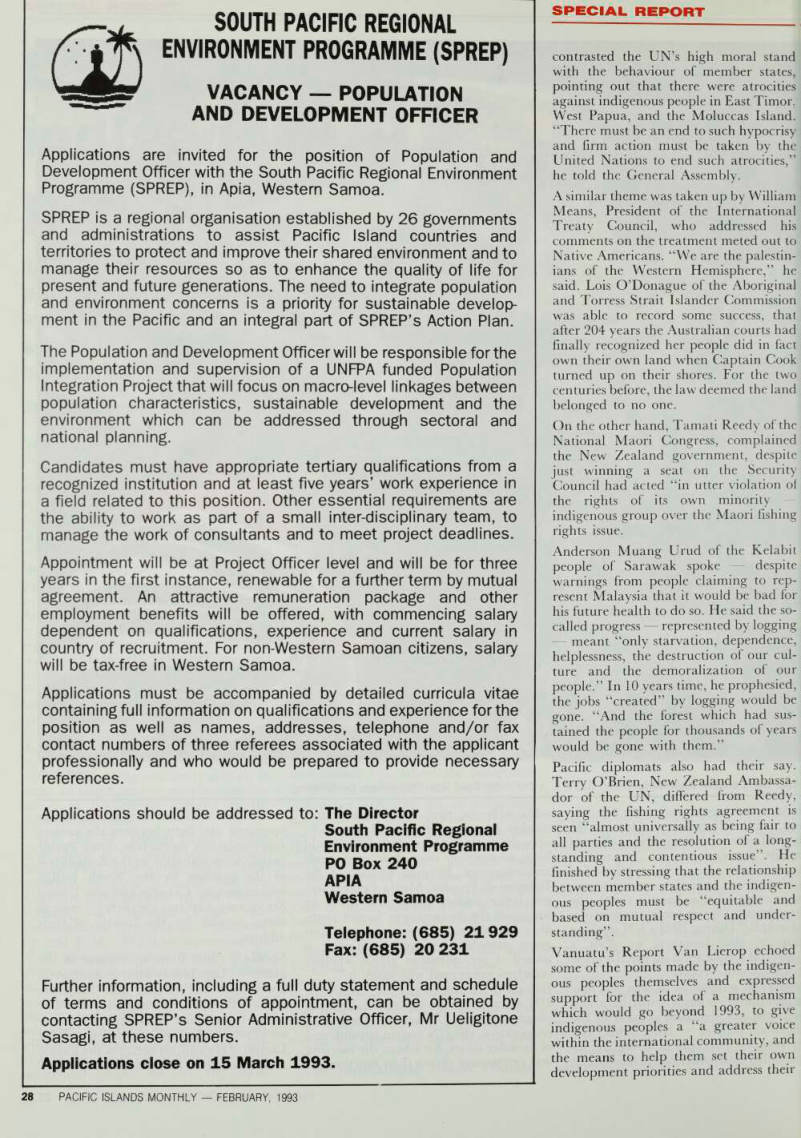
Vanuatu’s Report Van Lierop echoed some of the points made by the indigen ous peoples themselves and expressed support for the idea of a mechanism which would go beyond 1993, to give indigenous peoples a “a greater voice within the international community, and the means to help them set their own development priorities and address their
own needs.” Australian Senator Patricia Giles indulged in some uncommon self criticism by referring to the Royal Commission on the deaths of Aborigines in police custody which, she said, indicated the 99 people who died “were victims of entrenched and institutionalized racism and discrimi nation”.
The government, however, had ac cepted almost all the recommendations of the commission and was determined to stop such incidents in future.
Fiji’s Senator Adi Litia Cakobau, unsurprisingly, invoked the intentions of the year to bless the new constitution which, she said, was intended to “protect
and promote” the special “indigenous
position” of the indigenous Fijian people by giving them a majority of seats and by according recognition to the Great Council of Chiefs. This was, she claimed, in accordance with the “protective provisions in the constitutions of several other member countries of the UN”. It was an interesting analogy, which was not, however, pursued by anyone else.
By the end of the evening, the weary delegates found the cultural evening had started without them. Indeed one group of about 30 was prevented from entering the auditorium by the UN security guards. Despite their motley costumes, they did not have the right pass.
But there was one clear victory for the first peoples that day. The guard backed down when he saw the determination and anger of the crowd shouting that “it’s our evening”. It was a neat parable, of the fact that the peoples have to fight to gain control of their own year, let alone their own lands.
Van Lierop: going beyond 1993