Acid test for change
pp. 11-12 · Read in the full issue
Politics
By Bill Morton
As Tonga gears up for its elections, and as the call for change is put to the test, cracks are already appearing in the people’s unity
LATE November, 1992 saw one of the most important political events in Tonga’s political history. The Conven tion on the Constitution and Democracy, organised by the country’s Pro- Democracy Movement, was widely at tended and attracted attention regionally and internationally.
The four-day convention was a clear sign that the call for change is reverberat ing loudly and clearly around the Kingdom. Parliamentarians, church leaders and academics spoke of the need for a more democratic system, for reduced powers of the King and for constitutional amendment.
Two months later the impact of the convention is being overshadowed by the next one on the country’s political calendar. On February 4, elections will
be held for the Peoples’ Representatives
to the Legislative Assembly. Fifty-five candidates will contest the nine available seats. (The other 21 seats consist of nine representatives of the 33 noble families and 12 ministers appointed for life by the King. As a clear majority they ensure the Peoples Representatives can be outvoted on every issue.) Important questions which arose from the convention are now being put to the acid test by the pending elections. In a party-less system will the pro-democracy movement formalise itself into a political party? Will democracy and change be the most important election issues? At present five of the nine peoples’ represen tatives support change. Will this number be increased after the next election?
Firmly at the forefront of the call for :hange have been Akilisi Pohiva and Viliami Fukofuka, both peoples’ rep resentatives for Tonga’s main island Fongatapu and both committee mem bers of the pro-democracy movement. In their political careers Pohiva has been
the mouthpiece, exposing government
:orruption, leading opposition within
parliament, championing the cause of
the people and winning widespread
popular support. Fukofuka’s profile has also been high but somewhat in the shadow of his counterpart. He has, as he describes, “always been supportive of \kilisi, staying in the background, work ing on ideas and organisation.”
For the first time cracks appear to be ibrming in the armour of these two
leading Peoples Representatives. Speak
ing to PIM Fukofuka made his first public admission that the disagrees with
Pohiva on par ticular issues. One such disagree ment concerns the question of the formation of a
political party.
After the conven tion this was con sidered by many as the logical next step. But Pohiva says, “At least for now” the pro democracy move ment will not form a political party. We are now in the process of educating
people about
what democracy is and how it func tions. In the fu ture a party may eventually emerge
as a part of the process. But the idea of setting up a formal party now is not
appropriate.
Fukofuka, however, favours the forma tion of a political party. “If a party is formed they will be able to go into
parliament with a majority of people’s
representatives. This majority will have a mandate to put pressure on the government to bring about necessary changes. It's all very well to go as a loose informal group at initial stages. When things become serious you need disci pline, concerted efforts, direction.”
Voters on the main island of Tonga tapu will elect three people’s representa tives. Pohiva has given full endorsement to Fukofuka’s re-nomination. But he has chosen to overlook the pro-reform cur rent member Laki Niu. Instead he has endorsed former Secretary of Finance ‘Uhila Liava’a. This has also resulted in disagreement with Fukofuka. Fukofuka says Liava’a is “proven in his own field” but is “an uproven quality” for parlia ment. “I don’t see the need for a change at this time. There is more need for
united effort, to push things in parlia ment, than to renew the players with an unknown factor. He added he found it difficult to accept Pohiva’s “public announcement> . P f endor sement for makes have P oblems , wou|d a f dec ision.” 5 Pohiva strongly defends his decision to endorse Liava’a, saying Liava’a was totally committed.
Perhaps the most serious ramification Q f division within the ranks of the pro-democracy cause is that candidates will not present themselves at the election as a united, identifiable group. Fukofuka says the Tongatapu candidates who are pro-change have decided to run separ ately. “We are all for democracy. But to minimise mud-slinging we will run as individuals. Whoever gets to parliament will then work together”. Pohiva says the split may affect voters but he believes it won’t be significant. He says the most important thing is that the four Tonga tapu candidates “are still pro democracy. They stand on the same
Martin Tiffany
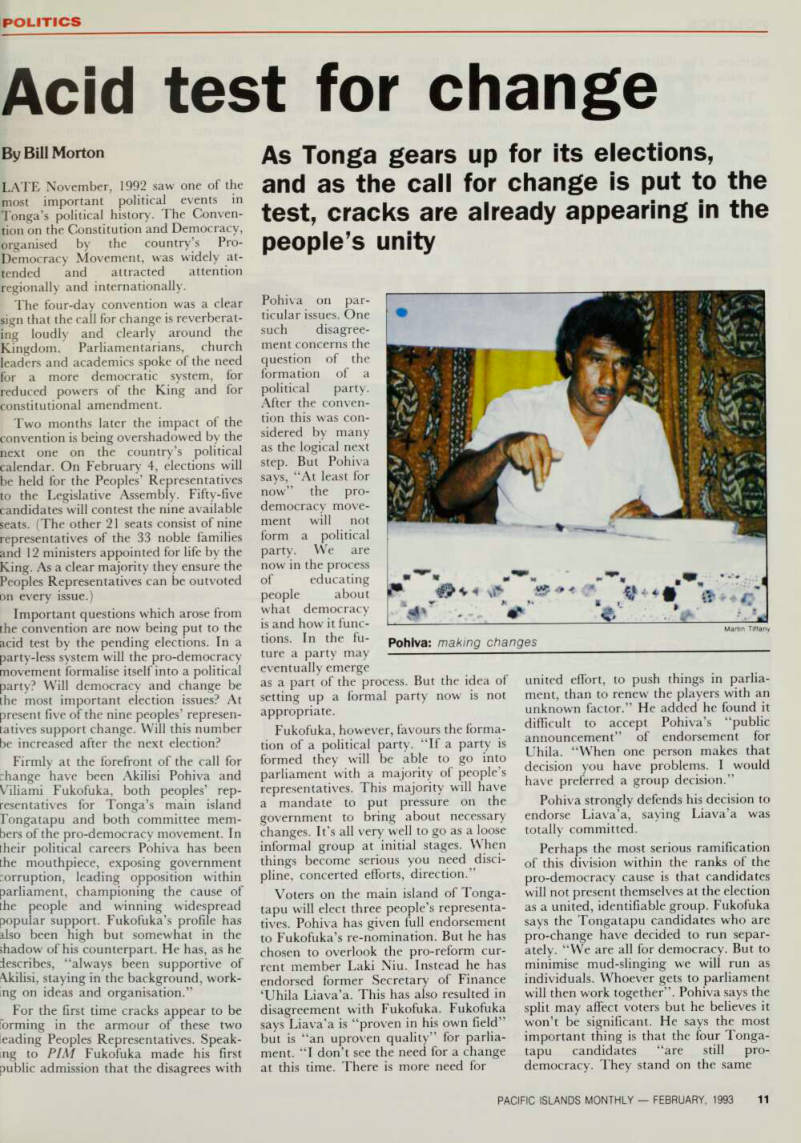
Pohiva: making changes
platform. The difference does not have anything to do with ideology.”
The extent of community support for change in Tonga has hither to been difficult to assess. Predictably, government and pro-democracy movement have disagreed in their estimates. The election was to provide the first real test of support for change. But Fukofuka believes this test has now been “watered down”. Because Laki Niu and Akilisi and mvself are not a team if has now hprnmp an election of persons rather than issues.
Unfortunately it won’t be a test. I’m
trying to move back to the issue of democracy. I pray and I hope we can get back to this issue on time for the election.
In Pohiva’s assessment the election will definitely test community support. “I see the election as like a referendum. Most people, if not all, will look at the candidates who are supporters of the Pro- Democracy Movement as symbols of what they believe. I have no doubt this be one of the criteria for peoples decision in the election”.
Despite Fukofuka’s belief that the test of support for change has been diluted he
still believes “change” will be “thea hottest issue” in the minds of voters. And, ( he says, there is no lack of pro-changea candidates. “A lot more have come outt for democracy. That has been anothen outcome of the convention morea people want to be involved in democratic:
change.”
He also points to other issues he sees ass important at the ballot box. As well asE economic issues, he believes the sociall considerations of health and education! will rate particularly highly. “It’s all well to talk of democratic changes. But]
don’t forget people have to con tinue in their daily lives too..
Health and education mean the;
world to Tongan people.”'
Fukofuka also gave notice of aj special issue he intends to address..
This appears to have beenj prompted by a talk given at the; pro-democracy convention by Dr* ‘Ana Taufulungaki on Women j and Democracy. “The reception j was overwhelming. She touched J on issues such as the way in which j women are not directly said to be; less than men, but the way things; are, they are treated as such.”
Only time will tell to what extent support for democracy will be reflected at the ballot box and whether “change” will be the most important issue in the minds oT voters. Unfortunately at present it appears political realities have come home to roost for the pro
democracy forces internal differences can be as problematic as the struggle to overcome.
The failure of pro-democracy candi dates to settle their differences and organise themselves into a cohesive and united group to contest the election will not go unnoticed by voters. Whether this will significantly affect voting patterns is unclear. What is clear is the people will get a chance to have their say about the issue of democracy. If the number of pro democracy candidates elected decreases to less than the five members presently sitting, the position of Pohiva and Fukofuka (who are almost certain of re election) will be seriously weakened. The process of change in Tonga would almost certainly de-accelerate.
But if an increased number of pro democracy candidates are elected they will find themselves with more political clout than they can currently wield. If this is the case the government will be forced to break the blanket of silence it has so far spent most of its time sheltering behind. It will have to face the reality the process of change in Tonga will eventu ally also involve some action on their part.
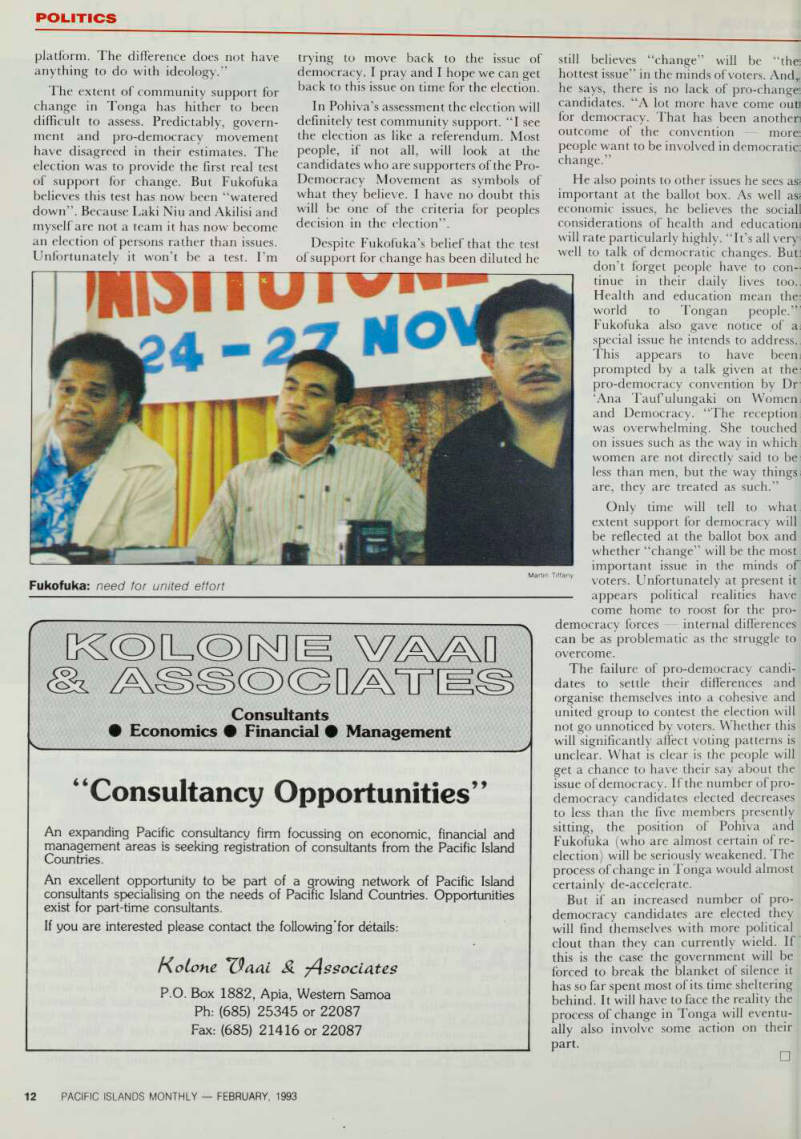
Fukofuka: need for united effort
Martin Tiffany