The king of Tonga
p. 19 · Read in the full issue
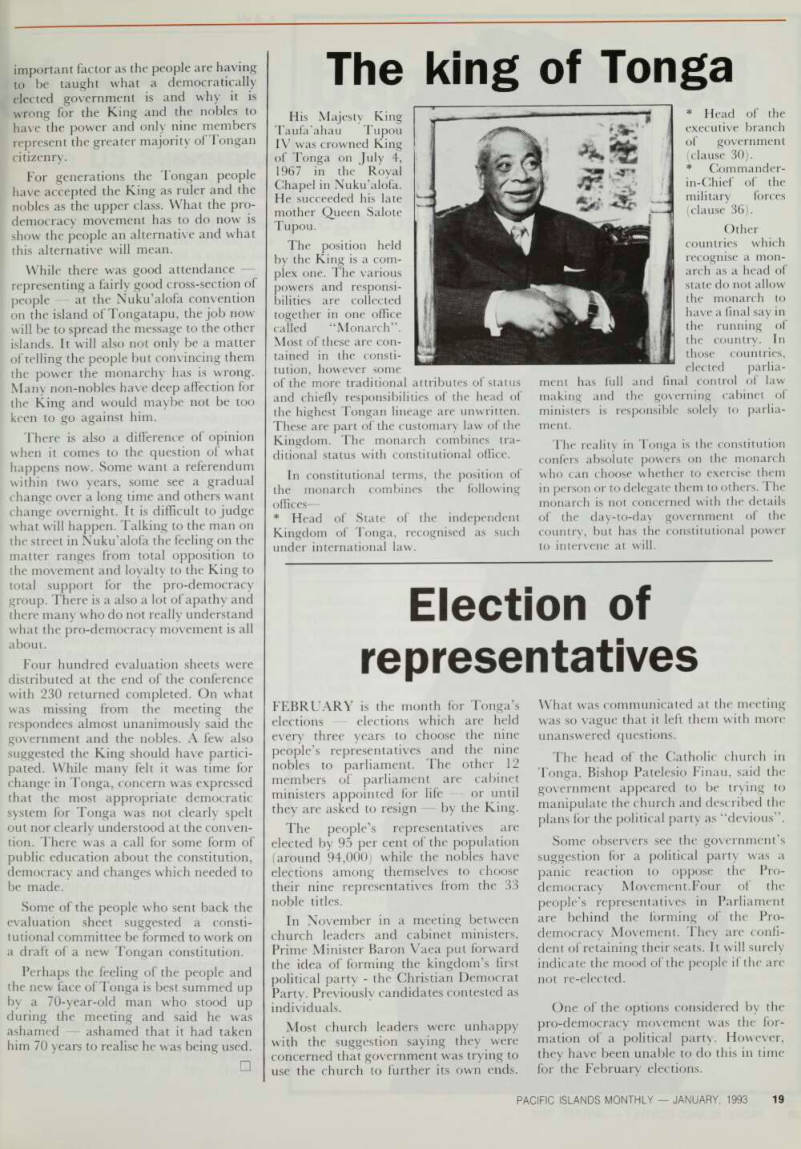
His Majesty King
Taufa'ahau Tupou
IV was crowned King of Tonga on July 4, 1967 in the Royal Chapel in Nuku’alofa.
He succeeded his late mother Queen Salote
Tupou.
The position held by the King is a com plex one. The various powers and responsi bilities are collected together in one office called “Monarch”.
Most of these are con tained in the consti tution, however some
of the more traditional attributes of status and chiefly responsibilities of the head of the highest Tongan lineage are unwritten.
These are part of the customary law of the Kingdom. The monarch combines tra ditional status with constitutional office.
In constitutional terms, the position of the monarch combines the following offices — * Head of State of the independent Kingdom of Tonga, recognised as such under international law.
* Head of the executive branch of government
(clause 30).
* Commander in-Chief of the military forces
(clause 36).
Other countries which recognise a mon arch as a head of state do not allow the monarch to have a final say in the running of the country. In those countries,
elected parlia
ment has full and final control of law making and the governing cabinet of
ministers is responsible solely to parlia
ment.
The reality in Tonga is the constitution confers absolute powers on the monarch who can choose whether to exercise them in person or to delegate them to others. The monarch is not concerned with the details of the day-to-day government of the country, but has the constitutional power to intervene at will.