Tonga’s call for democracy
pp. 16-19 · Read in the full issue
By Martin Tiffany
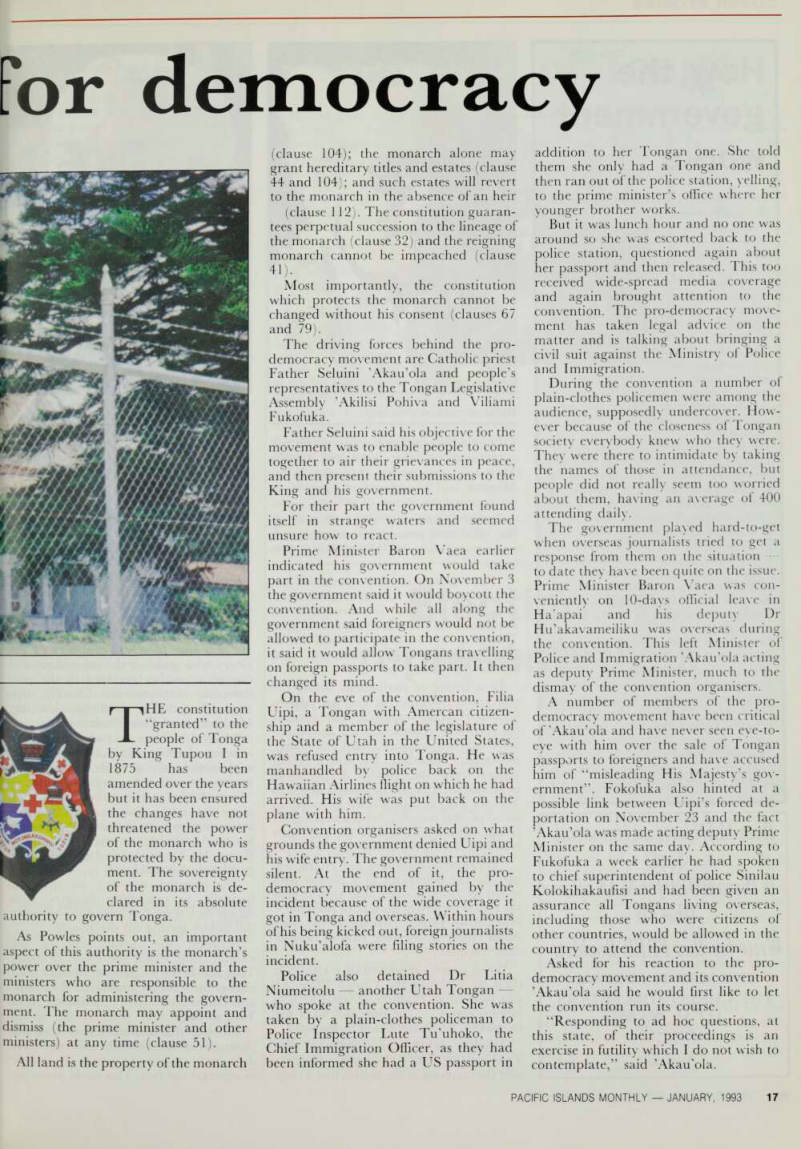
The royal palace
THE constitution
“granted” to the people of Tonga by King Tupou I in 1875 has been amended over the years but it has been ensured the changes have not threatened the power of the monarch who is protected by the docu ment. The sovereignty of the monarch is de clared in its absolute
authority to govern Tonga.
As Powles points out, an important aspect of this authority is the monarch’s power over the prime minister and the ministers who are responsible to the monarch for administering the govern ment. The monarch may appoint and dismiss (the prime minister and other ministers) at any time (clause 51).
All land is the property of the monarch
(clause 104); the monarch alone may grant hereditary titles and estates (clause 44 and 104); and such estates will revert to the monarch in the absence of an heir (clause 112). The constitution guaran tees perpetual succession to the lineage of the monarch (clause 32) and the reigning monarch cannot be impeached (clause 41).
Most importantly, the constitution which protects the monarch cannot be changed without his consent (clauses 67 and 79).
The driving forces behind the pro democracy movement are Catholic priest Father Seluini ’Akau’ola and people’s representatives to the Tongan Legislative Assembly ’Akilisi Pohiva and Viliami Fukofuka.
Father Seluini said his objective for the movement was to enable people to come together to air their grievances in peace, and then present their submissions to the King and his government.
For their part the government found itself in strange waters and seemed unsure how to react.
Prime Minister Baron Vaea earlier indicated his government would take part in the convention. On November 3 the government said it would boycott the convention. And while all along the government said foreigners would not be allowed to participate in the convention, it said it would allow Tongans travelling on foreign passports to take part. It then changed its mind.
On the eve of the convention, Filia Uipi, a Tongan with Amercan citizen ship and a member of the legislature of the State of Utah in the United States, was refused entry into Tonga. He was manhandled by police back on the Hawaiian Airlines flight on which he had arrived. His wife was put back on the plane with him.
Convention organisers asked on what grounds the government denied Uipi and his wife entry. The government remained silent. At the end of it, the pro democracy movement gained by the incident because of the wide coverage it got in Tonga and overseas. Within hours of his being kicked out, foreign journalists in Nuku’alofa were filing stories on the incident.
Police also detained Dr Litia Niumeitolu another Utah Tongan who spoke at the convention. She was
taken by a plain-clothes policeman to
Police Inspector Lute Tu’uhoko, the Chief Immigration Officer, as they had been informed she had a US passport in
addition to her Tongan one. She told them she only had a Tongan one and then ran out of the police station, yelling, to the prime minister’s office where her younger brother works.
But it was lunch hour and no one was around so she was escorted back to the police station, questioned again about her passport and then released. This too received wide-spread media coverage and again brought attention to the convention. The pro-democracy move ment has taken legal advice on the matter and is talking about bringing a civil suit against the Ministry of Police
and Immigration.
During the convention a number of plain-clothes policemen were among the audience, supposedly undercover. How ever because of the closeness of Tongan society everybody knew' who they were.
They were there to intimidate by taking the names of those in attendance, but people did not really seem too worried about them, having an average of 400 attending daily.
The government played hard-to-gct when overseas journalists tried to get a response from them on the situation to date they have been quite on the issue.
Prime Minister Baron Vaea was con veniently on 10-days official leave in Ha'apai and his deputy Dr Hu’akavameiliku was overseas during the convention. This left Minister of Police and Immigration ’Akau’ola acting as deputy Prime Minister, much to the dismay of the convention organisers.
A number of members of the pro democracy movement have been critical of ’Akau’ola and have never seen eye-to eye with him over the sale of Tongan passports to foreigners and have accused him of “misleading His Majesty’s gov ernment”. Fokofuka also hinted at a possible link between Uipi’s forced de portation on November 23 and the fact ’Akau’ola was made acting deputy Prime Minister on the same day. According to Fukofuka a week earlier he had spoken to chief superintendent of police Sinilau Kolokihakaufisi and had been given an assurance all Tongans living overseas, including those who were citizens of other countries, would be allowed in the country to attend the convention.
Asked for his reaction to the pro democracy movement and its convention ’Akau’ola said he would first like to let the convention run its course.
“Responding to ad hoc questions, at this state, of their proceedings is an exercise in futility which I do not wish to contemplate,” said ’Akau’ola.
“Once the meeting has wound up and submissions, if any, presented to His Majesty’s government then the Prime Minister and his cabinet will decide on an appropriate course of action.”
Father Seluini said they will take up the offer and present the convention's recommendations to “His Majesty’s gov ernment”.
"But we certainly hope these will not be treated like the various recommenda tions the people’s representatives in Parliament have made in the recent past.
That is to say, we hope they will not be simply dumped in the rubbish bin," said Father Seluini.
In a sitting of parliament before the convention Minister of Foreign Affairs, Crown Prince Tupouto’a, said some of the people’s representatives in parlia ment were unbalanced and may have personality disorders. He said a recent report from the Health Department indicated an increase in mental illness in Tonga. The Crown Prince referred to some of the pocple’s representatives as being mentally ill, not of the psychosis type but of the personality disorder type.
"Personality disorders are character ised by the behaviour of a person who insists he alone is right, and tries to win the rest of society to his way of thinking.” said Crown Prince Tupouto’a. He cited Adolf Hitler as a classic case of person ality disorder.
When peoples representative Laki Niu tried to interrupt the Crown Price, he was used as an example of what he was talking about “he does not want me to speak...he alone wants to speak”.
Another noble and speaker of the Tongan Legislative Assembly Fusitu’a said the convention organisers had a chip
on their shoulder and described the convention as a ripple that would be gone in a few days. He added church leaders involved in the meeting were out of step.
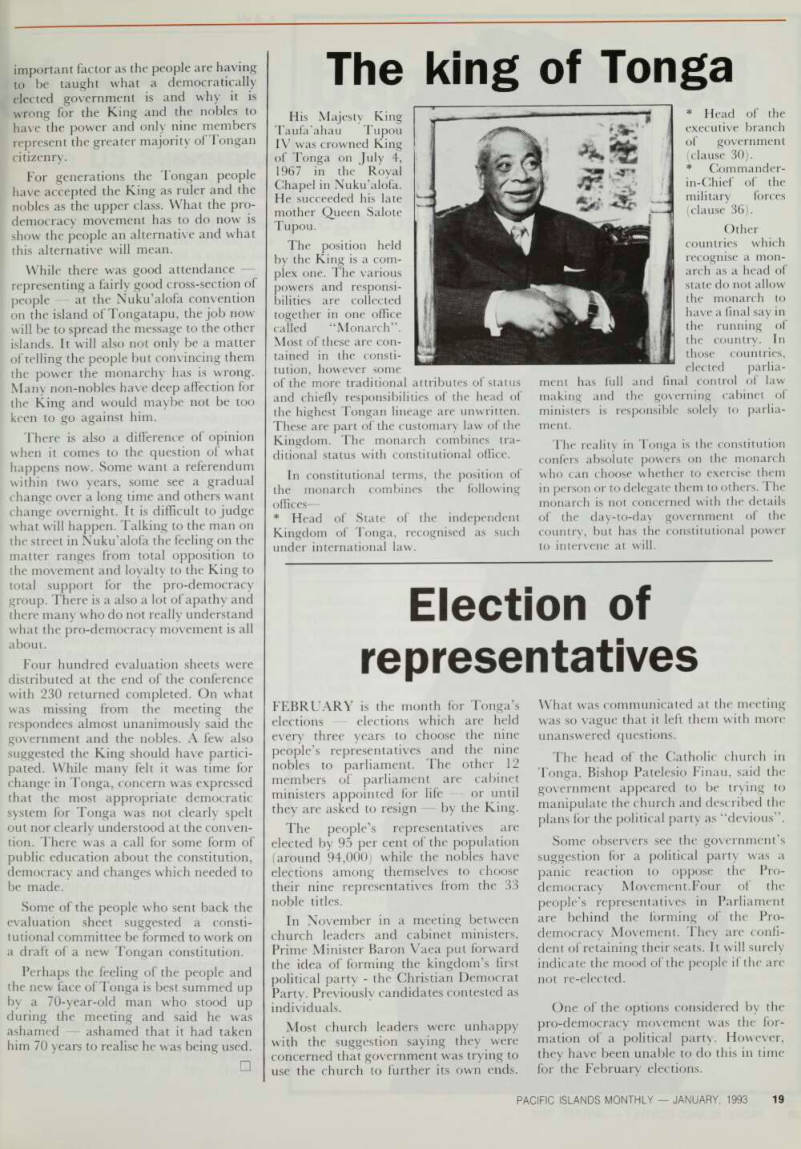
Responding to this, Bishop Patelesio Finau, the head of the Catholic Church in Tonga, said the problem with Fusitu’a was he was out of touch with what was happening in the country.
Bishop Finau has for a long time been critical of the nobility-dominated gov ernment and has been a driving force behind the pro-democracy movement.
He was one of seven members of the clergy who spoke at the convention and one of a number involved in the pro democracy movement. Church rep resented included Catholic, Uniting, Methodist and Free Wesleyan.
Many asked how and why the church were involved in politics. Father Seluini explained, with a smile, this was a movement and not a political party so “I’m alright". The other clergymen came up with similar answers. It is interesting to note that as Bishop Finau has no Archbishop he reports directly to Rome. He has obviously been given the go ahead to participate.
The churches say they are involved basically to peacefully disagree with things they regard as immoral - basically the nobles having all the power.
However the involvement of the church could cloud the vision of many Tongans. Being a Christian country with almost the total population avid church goers, the church is an important part of Tongan life.
There is the possibility that with the closeness of the church and the pro democracy movement people are unable to separate the two. This could prove an
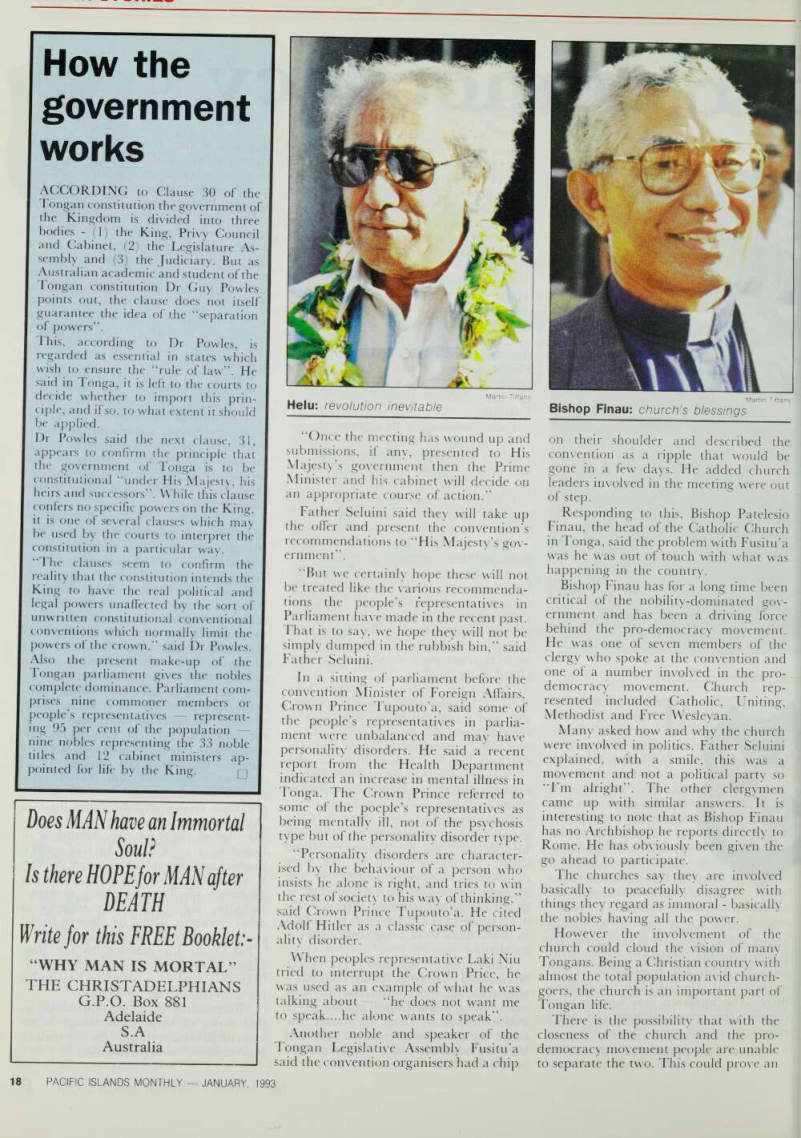
Martin Tiffany Helu: revolution inevitable
Martin Tiffany Bishop Finau: church’s blessings
important factor as the people are having to be taught what a democratically elected government is and why it is wrong for the King and the nobles to have the power and only nine members represent the greater majority of Tongan citizenry.
For generations the Tongan people have accepted the King as ruler and the nobles as the upper class. What the pro democracy movement has to do now is show the people an alternative and what this alternative will mean.
While there was good attendance representing a fairly good cross-section of people at the Nuku’alofa convention on the island ofTongatapu, the job now will be to spread the message to the other islands. It will also not only be a matter of telling the people but convincing them the power the monarchy has is wrong.
Many non-nobles have deep affection for the King and would maybe not be too keen to go against him.
There is also a difference of opinion when it comes to the question of what happens now. Some want a referendum within two years, some see a gradual change over a long time and others want change overnight. It is difficult to judge what will happen. Talking to the man on the street in Nuku’alofa the feeling on the matter ranges from total opposition to the movement and loyalty to the King to total support for the pro-democracy group. There is a also a lot of apathy and there many who do not really understand what the pro-democracy movement is all about.
Four hundred evaluation sheets were distributed at the end of the conference with 230 returned completed. On what was missing from the meeting the respondees almost unanimously said the government and the nobles. A few also suggested the King should have partici pated. While many felt it was time for change in Tonga, concern was expressed that the most appropriate democratic system for Tonga was not clearly spelt out nor clearly understood at the conven tion. There was a call for some form of public education about the constitution, democracy and changes which needed to be made.
Some of the people who sent back the evaluation sheet suggested a consti tutional committee be formed to work on a draft of a new Tongan constitution.
Perhaps the feeling of the people and the new face of Tonga is best summed up by a 70-year-old man who stood up during the meeting and said he was ashamed ashamed that it had taken him 70 years to realise he was being used.