Another crisis for Wingti
pp. 11-12 · Read in the full issue
Papua New Guinea
By Wally Hiambohn
IF Stephen Pokawin and 18 fellow provincial premiers had it their way Paias Wingti would not be prime minister of Papua New Guinea. Wingti touched a sensitive chord with Pokawin’s lot when he announced his intention to abolish the provincial government sys tem and to centralise most government and administrative functions.
The system, first introduced on Bou gainville in 1976 and later to all the other 18 provinces, was intended to bring government closer to the people. Most government functions, except for foreign affairs, police, defence and in a few selected cases, finance, where decentra lised giving provinces autonomy to make their own decisions on issues affecting
their respective provinces and people.
But after 16 years,* Wingti says, the system is “too costly” and achieving little of the objectives it was initially set up for.
The whole dream and purpose of provincial governments has gone wrong,” Wingti said on October 7, when announcing his government’s intention to do away with the system.
“They are becoming a power unto themselves to the point of downright disrespect and disobedience of national government directions,” he lamented.
Premiers in regional blocs shot back fast, telling Wingti he could not possibly remove their governments without ex pecting severe consequences. While they agreed there was a need for a review of the system, abolition, they said, was out of the question. They blamed the government for inadequate funding which had caused a disintegration of social and economic development in rural areas.
Pokawin, who once lectured in politi cal science at the University of PNG, and now premier of the northern-most tiny island province of Manus, led premiers of five of the island provinces, including representatives from Bougainville, for a crisis meeting in Rabaul. Their reaction to the whole issue was, as expected, most extreme.
They announced after the meeting that secession of the five provinces was now a possibility. “Independence is not out of reach,” they declared. “The option of a separate state of the combined provinces of the New Guinea island region remains on the agenda, and shall do so for as long as the prime minister, the deputy prime minister and their colleagues in the national government intend to gain exclusive control over all aspects of government administration throughout the country.”
“It is clear that the motive behind abolishing provincial governments is simply to place control over the exploi tation of our nation’s natural resources in the hands of a small number of national leaders in Waigani (national government headquarters in Port Moresby).
“Either Mr Wingti must go or the region must, and it is not of great concern to us which one it is.”
The islands’ leaders even resolved to draw up their own national anthem and flag and to remove those of PNG.
Furthermore, they wrote to Solomon Islands Prime Minister Solomon Mamaloni suggesting discussions in Honiara for future political association.
Mamaloni’s response to premier Pokawin and his invitation to premiers to travel to Honiara was received with total disbelief in PNG.
Mamaloni made known his strong
straight-forward views on provincial governments, and even Bougainville, in this response.
Prime Minister Wingti personally wrote back to complain Mamamaloni was meddling in PNG’s internal affairs.
On the other hand, Wingti took the islands premiers’ Stand calmly, saying it was to be expected. He said the vast
majority of people supported his move..
Only the premiers who had vested interests in seeing the continuation of provincial governments were opposed to it, Wingti said. Debate has since ensued on the issue.
One person opposed to the system wrote, “Papua New Guinea’s population of four million people is over-governed, and is a major drain on the nation’s purse. There seem to be 19 different prime ministers with 133 Cabinet minis ters throughout the 19 provinces, with a
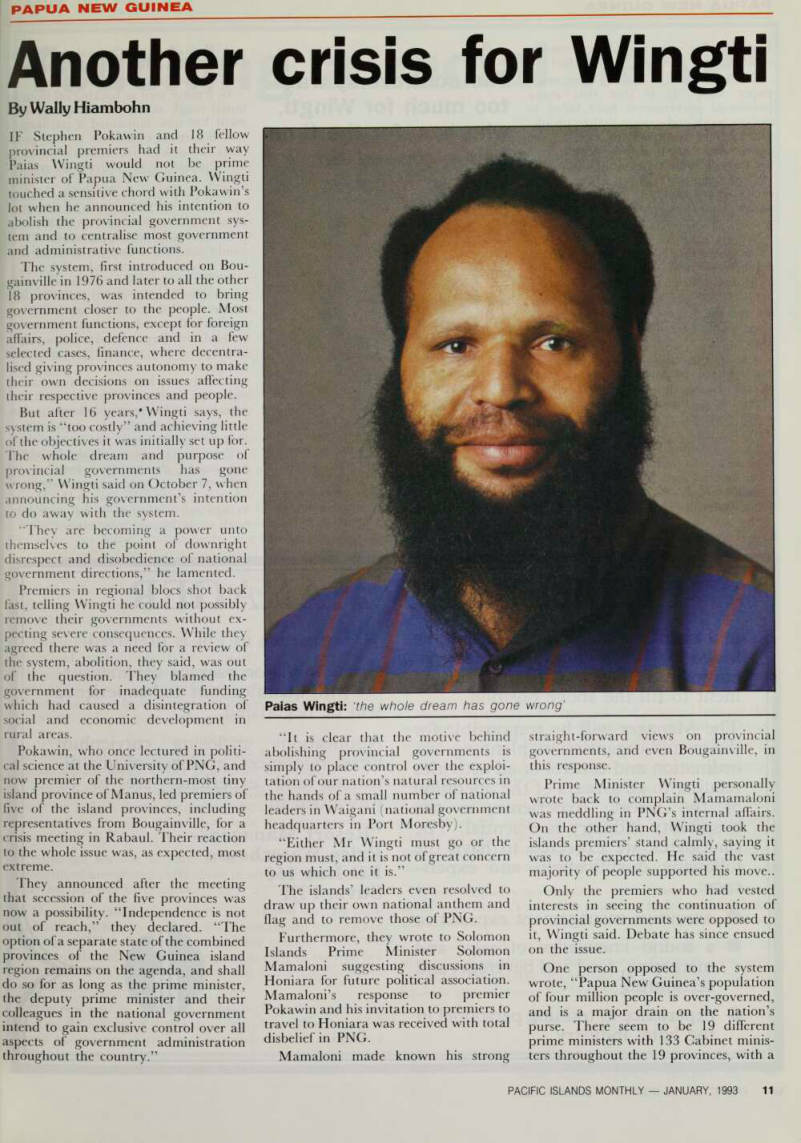
Paias Wingti: ‘the whole dream has gone wrong'
huge number of provincial government staff draining the provincial budget.”
In its editorial, The Post-Courier news paper said, “It is true that many provincial governments have failed to deliver goods and services to their people.
Others have succeeded in meeting the development needs of their people. It is not the system that is at fault, but leaders who were supposed to serve the needs of their people and in doing so have undermined the original objectives of the system.”
Wingti said in his October 7 an nouncement that K 329 million almost a quarter of the national budget went into provincial governments annually.
Up to 550 provincial politicians took up over KlO million in 1991 in wages alone. This excluded perks and privi leges.
Adding this number of politicians to the 109 national politicians gives a total of 659. Comparatively, New Zealand, which had a similar population but a far more advanced economy, had only 97 politicians.
This 97, Wingti said, cost the New Zealand tax-payer K 3.5 million a year to cover salaries and allowances. On this basis, he said, PNG's 109 politicians were
being under-utilised.
“By any test, provincial governments have failed to give people basic services,”
The controversy was too much for Wingti, who has, for the time being, passed the buck to Micah’s committee
he said. Provincial governments were established through the organic law on provincial governments. It was first introduced on Bougainville in 1976 when that part of the country first tried to secede in 1975. Ironically, when they are again trying to secede, and when the increased autonomy is among one of the options available to the government, it now wants to withdraw rather than give more powers.
Said Wingti, “Whether we like it or not this nation was forced to take on this costly second tier of government as a result of a blackmail from one provincial grouping. This blackmail was essentially give us provincial governments or Bougainville secedes. Once was enough.
We will not allow the same blackmail again.”
The government had planned to first
seek parliament’s approval in its last session in November, but the controversy was too much for it to do just yet.
In a move seen as backing off from its initial tough stand, the Wingti govern ment has now appointed a parliamen tary bipartisan committee to tour prov inces and seek a cross-section of views on an alternative to provincial govern ments.
One proposal, by Provincial Affairs Minister John Nilkare, is the establish ment of less costly and less cumbersome provincial and local authorities. These would basically comprise of reputable local leaders and national politicians.
With the bipartisan committee, prov incial governments would see it as their chance to lobby hard and build up enough influence for at least the system to stay on. They may agree to a major revamp of the system but not total abolition.
Already they have had an encouraging sign when the head of the committee, Ben Micah, a first term parliamentarian, announced soon after his appointment that the system would not be abolished.
Provincial premiers will also be lobby ing among the national members of parliament to vote against abolition when it is put to the vote in the House.
Wingti has, for the time being, passed the buck on to Micah's committee. □