The winds of change
From The Editor’S Desk
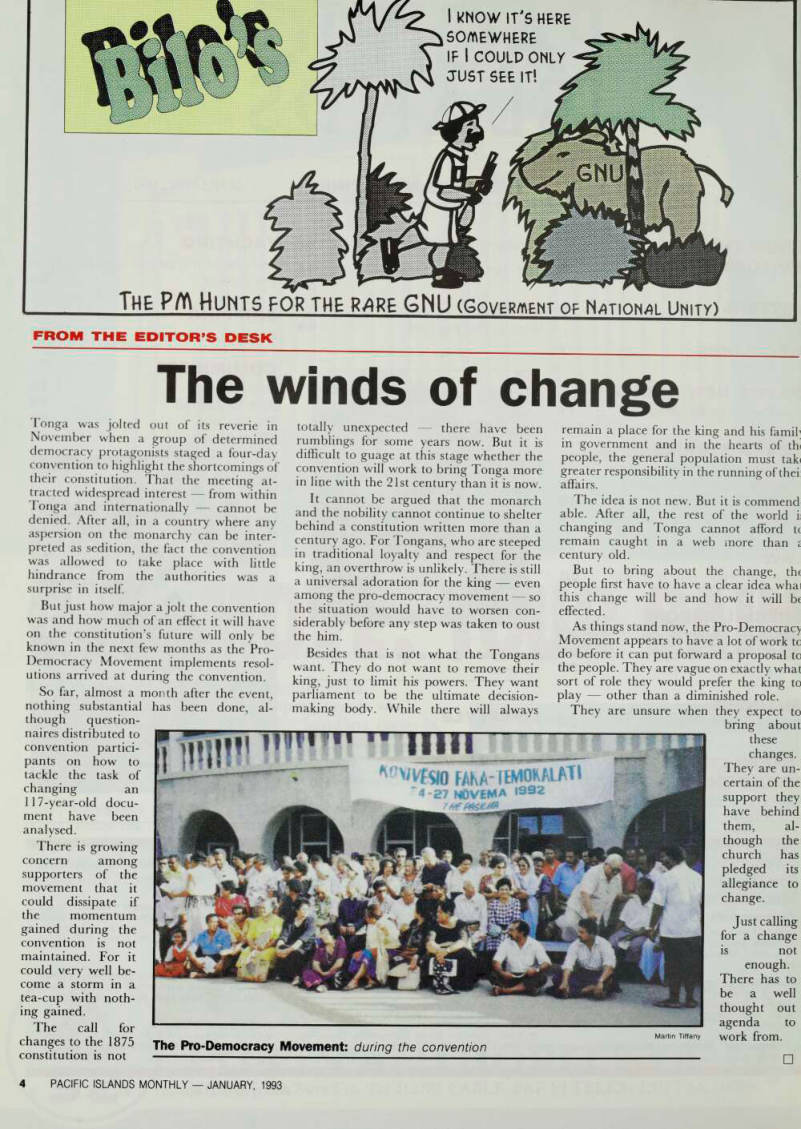
Tonga was jolted out of its reverie in November when a group of determined democracy protagonists staged a four-day convention to highlight the shortcomings of their constitution. That the meeting at tracted widespread interest from within Tonga and internationally cannot be denied. After all, in a country where any aspersion on the monarchy can be inter preted as sedition, the fact the convention was allowed to take place with little hindrance from the authorities was a surprise in itself.
But just how major a jolt the convention was and how much of an effect it will have on the constitution’s future will only be known in the next few months as the Pro- Democracy Movement implements resol utions arrived at during the convention.
So far, almost a month after the event, nothing substantial has been done, al
though question naires distributed to convention partici pants on how to tackle the task of
changing an
117-year-old docu ment have been analysed.
There is growing concern among supporters of the movement that it could dissipate if the momentum gained during the convention is not maintained. For it could very well be come a storm in a tea-cup with noth ing gained.
The call for changes to the 1875 constitution is not
totally unexpected there have been rumblings for some years now. But it is difficult to guage at this stage whether the convention will work to bring Tonga more in line with the 21st century than it is now.
It cannot be argued that the monarch and the nobility cannot continue to shelter behind a constitution written more than a century ago. For Tongans, who are steeped in traditional loyalty and respect for the king, an overthrow is unlikely. There is still a universal adoration for the king even among the pro-democracy movement so the situation would have to worsen con siderably before any step was taken to oust the him.
Besides that is not what the Tongans want. They do not want to remove their king, just to limit his powers. They want parliament to be the ultimate decision making body. While there will always
remain a place for the king and his famib in government and in the hearts of thl people, the general population must tak< greater responsibility in the running of theii affairs.
The idea is not new. But it is commend able. After all, the rest of the world ii changing and Tonga cannot afford tc remain caught in a web more than 2 century old.
But to bring about the change, the people first have to have a clear idea whal this change will be and how it will be effected.
As things stand now, the Pro-Democracy Movement appears to have a lot of work to do before it can put forward a proposal to the people. They are vague on exactly what sort of role they would prefer the king to play other than a diminished role.
They are unsure when they expect to
bring about these changes.
They are un certain of the support they have behind them, al though the church has pledged its allegiance to change.
Just calling for a change is not enough.
There has to be a well thought out agenda to work from.
Martin Tiffany
The Pro-Democracy Movement: during the convention