World’s [?]irst poisonous bird
pp. 44-45 · Read in the full issue
Science
By David North
American Association for the Adv ancement of Science
rtj
30 October 1992 $6.00 VOL. 258 • Pages 713-860
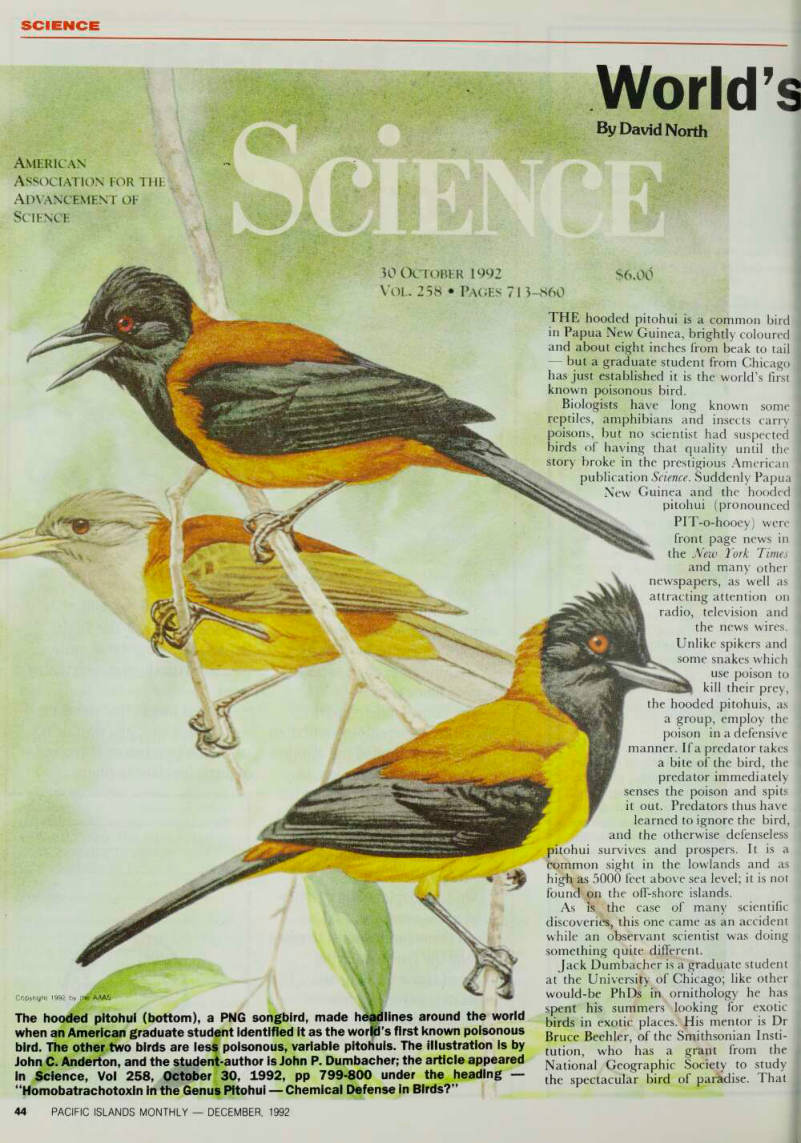
THE hooded pitohui is a common bird in Papua New Guinea, brightly coloured and about eight inches from beak to tail but a graduate student from Chicago has just established it is the world’s first known poisonous bird.
Biologists have long known some reptiles, amphibians and insects carry poisons, but no scientist had suspected birds of having that quality until the story broke in the prestigious American
publication Science. Suddenly Papua
New Guinea and the hooded pitohui (pronounced
PIT-o-hooey) were
front page news in the New York Times and many other v newspapers, as well as attracting attention on radio, television and the news wires.
Unlike spikcrs and some snakes which use poison to kill their prey, the hooded pitohuis, as a group, employ the poison in a defensive WB manner -l^ a predator takes a bite of the bird, the predator immediately f BF senses the poison and spits W it out. Predators thus have learned to ignore the bird, and the otherwise defenseless pitohui survives and prospers. It is a Cqmmon sight in the lowlands and as high as 5000 feet above sea level; it is not found on the off-shore islands.
As is the case of many scientific discoveries, this one came as an accident while an observant scientist was doing something quite different.
Jack Dumbacher is a graduate student at the University of Chicago; like other would-be PhDs in ornithology he has spent his summers looking for exotic birds in exotic places. His mentor is Dr Bruce Beehler, of the Smithsonian Insti tution, who has a grant from the National Geographic Society to study the spectacular bird of paradise. That
Copynght 1992 by the AAAS The hooded pitohui (bottom), a PNG songbird, made headlines around the world when an American graduate student identified It as the world’s first known poisonous bird. The other two birds are less poisonous, variable pitohuis. The illustration is by John C. Anderton, and the student-author is John P. Dumbacher; the article appeared in Science, Vol 258, October 30, 1992, pp 799-800 under the heading “Homobatrachotoxin in the Genus Pitohui Chemical Defense in Birds?”
study and others have taken Dr Beehler to Papua-New Guinea 14 times in recent years.
Working in PNG’s first national park, Varirata National Park, a 45-minute drive from downtown Port Moresby, Durnbaeher was busy trapping the bird of paradise. From time to time the nets caught hooded pitohui as well. Some times Dumbacher’s hands were scratched during these experiences, and he licked the blood from the cuts, finding, to his surprise, his mouth felt numb. At first he and his colleagues figured he had encountered a poisonous plant (and not being botanists had not pursued the matter.) Eventually, Durnbaeher sus pected the experience might have related to the pitohui, so he brought back to the US some feathers, skins, bones, muscle and internal organs of the little birds, all prepared as laboratory specimens.
All these items turned out to have poison in them, a neurotoxin which produces paralysed muscles, and if enough is injected in a mouse, quick death. The outer parts of the pitohui, however, the skins and particularly the feathers, were much more toxic than the inner parts of the bird as if the birds were sending out warning signals to would-be predators.
“How did this system work to protect the hooded pitohui?” Dr Beehler was asked. “Well, like so much in nature, it’s a messy system. Some pitohui die before predators know what they are doing, but usually the snakes and the raptors (birds of prey, like hawks) learn to leave the birds alone,” he replied.
He went on to say he thought, though he has never seen it in the wild, snakes lick what they eat before they kill it, and a snake licking a pitohui would get a taste of the poison and would slither off for other prey.
Further, and this may be one of the major secondary findings of this dis covery, it may well be the pitohui’s colourful plumage, with much strongly contrasting black and brick-orange, is not just designed to attract birds of the other sex, the traditional interpretation of bright colors in birds.
Maybe the reason for the colours is to let predators know here is a nasty mouthful so go bite something else! (All of this having been worked out over the aeons through a specialised form of evolution and of the survival of the fittest, or, in this case, the survival of the most
obviously poisonous.) Elsewhere in the animal kingdom there are brightly colored beasts laden with poison; there is the beautiful but toxic monarch butter fly, the coral snake, and in the jungles of South America, the brightly coloured poison-dart frog, so named because the indigenous population has long used a poison from the frog on the tips of the darts they shoot from their blow guns. (No one has yet reported a similar use, by the people of PNG, of the pitohui poison, but it is a large country and a question no one has researched.) The South American frog has some thing else in common with the hooded pitohui each carries the same poison which goes by the name of homobatrachotoxin; it appears no where else in the world. Scientists speculate the two creatures, so distant from each other both geographically and in the evol utionary scheme of things, must have independently arrived at the utility of the
poison.
As a matter of fact, the poison in the frog is much more concentrated than it is in the bird. There is a phenomenon in nature called “visual mimicry”. For example, there is the viceroy butterfly which looks very much like the monarch, while it is not poisonous to eat, predators do not know that, and the viceroy profits.
Something similar to that has occurred among the pitohui in PNG, according to Dumbach.
There are also the variable pitohui and the rusty pitohui, close cousins of the hooded pitohui, but with only a fraction of the latter’s poison. Many variable pitohui look very much like the hooded variety, and presumably are avoided by snakes and hawks as well.
Dumbach and Beehler are enthusiastic about the level of co-operation they have secured for their work in PNG. Both the government and the University of Papua New Guinea must endorse scientific expeditions, or they do not occur.
According to Beehler both lamo Ila, the ranking civil servant and secretary of the PNG Department of Environment and Conservation, and Dr lan Burrows, chair of the University’s Department of Bi ology, have been quite supportive of the bird of paradise and hooded pitohui studies.
Similarly, Durnbaeher spoke of the detailed assistance the ornithologists re ceived from two residents of the Kokoda region, Rodney Gaga and Michael
Lucas. Both gave the visitors detailed information on birds and plants, and were the first to identify the hooded pitohuis as “rubbish birds," i.e. those which should not be eaten.
Durnbaeher has also worked with residents of the East Sepik Province who had established, on traditionally-owned lands, their own nature preserve, the Mojirau Wild Life Arrea.
When an Asian-owned logging com pany started cutting down trees in the Wild Life Area, and the residents’ efforts to secure assistance from the PNG government came to naught, they en listed Dumbacher's help. He got some journalists in Port Moresby interested in the case, they poked around, and soon the illicit logging ended. Durnbaeher regarded his involvement in the matter as just a part of his relations with (he property owners.
On a different note the American
ornithologists, when asked, reported
their own brushes with crime in the bush.
A group of them were spending the night in Varirata Park; each was in his or her own tent, sound asleep. Ihe tents of two of the women were invaded by burglars; one of the women slept through it, and found later her camera and other valuables had been stolen. The other woke to find a strange man in her tent, screamed, and he ran away. Neither woman was touched by the burglars.
The research on the pitohui is far from complete, and much of it is now in the hands of scientists working in or near the field of medicine. They are curious about how the hooded pitohui (and the poison dart frog) manage to acquire the toxin do they generate it internally, or do they, through some chemical process, harvest it from their surroundings and then concentrate it in their bodies?
More importantly, how do they keep the poison from killing themselves?
Were scientists to know the answer to the last question, they probably could use the information to help treat arrhythmias (irregular heartbeats) in humans, and/or to develop reversible anesthetics, i.e. so that doctors could use drugs to move people both into and out of conscious ness.
And all because an American graduate student, with a habit of licking cuts on his hands in the PNG bush, stumbled on a scientific discovery. □