Tourism’s balancing act
p. 38 · Read in the full issue
Environment
By Martin Tiffany
Firstly, what is eco-tourism? That was one key question a conference at Auck land Univeristy in October, “Eco- Tourism Business in the Pacific Promoting a Sustainable Experience”, tried to answer. While many came up with similar explanations it was nature-based tourism which did not threaten the natural environment or culture there was no clear-cut expla nation.
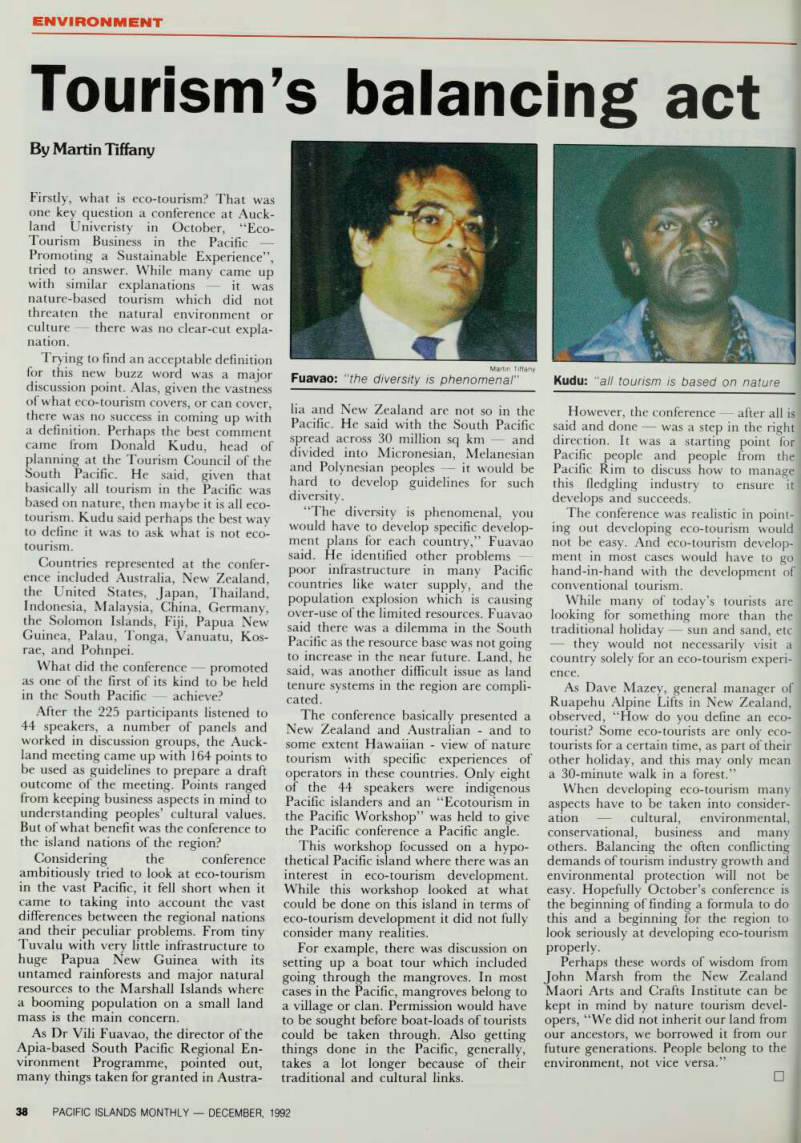
Trying to find an acceptable definition for this new buzz word was a major discussion point. Alas, given the vastness of what eco-tourism covers, or can cover, there was no success in coming up with a definition. Perhaps the best comment came from Donald Kudu, head of planning at the Tourism Council of the South Pacific. He said, given that basically all tourism in the Pacific was based on nature, then maybe it is all eco tourism. Kudu said perhaps the best way to define it was to ask what is not eco tourism.
Countries represented at the confer ence included Australia, New Zealand, the United States, Japan, Thailand,
Indonesia, Malaysia, China, Germany,
the Solomon Islands, Fiji, Papua New Guinea, Palau, Tonga, Vanuatu, Kos rae, and Pohnpei.
What did the conference promoted as one of the first of its kind to be held in the South Pacific achieve?
After the 225 participants listened to 44 speakers, a number of panels and worked in discussion groups, the Auck land meeting came up with 164 points to be used as guidelines to prepare a draft outcome of the meeting. Points ranged from keeping business aspects in mind to
understanding peoples’ cultural values.
But of what benefit was the conference to the island nations of the region?
Considering the conference ambitiously tried to look at eco-tourism in the vast Pacific, it fell short when it came to taking into account the vast differences between the regional nations and their peculiar problems. From tiny Tuvalu with very little infrastructure to huge Papua New Guinea with its untamed rainforests and major natural resources to the Marshall Islands where a booming population on a small land mass is the main concern.
As Dr Vili Fuavao, the director of the Apia-based South Pacific Regional En
vironment Programme, pointed out,
many things taken for granted in Austra-
lia and New Zealand are not so in the Pacific. He said with the South Pacific spread across 30 million sq km and divided into Micronesian, Melanesian and Polynesian peoples it would be hard to develop guidelines for such
diversity.
“The diversity is phenomenal, you would have to develop specific develop ment plans for each country,” Fuavao said. He identified other problems poor infrastructure in many Pacific countries like water supply, and the population explosion which is causing over-use of the limited resources. Fuavao said there was a dilemma in the South Pacific as the resource base was not going to increase in the near future. Land, he said, was another difficult issue as land tenure systems in the region are compli cated.
The conference basically presented a New Zealand and Australian - and to some extent Hawaiian - view of nature tourism with specific experiences of operators in these countries. Only eight of the 44 speakers were indigenous Pacific islanders and an “Ecotourism in the Pacific Workshop” was held to give the Pacific conference a Pacific angle.
This workshop focussed on a hypo thetical Pacific island where there was an interest in eco-tourism development.
While this workshop looked at what could be done on this island in terms of eco-tourism development it did not fully consider many realities.
For example, there was discussion on setting up a boat tour which included going through the mangroves. In most cases in the Pacific, mangroves belong to a village or clan. Permission would have to be sought before boat-loads of tourists could be taken through. Also getting things done in the Pacific, generally, takes a lot longer because of their traditional and cultural links.
However, the conference after all is said and done was a step in the right direction. It was a starting point for Pacific people and people from the Pacific Rim to discuss how to manage this fledgling industry to ensure it develops and succeeds.
The conference was realistic in point ing out developing eco-tourism would not be easy. And eco-tourism develop ment in most cases would have to go hand-in-hand with the development of conventional tourism.
While many of today’s tourists are looking for something more than the traditional holiday sun and sand, etc they would not necessarily visit a country solely for an eco-tourism experi ence.
As Dave Mazey, general manager of Ruapehu Alpine Lifts in New Zealand, observed, “How do you define an eco tourist? Some eco-tourists are only eco tourists for a certain time, as part of their other holiday, and this may only mean a 30-minute walk in a forest.”
When developing eco-tourism many aspects have to be taken into consider ation cultural, environmental, conservational, business and many others. Balancing the often conflicting demands of tourism industry growth and environmental protection will not be easy. Hopefully October’s conference is the beginning of finding a formula to do this and a beginning for the region to look seriously at developing eco-tourism properly.
Perhaps these words of wisdom from John Marsh from the New Zealand Maori Arts and Crafts Institute can be kept in mind by nature tourism devel opers, “We did not inherit our land from our ancestors, we borrowed it from our future generations. People belong to the environment, not vice versa,”
Martin Tiffany Fuavao: “the diversity is phenomenal"
Kudu: “all tourism is based on nature