All in the family
pp. 54-55 · Read in the full issue
Yachting
By Sally Andrew
WEATHERING a hurricane on land or at sea is scary. It’s not so much the wind and the incredible noise but the con fusion and danger when things go bump in the night. Cyclone Val hurled her fury at the two Samoas last December and yachts in Pago Pago harbour prepared themselves for the worst.
In the end it was not the wind but an errant 65-ton crane barge which wreaked the most havoc. The huge barge broke her mooring and drifted through the yacht anchorage. Wind shifts made
it impossible to an ticipate the path of destruction. The barge hit one boat, then dragged and rammed it into an other. Finally the barge broke loose and careened into the custom’s dock where it crushed three boats and damaged several others.
Yacht £orba, a Corando 34 from Southern Califor nia, was achored in Pago Pago when Cyclone Val hit.
Everything on deck was tied down but with the screaming winds J?obra sheared from side to side and was knocked down.
Owners Bill and Sarah Chase kept a vigilant watch but
at night you could see nothing. Their three children were anxious and scared, but £orba’s anchor held fast. Only when the situation deteriorated and the barge broke loose did the purse seiner Hornet 111 send out her skiff and retrieve the family.
Fortunately, the memory of a few wild days of wind during Cyclone Val is vastty overshadowed by the bigger thrill of sailing from one exotic port to another.
Nine-year-olds Etosha and Mika Chase love sailing, as does their father Bill and 11-year-old brother Zeke. The girls claim they never get seasick. “Only the first day there’s a good wind. If it’s flat calm there’s no reason to get sick.” With a
giggle they both simultaneously cry, “But mom prefers landfalls to passage making.”. They have had lots of slow passages and on the passage from Mexico to the Marquesas the girls learned the true name for the Horse Latitudes, “the DULL-drums”. Winds were non-J existent, the water glass-smooth, and only the homogeneous swells showed and sign of life. When becalmed, Etosha and Mika while away the time swimming mid-ocean, and reading and playing cards, checkers and chess. Mom breaks up the monotony of long passages with surprise gifts and celebrations for the family.
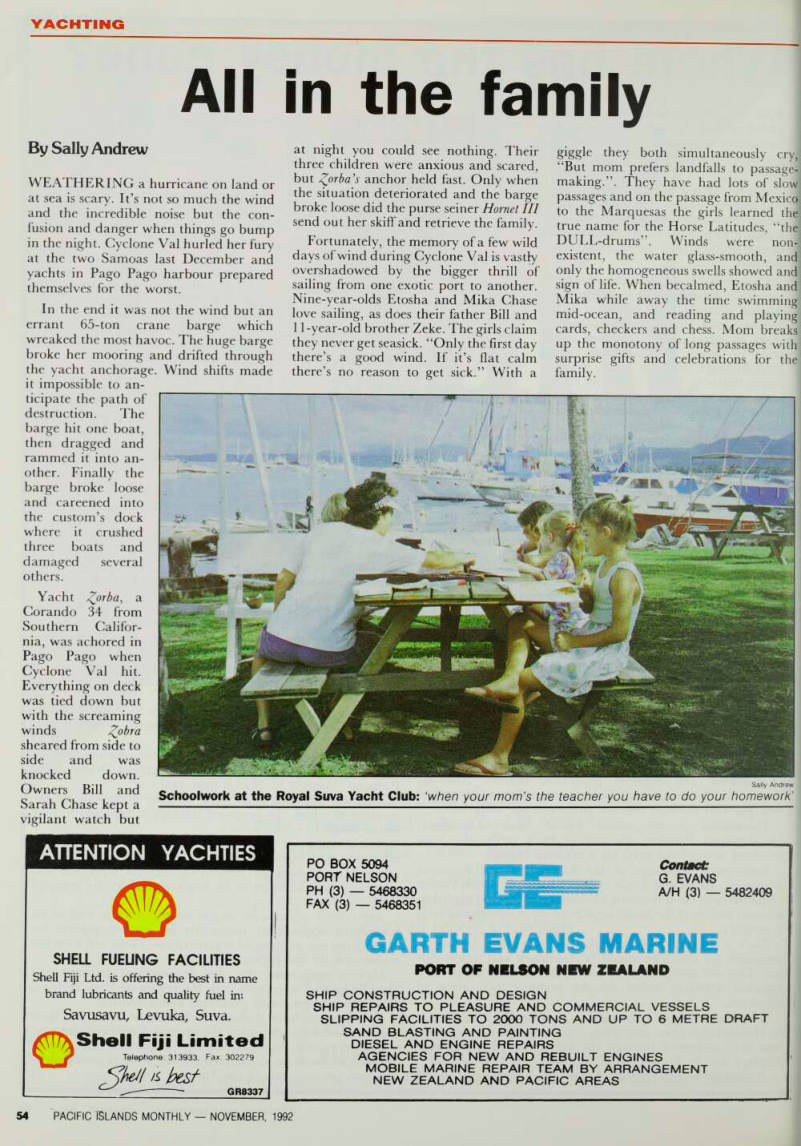
Sally Andrew Schoolwork at the Royal Suva Yacht Club: when your mom's the teacher you have to do your homework’
norkelling, shell-collecting and explor
g are favourite island activities and tosha and Mika remember all the good efs and caves they’ve discovered along ie way. In Vava’u, Tonga, they found e hidden underwater entrance into [ariner’s Cave and snorkeled inside here the sunlight shimmered on the alls of the cave. A magical fog came and cnt with the rise and fall of the ocean fell.
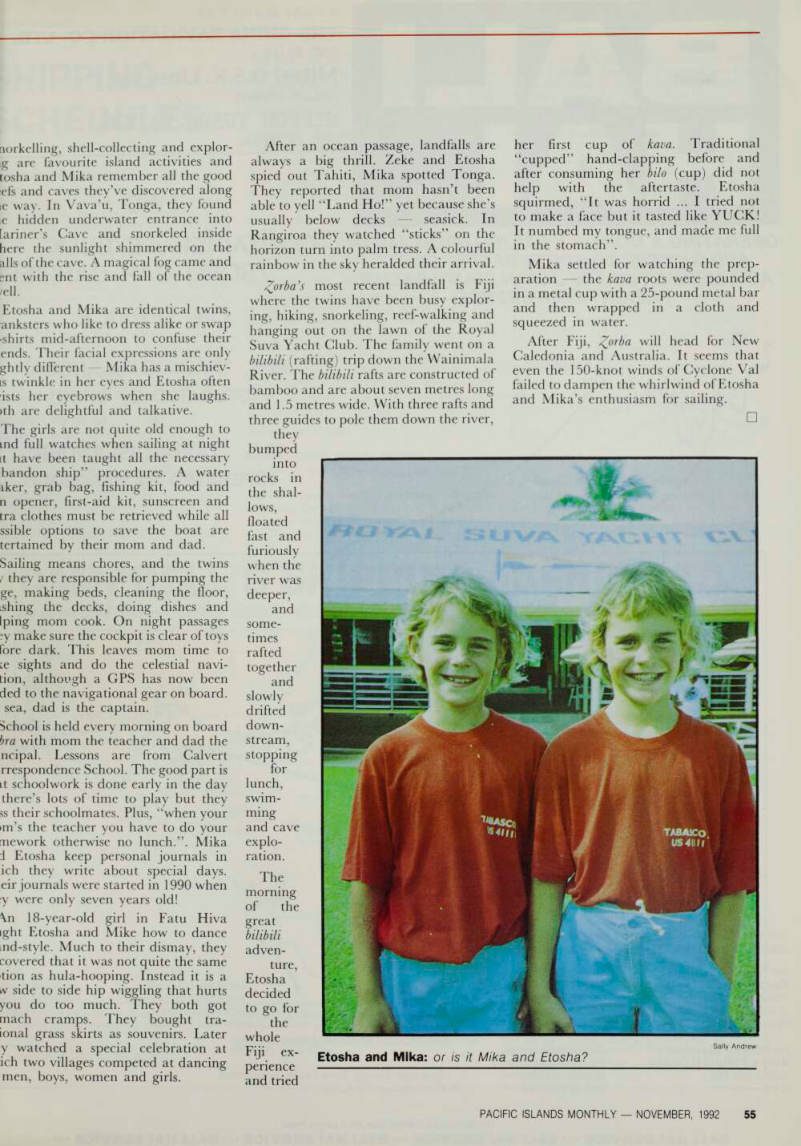
Etosha and Mika are identical twins, anksters who like to dress alike or swap ■shirts mid-afternoon to confuse their ends. Their facial expressions are only ghtly different Mika has a mischiev is twinkle in her eyes and Etosha often ists her eyebrows when she laughs. >th are delightful and talkative.
The girls are not quite old enough to md full watches when sailing at night it have been taught all the necessary bandon ship” procedures. A water iker, grab bag, fishing kit, food and n opener, first-aid kit, sunscreen and tra clothes must be retrieved while all ssible options to save the boat are tertained by their mom and dad.
Sailing means chores, and the twins i they are responsible for pumping the ge, making beds, cleaning the floor, ishing the decks, doing dishes and Iping mom cook. On night passages ly make sure the cockpit is clear of toys fore dark. This leaves mom time to :e sights and do the celestial navi tion, although a GPS has now been ded to the navigational gear on board, sea, dad is the captain.
School is held every morning on board bra with mom the teacher and dad the ncipal. Lessons are from Calvert rrespondence School. The good part is it schoolwork is done early in the day there’s lots of time to play but they >s their schoolmates. Plus, “when your •m’s the teacher you have to do your mework otherwise no lunch.”. Mika i Etosha keep personal journals in ich they write about special days, eir journals were started in 1990 when y were only seven years old! \n 18-year-old girl in Fatu Hiva ight Etosha and Mike how to dance
md-style. Much to their dismay, they
covered that it was not quite the same tion as hula-hooping. Instead it is a w side to side hip wiggling that hurts you do too much. They both got mach cramps. They bought tra ional grass skirts as souvenirs. Later y watched a special celebration at
ich two villages competed at dancing
men, boys, women and girls.
After an ocean passage, landfalls are always a big thrill. Zeke and Etosha spied out Tahiti, Mika spotted Tonga.
They reported that mom hasn’t been able to yell“ Land Ho!” yet because she’s usually below decks seasick. In Rangiroa they watched “sticks” on the horizon turn into palm tress. A colourful rainbow in the sky heralded their arrival. ? , , . . i^^ j ll f;;; /orbas most recent landtall is riji Z' . „ • , , , i i where the twins have been busy explor- ... , r ,i-i mg, hiking, snorkel.ng, reef-walking and hanging out on the lawn oi the Royal Suva Yacht Club. The family went on a bilibih (rafting) trip down the Wainimala River. The bilibili rafts are constructed of bamboo and are about seven metres long and 1.5 metres wide. With three rafts and three guides to pole them down the river,
they bumped into rocks in the shal lows, floated fast and furiously when the river was deeper, and some times rafted together and slowly drifted down stream, stopping for lunch, swim ming and cave
explo
ration.
The morning of the great bilibili adven ture, Etosha decided to go for the whole
Fiji ex
perience and tried
her first cup of kava. Traditional “cupped” hand-clapping before and after consuming her bilo (cup) did not help with the aftertaste. Etosha squirmed, “It was horrid ... I tried not to make a face but it tasted like YUCK!
It numbed my tongue, and made me full in the stomach”.
Mika settled for watching the prep aration the kava roots were pounded in a metal cup with a 25-pound metal bar and then wrapped in a cloth and squeezed in water.
After Fiji, £orba will head for New Caledonia and Australia. It seems that even the 150-knot winds of Cyclone Val failed to dampen the whirlwind of Etosha and Mika’s enthusiasm for sailing.
Sally Andrew
Etosha and Mika: or is it Mika and Etosha?