Taking them under her wing
p. 50 · Read in the full issue
Profile
By lan Williams
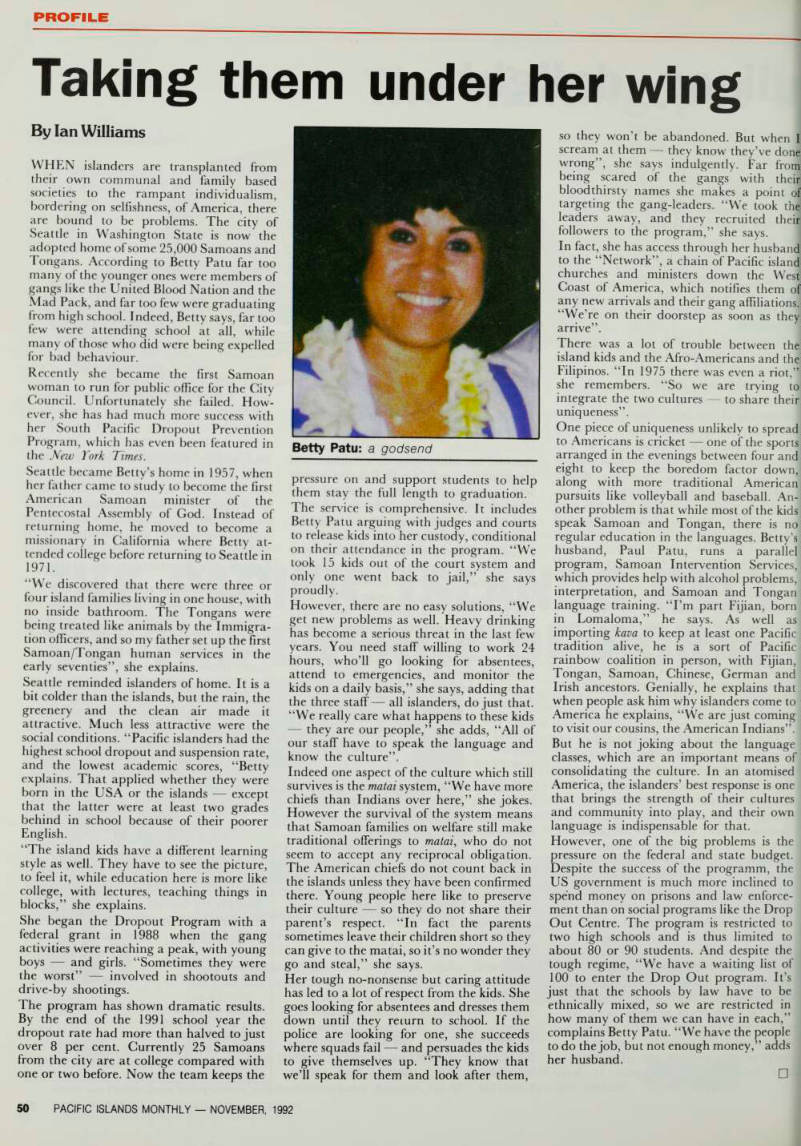
WHEN islanders are transplanted from their own communal and family based societies to the rampant individualism, bordering on selfishness, of America, there are bound to be problems. The city of Seattle in Washington State is now the adopted home of some 25,000 Samoans and Tongans. According to Betty Patu far too many of the younger ones were members of gangs like the United Blood Nation and the Mad Pack, and far too few were graduating from high school. Indeed, Betty says, far too few were attending school at all, while many of those who did were being expelled for bad behaviour.
Recently she became the first Samoan woman to run for public office for the City Council. Unfortunately she failed. How ever, she has had much more success with her South Pacific Dropout Prevention Program, which has even been featured in the New York Times.
Seattle became Betty’s home in 1957, when her father came to study to become the first American Samoan minister of the Pentecostal Assembly of God. Instead of returning home, he moved to become a missionary in California where Betty at tended college before returning to Seattle in 1971.
“We discovered that there were three or four island families living in one house, with no inside bathroom. The Tongans were being treated like animals by the Immigra tion officers, and so my father set up the first Samoan/Tongan human services in the early seventies”, she explains.
Seattle reminded islanders of home. It is a bit colder than the islands, but the rain, the greenery and the clean air made it attractive. Much less attractive were the social conditions. “Pacific islanders had the highest school dropout and suspension rate, and the lowest academic scores, “Betty explains. That applied whether they were born in the USA or the islands except that the latter were at least two grades behind in school because of their poorer English.
“The island kids have a different learning style as well. They have to see the picture, to feel it, while education here is more like college, with lectures, teaching things in blocks,” she explains.
She began the Dropout Program with a federal grant in 1988 when the gang activities were reaching a peak, with young boys and girls. “Sometimes they were the worst” involved in shootouts and
drive-by shootings.
The program has shown dramatic results.
By the end of the 1991 school year the dropout rate had more than halved to just over 8 per cent. Currently 25 Samoans from the city are at college compared with one or two before. Now the team keeps the
pressure on and support students to help them stay the full length to graduation.
The service is comprehensive. It includes Betty Patu arguing with judges and courts to release kids into her custody, conditional on their attendance in the program. “We took 15 kids out of the court system and only one went back to jail,” she says proudly.
However, there are no easy solutions, “We get new problems as well. Heavy drinking has become a serious threat in the last few years. You need staff willing to work 24 hours, who’ll go looking for absentees, attend to emergencies, and monitor the kids on a daily basis,” she says, adding that the three staff — all islanders, do just that.
“We really care what happens to these kids they are our people,” she adds, “All of our staff have to speak the language and know the culture”.
Indeed one aspect of the culture which still survives is the matai system, “We have more chiefs than Indians over here,” she jokes.
However the survival of the system means that Samoan families on welfare still make traditional offerings to matai, who do not seem to accept any reciprocal obligation.
The American chiefs do not count back in the islands unless they have been confirmed there. Young people here like to preserve their culture so they do not share their parent’s respect. “In fact the parents sometimes leave their children short so they can give to the matai, so it’s no wonder they go and steal,” she says.
Her tough no-nonsense but caring attitude has led to a lot of respect from the kids. She goes looking for absentees and dresses them down until they return to school. If the police are looking for one, she succeeds where squads fail and persuades the kids to give themselves up. “They know that we’ll speak for them and look after them,
so they won’t be abandoned. But when I scream at them they know they’ve done wrong”, she says indulgently. Far from being scared of the gangs with their bloodthirsty names she makes a point of targeting the gang-leaders. “We took the leaders away, and they recruited theirj followers to the program,” she says.
In fact, she has access through her husband to the “Network”, a chain of Pacific island churches and ministers down the West Coast of America, which notifies them of any new arrivals and their gang affiliations.
“We’re on their doorstep as soon as they arrive”.
There was a lot of trouble between the island kids and the Afro-Americans and the Filipinos. “In 1975 there was even a riot,”! she remembers. “So we are trying to integrate the two cultures to share their uniqueness”.
One piece of uniqueness unlikely to spread to Americans is cricket one of the sports arranged in the evenings between four and eight to keep the boredom factor down, along with more traditional American pursuits like volleyball and baseball. An other problem is that while most of the kids speak Samoan and Tongan, there is no regular education in the languages. Betty’s husband, Paul Patu, runs a parallel program, Samoan Intervention Services, which provides help with alcohol problems, interpretation, and Samoan and Tongan language training. “I’m part Fijian, born in Lomaloma,” he says. As well as importing kava to keep at least one Pacific tradition alive, he is a sort of Pacific rainbow coalition in person, with Fijian, Tongan, Samoan, Chinese, German and Irish ancestors. Genially, he explains that when people ask him why islanders come to America he explains, “We are just coming to visit our cousins, the American Indians”.
But he is not joking about the language classes, which are an important means of consolidating the culture. In an atomised America, the islanders’ best response is one that brings the strength of their cultures and community into play, and their own language is indispensable for that.
However, one of the big problems is the pressure on the federal and state budget.
Despite the success of the programm, the US government is much more inclined to spend money on prisons and law enforce ment than on social programs like the Drop Out Centre. The program is restricted to two high schools and is thus limited to about 80 or 90 students. And despite the tough regime, “We have a waiting list of 100 to enter the Drop Out program. It’s just that the schools by law have to be ethnically mixed, so we are restricted in how many of them we can have in each,” complains Betty Patu. “We have the people to do the job, but not enough money,” adds her husband.
Betty Patu: a godsend