Lasting impressions
p. 47 · Read in the full issue
Fashion
By George Matai
WESTERN SAMOA’S Puletasi of the ear Designers Award in August took a lifferent turn when the organisers urprisingly threw in an act seen for the irst time by Samoan people.
The showcase, which preceded the nnual revelation of new designs and olours, was put together and sanctioned ►y Aiono Dr Fannafi Le Tagaloa, Tofessor of Samoan Studies at the National Univeristy of Samoa.
Aiono wrote a script to go with the ramatisation of how Samoans dressed in ire-missionary days, after the arrival of be misionaries, the influence lissionaries brought to local wear and ow the puletasi (two-piece sarong and Dp) had evolved over the centuries.
The pre-missionary era bracket oasted outfits made of leaves, animal cm, mats; followed by wedding wear, mbrella-type capes and the dress of the umaga, men who sat around the tanoa uring the ava (kava) ceremonies.
This was followed by a brief illus ation of how missionaries and their ives dressed against the backdrop of the
amoan matai (titled Samoans).
Patrons at this stage could clearly isualise what was to follow - the /olution of the traditional Samoan detasi.
It was evident the lavalava had main lined its stability over the years despite
le continuing influence of
esternisation.
Cleverly tapering into the puletasi of ic 1920 s to the 1950 s category, the stage as now set for a grand show of the
contemporary designs of the present century.
Model Pania Schwenke then projected into the future with an outfit showing how tastes could match dress sense of the space age.
Twenty-three young local designers then took over the stage for what turned out to be a panorama of styles, colour and taste.
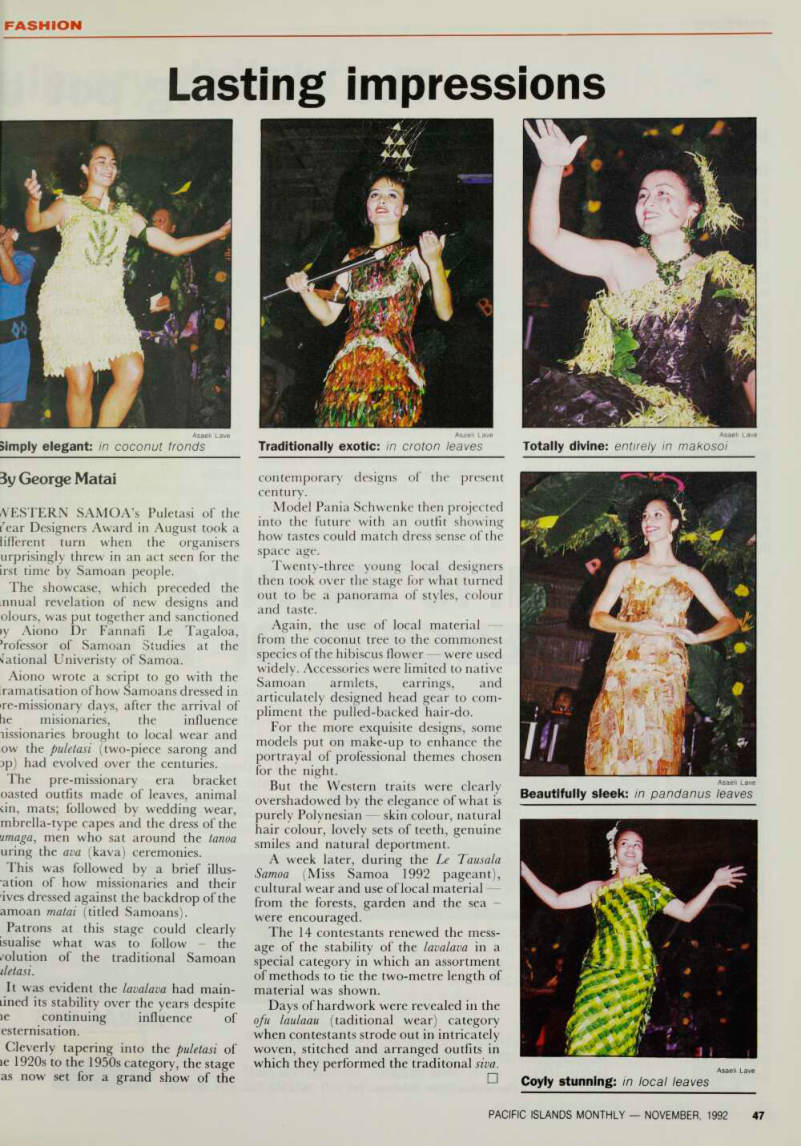
Again, the use of local material from the coconut tree to the commonest species of the hibiscus flower were used widely. Accessories were limited to native Samoan armlets, earrings, and articulately designed head gear to com pliment the pulled-backed hair-do.
For the more exquisite designs, some models put on make-up to enhance the portrayal of professional themes chosen for the night.
But the Western traits were clearly overshadowed by the elegance of what is purely Polynesian skin colour, natural hair colour, lovely sets of teeth, genuine smiles and natural deportment.
A week later, during the Le Tausala Samoa (Miss Samoa 1992 pageant), cultural wear and use of local material from the forests, garden and the sea -
were encouraged.
The 14 contestants renewed the mess age of the stability of the lavalava in a special category in which an assortment of methods to tie the two-metre length of material was shown.
Days of hardwork were revealed in the ofu laulaau (taditional wear) category when contestants strode out in intricately woven, stitched and arranged outfits in which they performed the traditonal siva.
Asaeli Lave Simply elegant: in coconut fronds
Asaeli Lave Traditionally exotic: in croton leaves
Asaeli Lave Totally divine: entirely in makosoi
Asaeli Lave Beautifully sleek: in pandanus leaves
Asaell Lave Coyly stunning: in local leaves