The power of knowledge
pp. 40-41 · Read in the full issue
Education
By Debbie Singh
Fiji’s Education Minister, Tania Vakatale, speaks on the shortcomings of the system
Fiji’s education system is too academic and examination oriented, with teachers constantly under pressure to complete syllabuses and students being denied personally enriching subjects in the process, says the Fiji’s education minis ter, Taufa Vakatale.
“Non examinable subjects like re ligious teaching, literature, drama, cul
ture and physical education are swapped in favour of physics, chemistry and biology, and teachers don’t digress when teaching these,” she says.
“So when an opportunity crops up and we need to stress values we don’t. For instance, teachers could spend a period
on male-female stereotyping in or social science classes, but they don’t pick up opportunities to digress.
“I find it very disturbing that if secondary school students miss a math-] ematics or physics class, they use a physical education class to make up for it. They shouldn’t be doing this but if stems from the fact that we have become very examination conscious and as a result, very narrow-minded”, Vakatale says.
“So our children have become com petitive in a very negative way and schools are competing with other schools for 100 per cent pass rates (in exams),” she says.
“But I don’t see education as a means of getting jobs I see it as a means of preparing a child to cope with life and, perhaps this is a rather radical thing for| one to be thinking of, especially as minister for education. But I’m not too| worried if we teach subjects in schools! that are irrelevant to the employment market”.
“Teachers are not worried about the full development of the child or whether 1 they have been enriched by other things.
“For instance, most Fiji schools gear students toward scoring high marks in subjects such as economics, accounting, mathematics and english, thus narrow ing them into taking the barest minimum subjects,” Vakatale says.
“We need to have more core require ments like arts students taking science subjects and vice-versa”.
Vakatale says the only way the system can be improved is by cutting the link between employment and what is ■ achieved via a certificate in schools. She recommends employers put prospective applicants through aptitude tests before interviewing them and then look at their examination results. “For instance, why should a care-taker need to have a pass I in english in the Fiji School Leaving Certificate examination? I think all he needs is to be vigilant, have a strong body, be awake at night and in good health. Why should a pass in english be a qualifying thing?” Vakatale asks.
She says only when this link is cut, can schools relax and treat an examination pass as just a pass and not judge it on the merit of its grades.
“Why should we look at marks? They j have their certificate and that’s it”, she j says.
“They’ll need their marks if they decide to go to university but they don’t
need their marks to get a job. Some leople might say, it’s all very well for her she’s already got her degree and is low minister for education. Okay, I iccept that. But I look at my own family :00. I go back and see my family in the dllage and they have never got out of the
ut of living in he village and ust going up to :lass 6, or even :lass 4. So hey’ve given up he whole idea of
;ver progressing
n that way,” he says.
Vakatale goes m to say that chools do not ;quip leavers for vork and their
knowledge of
he workforce is
gained after
ecuring jobs. >he says school eavers should
>e taught work
thics to enable hem to respect ill kinds of
vork, discipline and work conduct.
“I think school curriculums are trying o prepare and adapt to the school ystems’ desire to get students to pass xams, but in practice, this is not elevant.
“Often subjects are dished out to tudents just to sit exams and these are ill forgotten when students pass their Fiji ichool Leaving Certificate or Form 7 xams,” she says.
“While the curriculum is relevant to he job market, it is only good for those ;oing on to university and tertiary nstitutions. Those who drop out and nter the work system are hopeless. And t’s not their fault, it’s the fault of the >arents and the school system,” Vakatale ays.
“The content is there but the way this s communicated to the students and the vay they absorb it, is not there. And igain, I go back to the weakness of the ystem, which is the fact that it is too xamination oriented,” she says.
“But schools can be recognised for »ther things such as boasting a good hoir or good sports or cultural teams.”
Vakatale, who attended the country’s op Fijian girls school says, “Adi Cako >au School takes the cream of the Fijian
girls. “And these girls can afford to have their time filled up with other things and still pass their exams because they’re boarding as well.
“They used to be very good at sports but now only excel in athletics and
that’s because it’s big show. They refrain from sports like hockey, netball and table tennis or other little sports not for big audiences,” she says.
“Compulsory education is also one of my plans and I’d like to do this because education might not be a priority for some survival might be. With large families in Fiji the eldest child, usually a girl, stays at home for economic reasons to mind the children, while both parents go out to work.
“She is deprived of education in the process. So legislation for compulsory education might be the answer, as very often those we want to help are in a lower economic bracket and have many more children,” Vakatale says.
The minister says her ministry has thrown the idea of compulsory education around for some time and has found it is what the majority of the people want.
Vakatale also has plans to strengthen kindergartens and reduce the school entry age from its current six years to five.
“I would also like to see more teachers in classrooms and achieve one teacher per class, rather than work on the current teacher/pupil ratio,” she says.
“I also want to introduce more moral
and values education into schools as teachers have lost confidence in teaching something that can be subjective. So I have ordered about 200 copies of a book on moral education in India for our (142) secondary schools and the exercises are very simple and relevant to our
country. Anyone can use the book irres pective of race or religion,” she says.
Vakatale, who was national President of the Fiji Young Women’s Christian Association during the 1970 s and is the
country’s only
woman cabinet min ister says more em phasis should be placed on education
for girls.
“And we must not just concentrate on carpentry and engin eering, we must also train girls who want to go into traditional female jobs like home economics, textiles and craft.
“So, if a girl decides she wants to take up sewing, she should be trained in professional tailoring, or food technology should she decide on home economics as a career emphasis should be placed on more sophisticated things like these,” she says.
“The current Fiji Institute of Tech nology caters mainly for boys and I would like to see some institutions that include girls as well. Girls should be taught fish, prawn and poultry farming or light engineering and motor repair work.
“We must go out of our way to recruit women. For instance, if there is an intake of 30 people, then 10 of them should be women. And boys should be included in cooking and food technology classes as well,” Vakatale says.
So, while our education system is relevant, we need to create more blue collared jobs and teach people to be more self-sufficient and self-employed. The trouble lies in society’s perception of blue-collared jobs as being inferior to white-collared ones. Maybe our edu cators would stop trying to prepare students for the job market and concen trate more on making them good Fiji citizens.
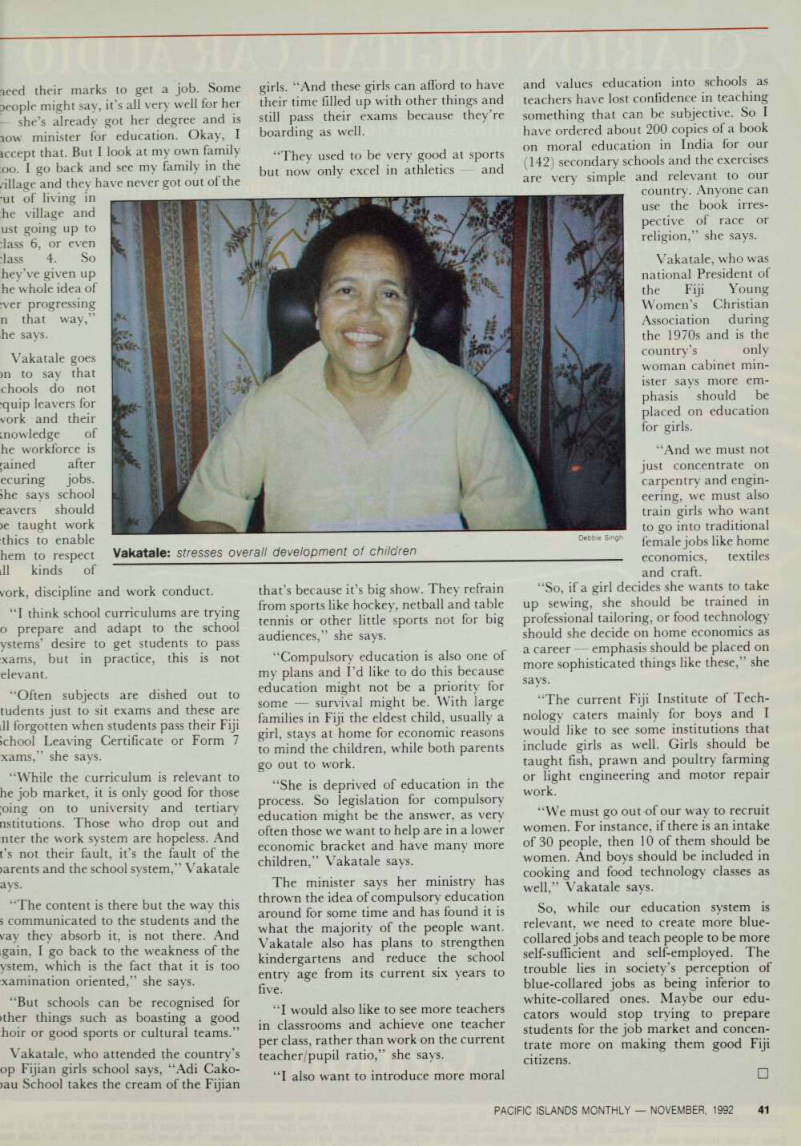
Vakatale: stresses overall development of children