No end to PNG-Solomo slands border problems
pp. 6-7 · Read in the full issue
Bougainville
By Wally Hiambohn
PAPUA NEW GUINEA’S deputy Prime Minister Sir Julius Chan while attending a meeting of World Bank and Interna tional Monetary Fund governors in New York in late September decided he should also drop in for a “chat” with the United Nations Security Council Presi dent Dr Jose Ayala Lasso and its members.
Sir Julius took the opportunity to brief Lasso on the Bougainville situation, including the recent incident in which PNG troops crossed over into neighbour ing Solomon Islands and allegedly killed two people, shot an child and abducted a man.
A Soloman Islands delegation had also been present in New York to take the issue to the Security Council, and to seek a UN intervention in addressing the Bougainville crisis and its spill-over effects into their country.
After consulting both sides Lasso announced the Security Council had decided the two countries should resolve the matter between themselves and that there was no need for UN intervention.
Sir Julius happily reported back that he was successful in persuading Lasso’s council that PNG had taken swift action to resolve the dispute.
“I told them (members of the council) that the incident happened; that we were very quick to reconcile all the issues raised by the Solomons government and I didn’t see any need for the Solomons to prematurely ask for UN intervention at this time,” Sir Julius told reporters when he returned to PNG on October 3.
He said he told the council the PNG
government intended to put those mem bers of the security force involved through the legal process and that PNG was prepared to pay compensation for damages done.
“I'm so happy the UN has responded favourably to our presentaton and I think that is all we can do at this point,” he said.
While the two sides ponder one bitterly and the other with regret over the incident and seek dialogue, one
pertinent question remains.
Could this incident and many others over the past four years been avoided or minimised?
Since 1989, officials of both sides have had numerous discussions on how to deal with the spill over effects. A key consideration was for a boarder surveil lance leading to a Memorandum of Understanding being signed in 1990 for this surveillance.
Under this MOU Solomon Islands was responsible for the provision of one patrol boat; the cost and manning of all necessary logistical and administrative support to the program from the Sol omon Islands side; the establishment of a surveillance centre and staff; and the provision of backup liaison between the two surveillance centres of both countries.
The government of PNG on the other hand was to be responsible for the provision of boats and crew for surveil lance purposes as agreed, within an
agreed area of operation; the provision
and manning of surveillance centre to be located in an appropriate location; the cost of administering the program for the PNG side; and taking necessary actions
on any other issues related to the program from time to time.
Although the idea of a joint operation has not been fully supported by thej Solomon Islands on legal grounds, it claims its has, since the MOU, markedly; improved its presence along the border, both in terms of the personnel and the
regularity of the patrols.
It says that while it had been willing] to co-operate, its major constraints have been its inability to sustain the cost or operation indefinitely and its inability to
effectively police the extensive boundary.]
It further claims that it had observed PNG had also not fulfilled its obligations under the MOU.
“It has never been able to command a presence on the border. This failure has! led to the situation on the border to deteriorate and to cause the BRA
(Bougainville Revolutionary Army) el-j
ements and others to move freely into!
Solomon Islands territory,” the governs ment claimed in a recent document.
“In our view these violations havej
been completely ignored by the Namaliuj
government,” it said. “It protested to|
Solomon Islands government against matters such as the illegal BRA office in Honiara and the presence of Miriori in the Solomon Islands but sees little or nol sensitivity in these violations.
The report concluded, “The effects of Bougainville have already been ad-1 versely felt in the Solomon Islands. It is in the interest of the Solomon Islands to co-operate with and be helpful to PNG] in finding a lasting peaceful solution' . I PNG however, secs things differently.
It says it has kept its part of the bargain and maintained regular naval patrols using its part of the bargain.
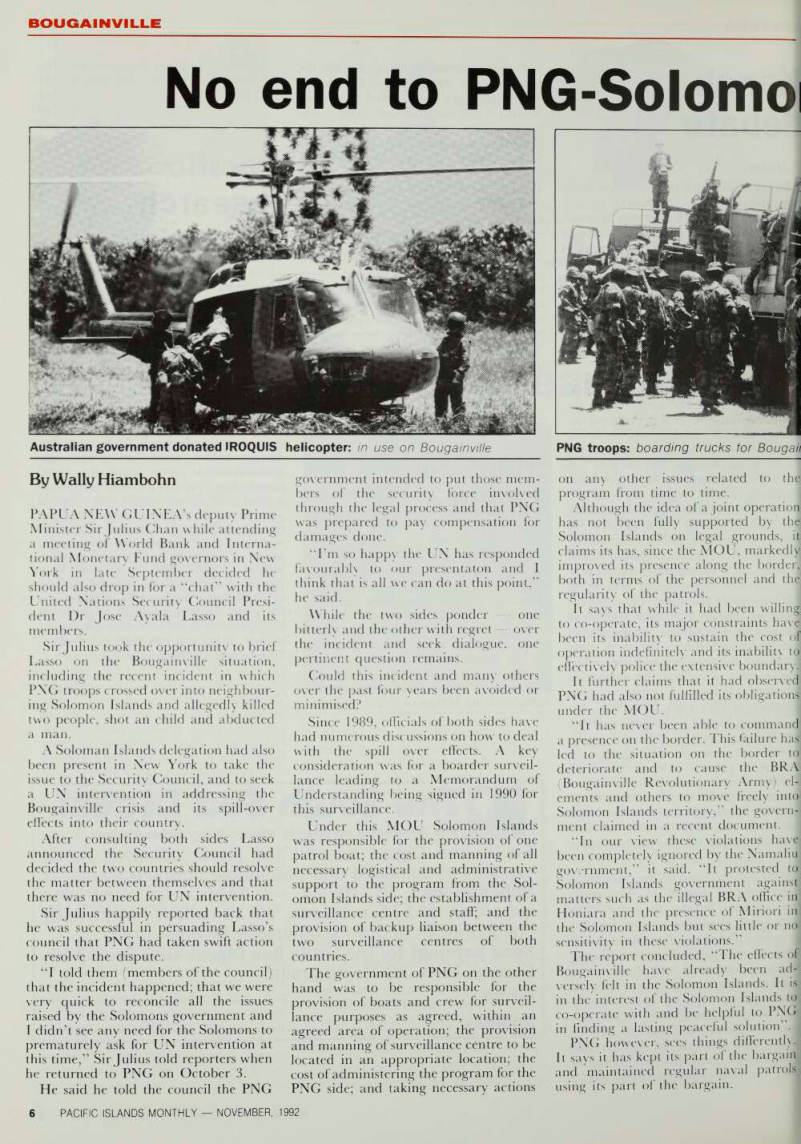
Australian government donated IROQUIS helicopter: in use on Bougainville
PNG troops: boarding trucks for Bougaii
This it says has been evident in ecurity forces apprehending illegal :rossers, even pursuing rebels who flee icross the border to hide.
Islands in the Shortland Group were >eing used as bases to conduct militant ictivities against security forces without
he Solomon Islands doing anything
bout it.
The Solomon Islands government’s pproval of a Bougainville Revolution ry Army office in Honiara, granting of olomon Islands visas to leaders of the “cessionist movement, and the repeated se of its territory by foreigners as an
ntry point to illegally enter Bougainville
ave also upset Port Moresby.
Sentiments this week by Opposition ;ader Sir Michael Somare, who had a )t to do with the Bougainville issue when i government, would sum up the PNG osition.
He said the tendancy by Solomon >lands to give “support and recog ition” to the Bougainville Revolution ry Army was at the root of the on-going roblems between the two countries.
“BRA offices have been opened in the ilomon Islands, and BRA sympathisers id quasi-officials such as Bishop John ale and Martin Miriori, have been anted visas by Solomons governments hile they are clearly citizens of Papua ew Guinea,” Sir Michael said.
“Had these doubtless well-meaning 'tions not taken place, and had Sol non Islands turned its back on this
PNG domestic issue, troops would not have played such an active part on and around the border areas between our two nations.”
“Two adjoining nations must have total respect for each other’s sovereignity and it is the Solomons who first put that respect in jeopardy, by their attitude towards the BRA.”
The new Wingti government should also shoulder some blame.
Since taking office on July 17, it has not announced its policies on Bougain ville thus leaving people, more so the security force, ignored and frustrated.
Government officials have said, since Wingti’s first move last month to patch up relations with the Solomons, there had been no follow-up to initiatives he and Mamaloni agreed to at an extraord inary meeting of the Melanesian Spear head Group in Port Vila, Vanuatu.
Known as the Vila Statement, officials at both political and bureaucratic levels were to meet regularly to define and put in place measures to address the spill over effects.
Known as the Vila Statement, it was based on the two countries resolve to; Work together and in accordance with Melanesian traditions and shared inter ests to speedily and amicably address the spill-over effects of the crisis.
The Vila Statement was based on the two countries’ resolve to —
• Work together and in accordance with Melanesian traditions and shared interests to speedily and amicably ad dress the spill-ver effects of the crisis; • Recognise that the historical, cultural and human interactions of the two countries’ citizens would continue to be an important consideration in resolving issues which affect both countries; • Adopt a comprehensive and mutually agreed approach to effectively deal with the crisis on Bougainville in as far as the crisis affects both countries’ national interests; and • Reaffirm their government’s view that the Bougainville crisis is an internal matter for PNG to resolve given the constitutional, moral and human dimen sions associated with the crisis.
Officials of both countries were to have met soon after this statement to further pursue areas of co-operation but have not done so.
According to one PNG official, while bureaucrats were keen to keep the ball rolling following the success of the Vanuatu trip, political direction was to “go slow and take it as it comes”.
In fact Wingti personally said when he first took office as prime minister, the Bougainville issue was a complex one and he was in no hurry to address it.
The Wingti government intends to spell out its policies on Bougainville in the November session of Parliament.
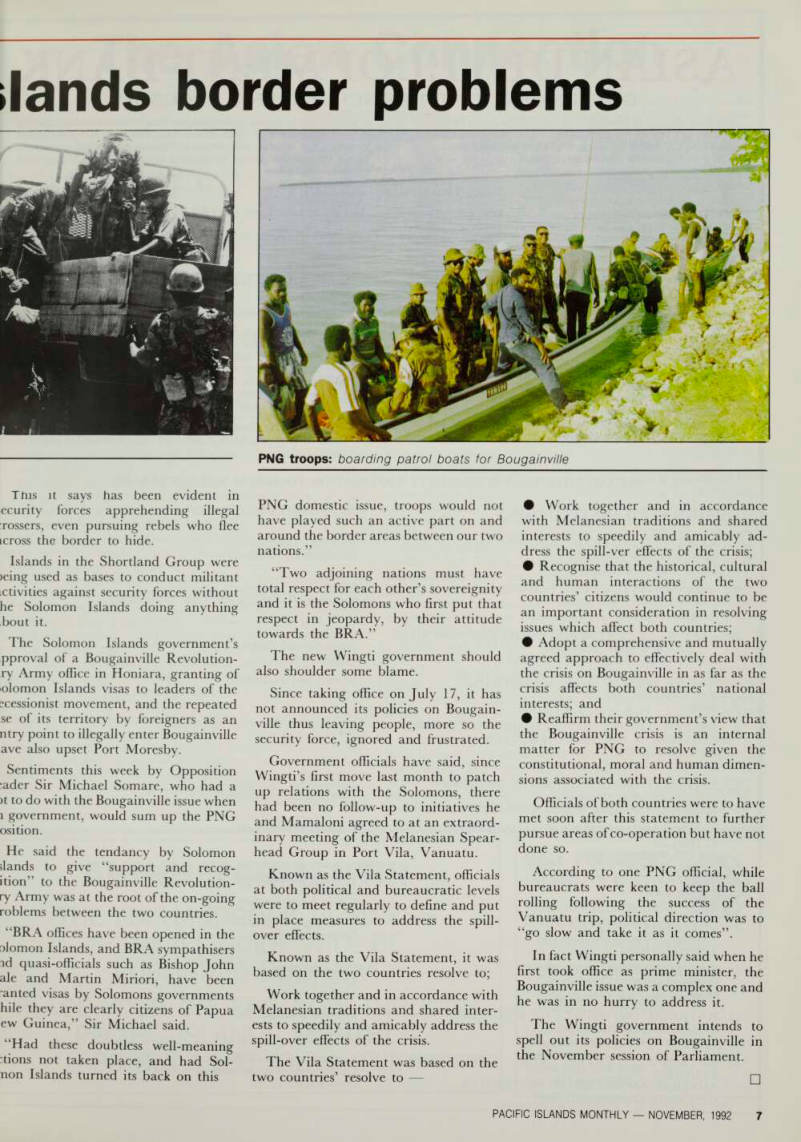
PNG troops: boarding patrol boats for Bougainville