Of schools and learning
From The Editor’S Desk
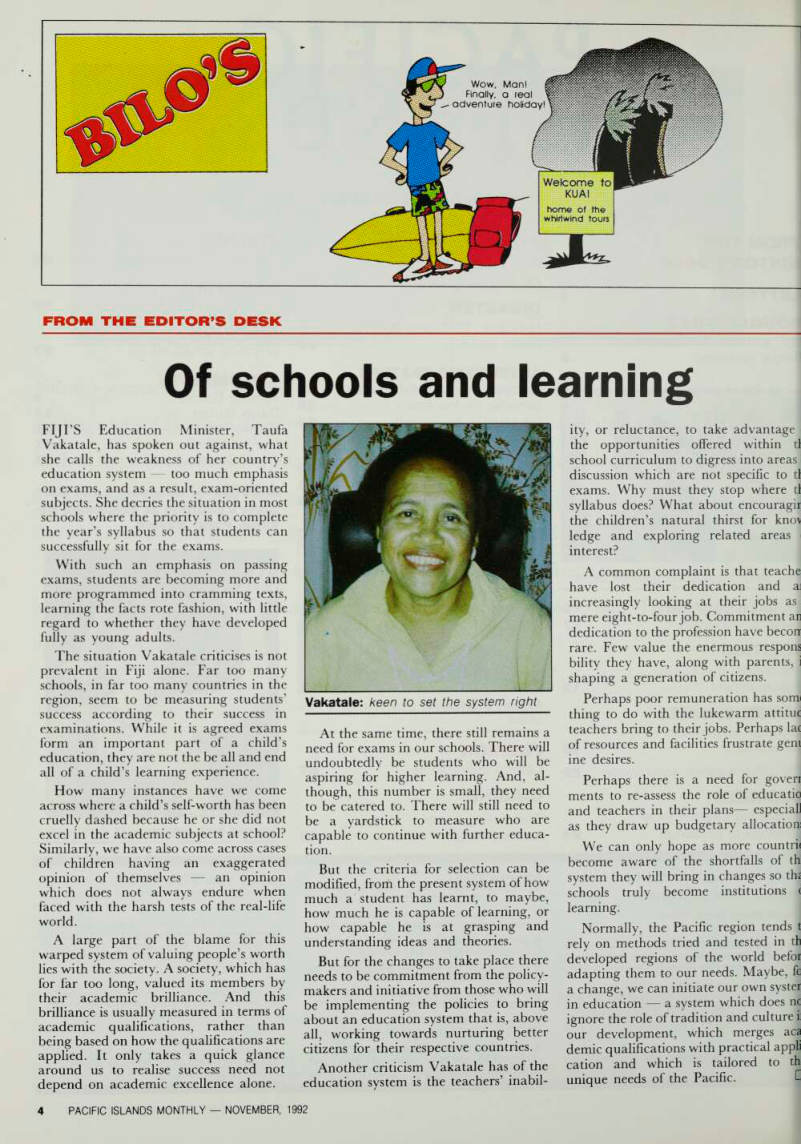
FIJI’S Education Minister, Taufa Vakatale, has spoken out against, what she calls the weakness of her country’s education system too much emphasis on exams, and as a result, exam-oriented subjects. She decries the situation in most schools where the priority is to complete the year’s syllabus so that students can successfully sit for the exams.
With such an emphasis on passing exams, students are becoming more and more programmed into cramming texts, learning the facts rote fashion, with little regard to whether they have developed fully as young adults.
The situation Vakatale criticises is not prevalent in Fiji alone. Far too many schools, in far too many countries in the region, seem to be measuring students’ success according to their success in examinations. While it is agreed exams form an important part of a child’s education, they are not the be all and end all of a child’s learning experience.
How many instances have we come across where a child’s self-worth has been cruelly dashed because he or she did not excel in the academic subjects at school?
Similarly, we have also come across cases of children having an exaggerated opinion of themselves an opinion which does not always endure when faced with the harsh tests of the real-life world.
A large part of the blame for this warped system of valuing people’s worth lies with the society. A society, which has for far too long, valued its members by their academic brilliance. And this brilliance is usually measured in terms of academic qualifications, rather than being based on how the qualifications are applied. It only takes a quick glance around us to realise success need not depend on academic excellence alone.
At the same time, there still remains a need for exams in our schools. There will undoubtedly be students who will be aspiring for higher learning. And, al though, this number is small, they need to be catered to. There will still need to be a yardstick to measure who are capable to continue with further educa tion.
But the criteria for selection can be modified, from the present system of how much a student has learnt, to maybe, how much he is capable of learning, or how capable he is at grasping and understanding ideas and theories.
But for the changes to take place there needs to be commitment from the policy makers and initiative from those who will be implementing the policies to bring about an education system that is, above all, working towards nurturing better citizens for their respective countries.
Another criticism Vakatale has of the education system is the teachers’ inabil
ity, or reluctance, to take advantage i the opportunities offered within tl school curriculum to digress into areas i discussion which are not specific to tl exams. Why must they stop where tl syllabus does? What about encouragir the children’s natural thirst for knov ledge and exploring related areas i interest?
A common complaint is that teache have lost their dedication and ai increasingly looking at their jobs as mere eight-to-four job. Commitment an dedication to the profession have becorr rare. Few value the enermous respons bility they have, along with parents, i shaping a generation of citizens.
Perhaps poor remuneration has somi thing to do with the lukewarm attituc teachers bring to their jobs. Perhaps lac of resources and facilities frustrate gem ine desires.
Perhaps there is a need for goverr ments to re-assess the role of educatio and teachers in their plans — especial! as they draw up budgetary allocation!
We can only hope as more countrk become aware of the shortfalls of th system they will bring in changes so th? schools truly become institutions ( learning.
Normally, the Pacific region tends t rely on methods tried and tested in th developed regions of the world befor adapting them to our needs. Maybe, fo a change, we can initiate our own syster in education a system which does nc ignore the role of tradition and culture ii our development, which merges aca
demic qualifications with practical appli
cation and which is tailored to th unique needs of the Pacific.
Vakatale: Keen to set the system right