Nauru vs Australia: Round One
p. 48 · Read in the full issue
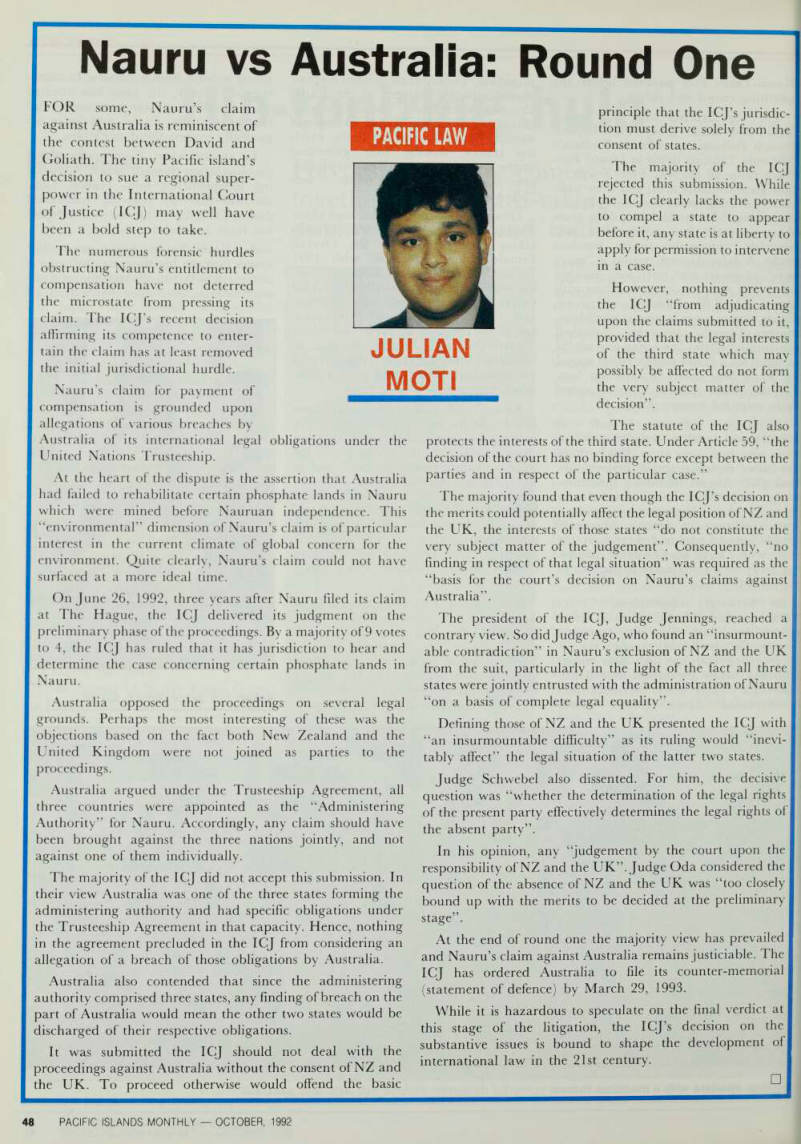
FOR some, Nauru’s claim against Australia is reminiscent of the contest between David and Goliath. The tiny Pacific island’s decision to sue a regional super power in the International Court of Justice (ICJ) may well have been a bold step to take.
The numerous forensic hurdles obstructing Nauru’s entitlement to compensation have not deterred the microstate from pressing its claim. The ICJ’s recent decision affirming its competence to enter tain the claim has at least removed the initial jurisdictional hurdle.
Nauru’s claim for payment of compensation is grounded upon allegations of various breaches by
Australia of its international legal obligations under the United Nations Trusteeship.
At the heart of the dispute is the assertion that Australia had failed to rehabilitate certain phosphate lands in Nauru which were mined before Nauruan independence. This “environmental” dimension of Nauru’s claim is of particular interest in the current climate of global concern for the environment. Quite clearly, Nauru’s claim could not have surfaced at a more ideal time.
On June 26, 1992, three years after Nauru filed its claim at The Hague, the ICJ delivered its judgment on the preliminary phase of the proceedings. By a majority of 9 votes to 4, the ICJ has ruled that it has jurisdiction to hear and determine the case concerning certain phosphate lands in Nauru.
Australia opposed the proceedings on several legal grounds. Perhaps the most interesting of these was the objections based on the fact both New Zealand and the United Kingdom were not joined as parties to the
proceedings.
Australia argued under the Trusteeship Agreement, all three countries were appointed as the “Administering Authority” for Nauru. Accordingly, any claim should have been brought against the three nations jointly, and not against one of them individually.
The majority of the ICJ did not accept this submission. In their view Australia was one of the three states forming the administering authority and had specific obligations under the Trusteeship Agreement in that capacity. Hence, nothing in the agreement precluded in the ICJ from considering an allegation of a breach of those obligations by Australia.
Australia also contended that since the administering authority comprised three states, any finding of breach on the part of Australia would mean the other two states would be discharged of their respective obligations.
It was submitted the ICJ should not deal with the proceedings against Australia without the consent of NZ and the UK. To proceed otherwise would offend the basic
principle that the ICJ’s jurisdic tion must derive solely from the consent of states.
The majority of the ICJ rejected this submission. While the ICJ clearly lacks the power to compel a state to appear before it, any state is at liberty to apply for permission to intervene in a case.
However, nothing prevents the ICJ “from adjudicating upon the claims submitted to it, provided that the legal interests of the third state which may possibly be affected do not form the very subject matter of the decision”.
The statute of the ICJ also
protects the interests of the third state. Under Article 59, “the decision of the court has no binding force except between the parties and in respect of the particular case.”
The majority found that even though the ICJ’s decision on the merits could potentially affect the legal position of NZ and the UK, the interests of those states “do not constitute the very subject matter of the judgement”. Consequently, “no finding in respect of that legal situation” was required as the “basis for the court’s decision on Nauru’s claims against Australia”.
The president of the ICJ, Judge Jennings, reached a contrary view. So did Judge Ago, who found an “insurmount able contradiction” in Nauru’s exclusion of NZ and the UK from the suit, particularly in the light of the fact all three states were jointly entrusted with the administration of Nauru “on a basis of complete legal equality”.
Defining those of NZ and the UK presented the ICJ with “an insurmountable difficulty” as its ruling would “inevi tably affect” the legal situation of the latter two states.
Judge Schwebel also dissented. For him, the decisive question was “whether the determination of the legal rights of the present party effectively determines the legal rights of the absent party”.
In his opinion, any “judgement by the court upon the responsibility ofNZ and the UK”. Judge Oda considered the question of the absence of NZ and the UK was “too closely bound up with the merits to be decided at the preliminary stage”.
At the end of round one the majority view has prevailed and Nauru’s claim against Australia remains justiciable. The ICJ has ordered Australia to file its counter-memorial (statement of defence) by March 29, 1993.
While it is hazardous to speculate on the final verdict at this stage of the litigation, the ICJ’s decision on the substantive issues is bound to shape the development of international law in the 21st century.