Hip-tonizing hula
pp. 46-47 · Read in the full issue
Culture
By Ed Rampell
Polynesian culture comes
together in a breath-taking
display of dance and tradition
Kauai-Tahiti Fete Unites Indigenous Dancers
By E. Rampell
The native peoples of Hawaii and French Polynesia united through dance at the annual Kauai-Tahiti Fete.
Dancers from Tahiti, the Continental US, Japan, and Hawaii came to the neighbour island of Kauai to compete and perform ori Tahiti (Tahitian dance) in one of the Aloha state’s top cultural events.
For the first time, French Polynesia officially recognized and endorsed an overseas fete. In Polynesie Francaise, the heiva or fete (festival) in dance compe titions and celebrations every year around July 14, Bastille Day. James Michener said during the fete Tahiti is “the most erotic place on earth,”
Representatives of the territory’s Min istry of Culture, OTAC (the culture bureau), and OPATTI (Tahiti’s visitors bureau), and top choreographer Coco Hotahota with his troupe Temaeva, participated in Kauai-Tahiti Fete.
Conch shells a-blowing, in a moving ceremony filled with Polynesian pomp, protocol, and pageantry, Tahitian digni taries and dancers in aboriginal apparel exchanged chants, prayers, gifts, and dances with their Hawaiian counterparts in a sacred ceremony.
From August 14-16, the Kauai Coco nut Beach Hotel exploded with pounding rhythms, fancy footwork, vivid costumes, beauty contests, creative choreography, and art displays, as islanders celebrated their heritage before thousands of fans.
The main competitions included
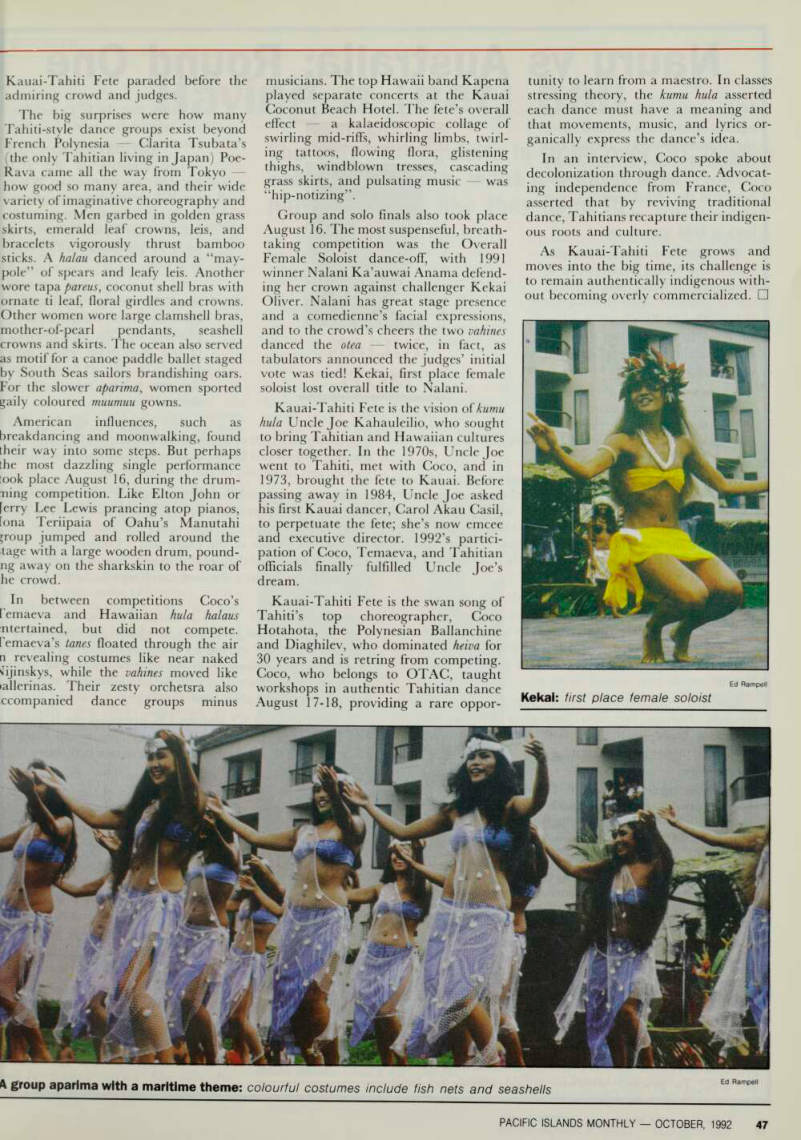
drumming and the traditional aparima (aka ahuroa) and otea Tahitian dances for groups and soloists ranging in age from five years old to 20 and over. The graceful, gently swaying aparima is gener ally performed by female groups in long dresses, accompanied primarily by strings, and is similar to Hawaiian hula, otea, the sensuous fast-moving, hip swinging dance performed by males and females (group and solo) garbed in grass skirts or pareus (sarongs) to the beat of pounding wooden drums, is Tahiti’s best known dance.
The panel of expert judges included: head judge Eriki Marchand, a Tahitian artist who is chief of the Polynesian Cultural Center’s (a Fete co-sponsor)
Marquesan village; Coco Hotahota;
OTAC director Gerard Cowan; OTAG historian Yvette Oopa.
Competition began August 14 with male and female otea solo eliminations, performed according to gender and age.
Mid-day, “Mr Kauai-Tahiti Fete” beauty pageant contestants clad in native regalia strutted their stuff, flexed muscles, and told the ogling audience about favourite hobbies, such as “diving for oysters, coconut tree climbing, and picking limu (seaweed).” Solo finals took place that afternoon.
August 15, the halaus (dance troupes) began otea and aparima group compe tition, a daylong process of elimination.
Early afternoon, contestants for Miss
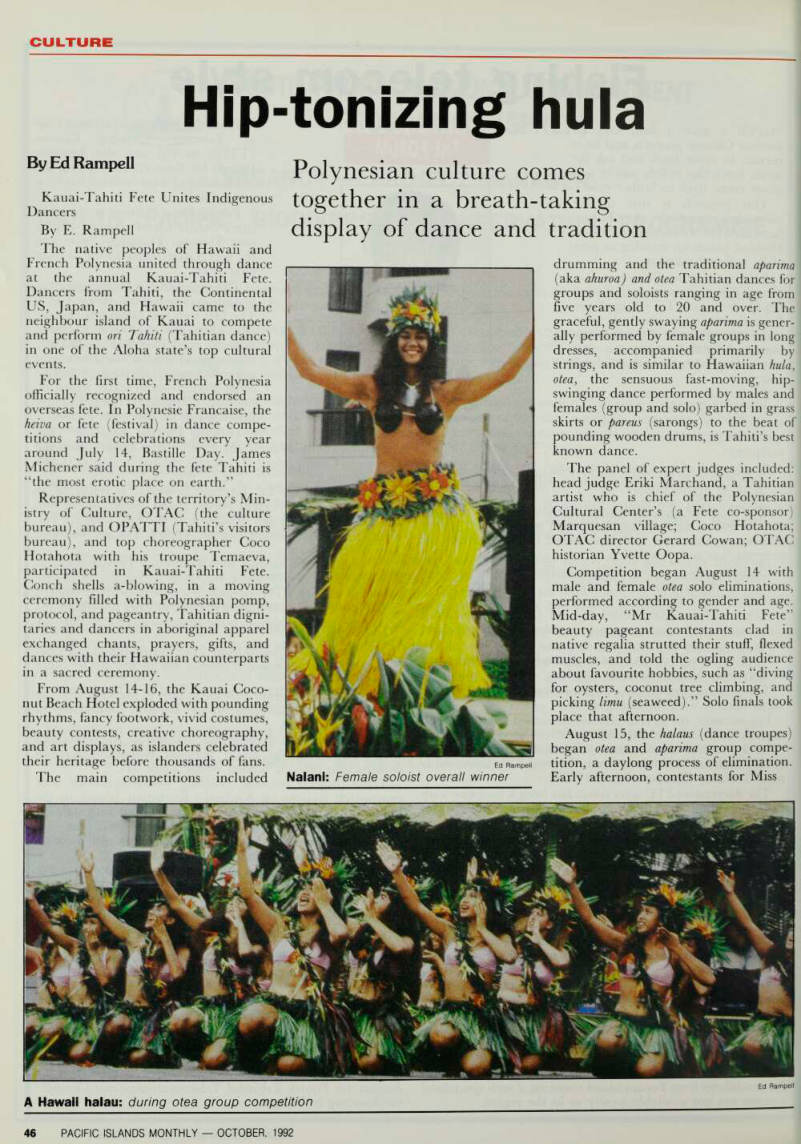
Ed Rampell Nalani: Female soloist overall winner
Ed Rampell
A Hawaii halau: during otea group competition
Kauai-Tahiti Fete paraded before the admiring crowd and judges.
The big surprises were how many Tahiti-style dance groups exist beyond French Polynesia Clarita Tsubata’s (the only Tahitian living in Japan) Poe- Rava came all the way from Tokyo how good so many area, and their wide variety of imaginative choreography and costuming. Men garbed in golden grass skirts, emerald leaf crowns, leis, and bracelets vigorously thrust bamboo sticks. A halau danced around a “may pole” of spears and leafy leis. Another wore tapa pareus , coconut shell bras with ornate ti leaf, floral girdles and crowns.
Other women wore large clamshell bras, mother-of-pearl pendants, seashell crowns and skirts. The ocean also served as motif for a canoe paddle ballet staged by South Seas sailors brandishing oars.
For the slower aparima , women sported gaily coloured muumuu gowns.
American influences, such as breakdancing and moonwalking, found their way into some steps. But perhaps the most dazzling single performance took place August 16, during the drum rung competition. Like Elton John or ferry Lee Lewis prancing atop pianos, lona Teriipaia of Oahu’s Manutahi jroup jumped and rolled around the tage with a large wooden drum, pound ng away on the sharkskin to the roar of he crowd.
In between competitions Coco’s femaeva and Hawaiian hula halaus ntertained, but did not compete, femaeva’s fanes floated through the air n revealing costumes like near naked ftjinskys, while the vahines moved like •allerinas. Their zesty orchetsra also ccompanied dance groups minus
musicians. The top Hawaii band Kapena played separate concerts at the Kauai Coconut Beach Hotel. The fete’s overall effect a kalaeidoscopic collage of swirling mid-riffs, whirling limbs, twirl ing tattoos, flowing flora, glistening thighs, windblown tresses, cascading grass skirts, and pulsating music was
“hip-notizing”.
Group and solo finals also took place August 16. The most suspenseful, breath taking competition was the Overall Female Soloist dance-off, with 1991 winner Nalani Ka’auwai Anama defend ing her crown against challenger Kekai Oliver. Nalani has great stage presence and a comedienne’s facial expressions, and to the crowd’s cheers the two vahines danced the otea twice, in fact, as tabulators announced the judges’ initial vote was tied! Kekai, first place female soloist lost overall title to Nalani.
Kauai-Tahiti Fete is the vision o {kumu hula Uncle Joe Kahauleilio, who sought to bring Tahitian and Hawaiian cultures closer together. In the 19705, Uncle Joe went to Tahiti, met with Coco, and in 1973, brought the fete to Kauai. Before passing away in 1984, Uncle Joe asked his first Kauai dancer, Carol Akau Casil, to perpetuate the fete; she’s now emcee and executive director. 1992’s partici pation of Coco, Temaeva, and Tahitian officials finally fulfilled Uncle Joe’s dream.
Kauai-Tahiti Fete is the swan song of Tahiti’s top choreographer, Coco Hotahota, the Polynesian Ballanchine and Diaghilev, who dominated heiva for 30 years and is retring from competing.
Coco, who belongs to OTAC, taught workshops in authentic Tahitian dance August 17-18, providing a rare oppor
tunity to learn from a maestro. In classes stressing theory, the kumu hula asserted each dance must have a meaning and that movements, music, and lyrics or gamcally express the dance s idea. j n an j nterv i ew Coco spoke about decolonization through dance. Advocat jn g independence from France, Coco asserted that by reviving traditional dance, Tahitians recapture their indigen ous roots and culture, A • -n , . . , As Kaua.-Tah.ti Fete grows and moves 1n ° e 'S 1171 e ’ ls c a en g e 15 to re I maln authentically indigenous w.th out becoming overly commercialized. □
Ed Rampell
Kekai: first place female soloist
A group aparima with a maritime theme: colourful costumes include fish nets and seashells
Ed Rampell