Looking abroad for treatment
pp. 34-35 · Read in the full issue
By Robert Simms
EMANUEL, an-eight-year old boy from New Caledonia, was near death. A tumour was pressing on his brain. The hospital in Noumea lacked the sophisti cated facilities needed to treat his condition. Two weeks was the maximum he could survive without appropriate
medical help.
The scenario in not unusual. Hun dreds of children in the Pacific need life saving medical treatment that is not available in the islands. However, Emanuel is lucky. He was one of the 250 island children who are evacuated each year to The Children’s Hospital, Camperdown, in Sydney.
“Soon after he arrived, surgery was performed to remove most of the primary tumour,” said Dr Stewart Kellie, paediatric oncologist at the hospital.
“Later, we found other tumours in his brain and spinal cord.”
In the past, such children could not be saved. However, a new combination of tumour-fighting drugs appears to have worked. After four courses of chemo therapy over a 16-week period, followed by eight weeks to return home. It took almost six months to achieve a cure, but now he should be able to lead the boisterous life of a normal school boy.
The lack of specialised medical facili ties in Pacific island nations means many children with serious medical problems must travel overseas. Conditions such as congenital heart disorders, leukaemia,
cancers and brain tumours require treat ment which often cannot be provided in the islands.
Heart conditions are common.
Cardiologists and surgeons at The Chil dren’s Hospital see 30 to 35 island children with cardiac disorders such as heart valve abnormalities caused by rheumatic fever, or holes in the heart each year. “It is important to correct the problem in a single operation,” said cardiologist Dr Gary Sholler. “Most will be unable to return to Australia, so we must be sure their problem is fixed permanently.”
They stay in hospital for six or seven days after their operation, before being allowed to leave. A final check-up about three weeks later ensures they are fit to travel home.
Other major hospitals also make their facilities available to children who can not be treated in their own countries.
The Prince of Wales Children’s Hospital
in Sydney receives patients from Tonga,
Fiji, Solomon Islands, Papua New Guinea, as well as New Caledonia.
They have strict guidelines regarding the types of patients they will accept from Pacific countries. “The children we see have conditions that cannot be managed locally, have the potential to be cured, and have little need for on-going care,” said Dr Michael Bryden, the hospital’s
medical superintendent.
They have treated children with extensive scarring after bad burns, cor neal problems of the eye, and with foreign bodies caught in their throats.
“One child from the Solomon Islands swallowed a plastic whistle that lodged in the opening of his trachea,” he said.
“Each time he coughed, he blew the whistle.” It is amusing in retrospect, but had the child inhaled it into the airway of his lungs, the result could have been fatal.
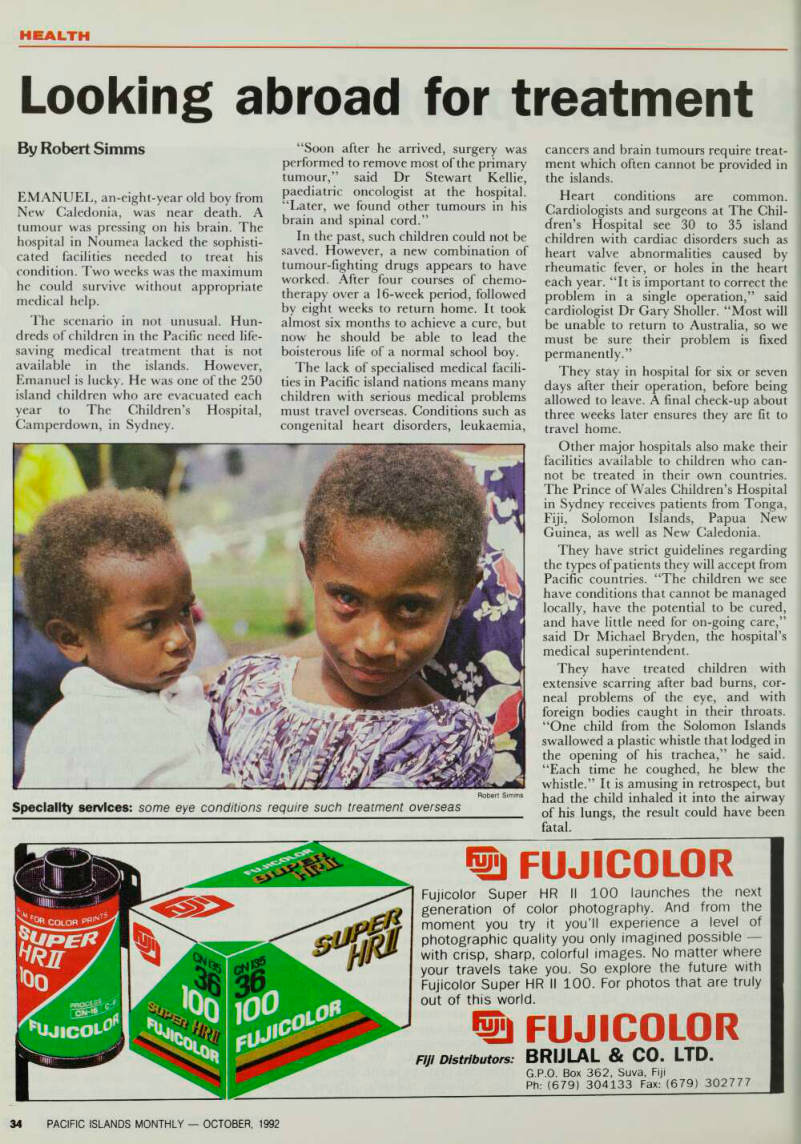
Robert Simms Speciality services: some eye conditions require such treatment overseas
The specialist facilities at Australian hospitals can accept only a limited number of patients. Some requests for help from overseas patients are refused because others already on the program would be disadvantaged. In the case of cancer, in particular, where the prog nosis is poor, it can be futile to accept new patients. They may survive some months longer, but the quality of their lives, in hospital away from their families, would be poorer.
“The children have to be assessed correctly in the islands before being referreed to us,” Bryden said. “It must be to the benefit of everyone before a patient is sent for treatment.”
The social aspects, as well as the medical advantages, of going to Austra lia should be considered by the patient’s family. A child may go without the close support of parents and relations when they leave their country. Often they are placed in the care of a grandmother or aunt. If they do not speak English, they can be at a further disadvantage. “Those who come must realise the problems of being in a foreign country,” Kellie said.
“If they find it difficult to understand what is involved in the treatment, it is hard for them to give informed consent, and to comply with treatment require ments.”
The length of treatment required by patients varies with their conditions.
Some may stay for as little as two weeks, while others require extended care. One child with kidney disease came Tom a remote village in New Caledonia. ‘Soon after he arrived, he had kidney ailure, so he was put on dialysis (which lets as an artificial kidney),” Bryden
said. “It was three years before he could receive a kidney transplant and return.”
A better method of supplying health care to seriously ill islanders is to upgrade the services and equipment available in their own countries. For some years, medical teams have been coming to the islands to provide assistance. Interplast Australia, for example, has an excellent record in treating burn patients and others who require plastic surgery.
Local doctors are instructed in ad vanced treatment and surgical tech
niques while assisting the visiting special
ists. Others receive additional training in Australia. This can create a gap in the local health system, however. “We are looking at replacing the local physicians with Australian doctors while they are away,” Bryden said. “Both the Solomon Islands and Fiji have expressed interest in the scheme which would be similar to the arrangement we’ve had with Papua New Guinea for years.” In this way, the local doctors receive valuable training, and the island’s health system is not
disadvantaged by their absence.
Although such projects will increase the number of well-trained local doctors, it will take some years before many island patients with serious medical conditions can be treated successfully in their own country. It may be always necessary for those with rare diseases to be sent overseas for specialist care. For these patients, the facilities and specialists at hospital such as The Children’s Hospital Camperdown, and The Prince of Wales Children’s Hospital, in Sydney, will remain a valuable addition to the islands health care services.
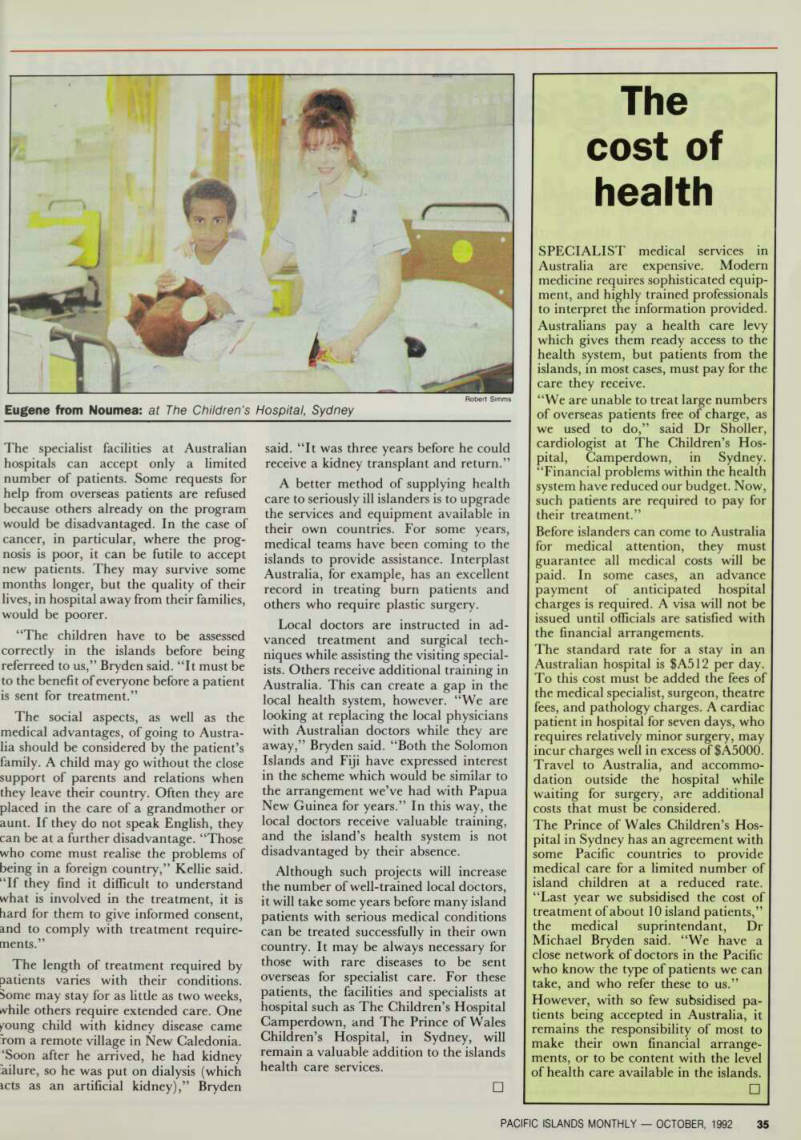
Robert Simms Eugene from Noumea: at The Children’s Hospital, Sydney