A matter of setting the right priorities
pp. 32-33 · Read in the full issue
By Bill Winkley
Visiting the islands of the South Pacific and reading the travel literature will certify the visual beauty of this part of the world. Thoughts of the area conjure up visions of paradise. Pristine beaches of white sand stretching endlessly. Cloud festooned mountain ranges beckoning seductively. Lush tropical foliage offering a visual feast.
While there for the traveller, however, these sights are often not available for the islanders themselves. Eye care in much of the region is in a crisis situation.
Unnecessary blindness is a reality in
paradise.
Are people really going blind need lessly? How much of the blindness could be prevented? And what is available for persons who have lost their sight perma nently?
“The bureaucracy, with the low pri ority it gives eye care, keeps many good things from happening,” states a con cerned ophthalmologist (medical doctor specialising in eye treatment and sur gery), Dr. John Szetu of the Solomon Islands. “There is needless blindness in the Solomons. Indifference, a lack of initiative by the Ministry of Health and the sluggishness of the entire system are all factors. Certainly eye care is suffering.
And certainly when the entire health care system is in dire straits, that suffering
is magnified.”
Dr Bage Yominao of Papua New Guinea echoes Szetu’s concerns. “For four weeks now, we have had no local anesthesia. This means we cannot re move foreign bodies which, left unat tended, can cause blindness. Glaucoma, a disease characterised by a buildup of fluid and destructive pressure inside the eye, cannot be properly treated and monitored. The precise care this blinding disease requires is virtually unattainable.
“Right now I have two glaucoma patients, one expatriate and the other a PNG national. Because the expatriate has the funds to purchase the medicine from the commercial chemist, he gets treated. However, without local anesthesia, I cannot read his eye pressure and determine the effectiveness of treat ment. I do not know whether I am overtreating or undertreating his con dition and therefore cannot adjust the medicine as progress or deterioration occurs.
“The hapless Papua New Guinean, the very person for whom the National Health care system exists, cannot afford the medicine. He loses on both counts. I
am so frustrated, I am thinking of a one woman strike. It hurts to be able to help and then have the system stuff things up!
“We don’t know why there’s no money for these needs. According to the govern ment only half of our allocation for the year has been accounted for. Nobody seems to know what happened to the other half. For four months we have been told that we cannot do elective surgeries.
Cataracts, the leading cause of blindness in the world and a magnified problem in PNG, are considered elective surgery.
The success rate of cataract surgery is over 9.5 per cent.
“And yet we’re stymied and blind persons who can be cured with a 30-minute surgery go without sight. And that sight can be lost permanently, if left unattended too long. I don’t know whether to scream, cry or give up!”
Compound this situation with ram pant diabetes, with a shortage of oph thalmologists, a lack of equipment, confused priorities in health care and the hopelessness becomes pervasive. “It is no wonder we cannot recruit and keep eye specialists in the government system!
There is not one laser machine in the entire area. And laser is the only effective treatment for diabetic retinopathy proliferens, the bursting of blood vessels in the eye due to advanced and uncon trolled diabetes,” she laments.
“Tinned fish and rice are the cheapest diet available to the urban dweller. Such a diet is virtually without vitamin A, another major cause of blindness. I used to think Vitamin A deficiency was non-
existent in the Pacific. A couple of weeks looking at eyes in Kiribati turned my thinking around. Kiribati has the highest incidence of Vitamin A problems in the world! Over 14 times as great as the incidence that the world health considers a major public health problem. There are children going incurably blind for the rest of their lives in Kiribati, blindness that is entirely preventable. A monumen tal program of educating islanders to change their dietary habits is needed,”
Yominao explains.
Fortunately for Kiribati, the Depart ment of Health and the Foundation for the Peoples of the South Pacific are working to find funding to address the problem. But until they do, how many eyes will be lost?
The diabetes problem has been veri fied in other countries as well. Dr Frank Smith, national ophthalmologist with the Western Samoan Ministry of Health, expresses grave concern for the high incidence of diabetes as shown by a recent survey he conducted there.
“We were astounded at the high incidence of diabetes. Over 40 per cent of persons over 40 years of age were found to have diabetes in some stage of its development. Unless diets change and treatment becomes available, the alarm ing situation we have today can only get worse.”
Ten years ago PNG had an outbreak of rubella, often called German measles.
Today there are many 10 year old youngsters running around, needlessly and incurably blind. Did the government implement the obviously needed vacci nation program to prevent a recurrence
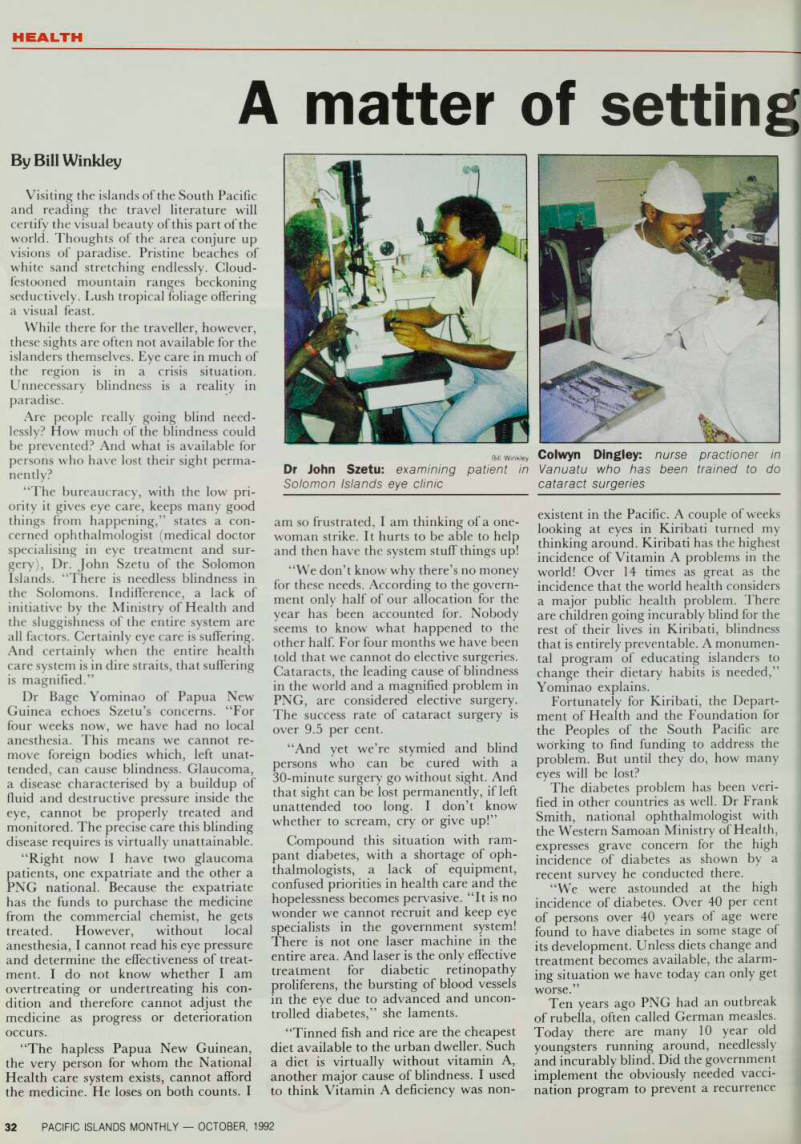
Bill Wlnkley Dr John Szetu: examining patient in Solomon Islands eye clinic
Colwyn Dingley: nurse practioner in Vanuatu who has been trained to do cataract surgeries
of this epidemic? Yominao gives a resounding, “No! Today, 1992, we have had another outbreak. And the vacci nation is available. Getting it to the persons at risk is simply not a mandate for the government.”
The problem is systemic, however.
Some feel blame lies with the Australians, who set up the health scheme in PNG before independence. At that time there was a shortage of eye care specialists in Australia, hence eye care was not a priority in the new structure for PNG.
The vestiges of that lack of concern are still predominant today.
The system suffers from other prob lems as well. A severe lack of manage ment skills results in rural health care workers going unsupervised and unsup ported in their work. Additionally, these workers get virtually no training in eye care in school. Another difficulty lies in the fact that the eye care offered in almost all island nations is hospital based; not village based, where most problems could be diagnosed and treated.
According to Dr Guy Hawley, oph
thalmologist now in private practice in Fiji after 17 years of service with the government, the Australasian College of surgeons recommends one ophthalmol ogist per 100,000 people. Fiji is well catered for with its 9 ophthalmologists serving a population of 700,000. PNG, with a population approaching 4,000,000, has four, of which three work in government service and one is in private practice. Fortunately for PNG, there are four students training to become ophthalmologists under govern
ment sponsorship.
However, whether the system will be able to retain them is another question.
“Losing an ophthalmologist from the government system to the private system is not a loss to the country. But it simply can put eye care outside the realm of financial possibility for the average villager,” exclaims Yominao.
She and Szetu agree that a pro-active concern for eye care by ministries and departments of health would see more new recruits and the retention of existing practitioners.
The lack of affordable eye glasses is another significant problem in the island nations. Often patients after cataract surgery cannot be given the special glasses they require to be able to focus their regained sight. Simple spectacles to correct near or far sightedness usually are not available or affordable. Simple glasses could be made available for well
under forty dollars. Interestingly, glasses could be bought en masse from India, Indonesia or Hong Kong for about SUS4.OO per pair, landed in the various island countries. Again, government malaise seems to be the cause for the
blockage.
There are, however, brighter stars on the horizon. Recently several island nations banded together to form the Pacific Islands Council for Blind Persons (PIC), based in Suva. PlC’s goal is to assist island nations in designing and implementing national eye care schemes and in delivering rehabilitation and education services to the incurably blind.
This assistance takes the form of training, technical assistance, and even financial support. Services officer, Jack Aita of PNG, states, “Because eye care is a low priority in the region, PIC has been formed to attempt to raise awareness. By banding together, sharing resources and expertise, the concerned islanders hope to move eye care closer to the top of the national health agendas.
“We are amazed at the reception we have found among the eye care specialists and the non-governmental organisations (NGOs) to PIC. We are especially delighted that the health departments of the Solomon Islands, Papua New
Guinea, and Western Samoa have joined the PIC family.”
Additionally, eight NGOs serving
incurably blind persons are also a part of the PIC membership. “Maybe by our collective voice we can stop and cure needless blindness and see that the incurably blind persons of the Pacific have an opportunity to share in the lives of their nations,” Aita hopes.
Services to prevent blindness and to serve incurably blind persons within the developing nations of the Pacific are attainable. The key to their existence lies in the awareness of the decision makers that 80 per cent of all blindness is preventable or curable. The situation as it now exists is deplorable if not down right criminal. The call to action by those persons fighting the battle can no longer go unheeded.
“What can be done to turn the situation around action that does not require huge outlays of money, but rather a change in priorities, is remark able. Can we afford to wait any longer?
I think not. We cannot allow additional Pacific islanders to go blind, to remain blind, or to do without appropriate rehabilitation and education services,”
Aita warns. □
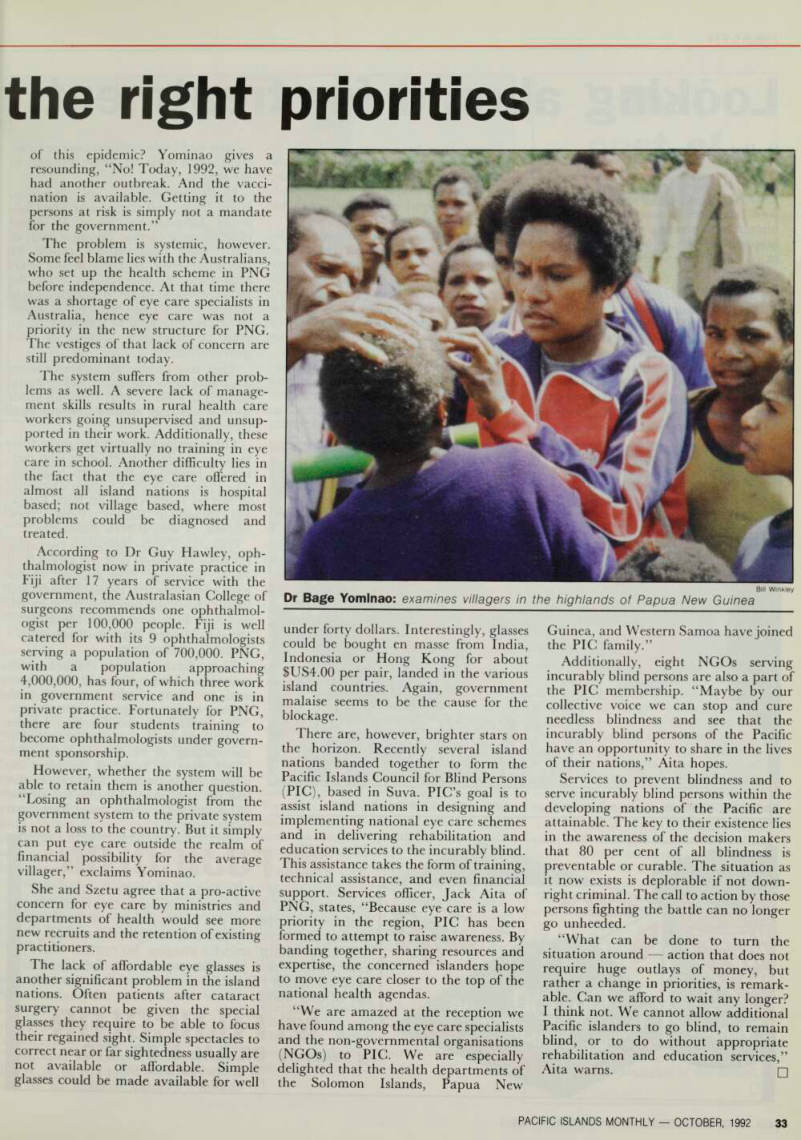
Bill Winkley Dr Bage Yominao: examines villagers in the highlands of Papua New Guinea