Rabuka wins over
p. 10 · Read in the full issue
Politics
Rabuka wins over Australia
By Samisoni Kakaivalu
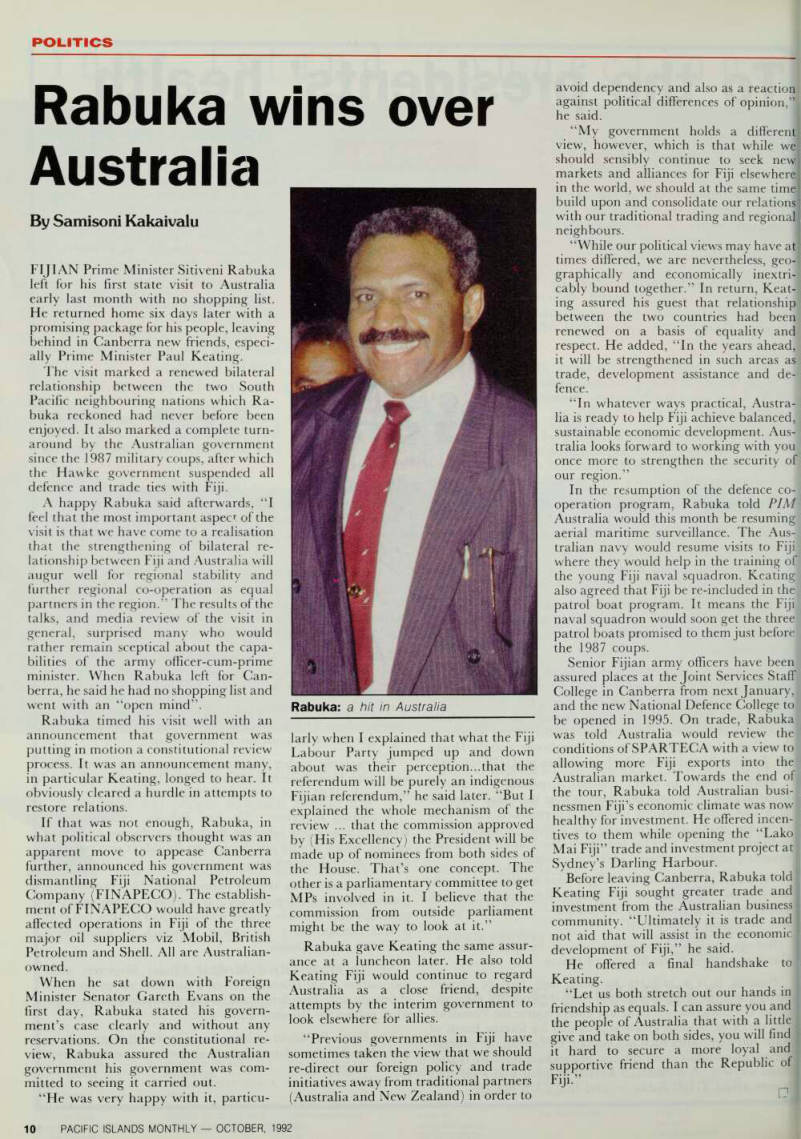
FIJIAN Prime Minister Sitiveni Rabuka left for his first state visit to Australia early last month with no shopping list.
He returned home six days later with a promising package for his people, leaving behind in Canberra new friends, especi ally Prime Minister Paul Keating.
The visit marked a renewed bilateral relationship between the two South Pacific neighbouring nations which Ra buka reckoned had never before been enjoyed. It also marked a complete turn around by the Australian government since the 1987 military coups, after which the Hawke government suspended all defence and trade ties with Fiji.
A happy Rabuka said afterwards, “I feel that the most important aspect of the visit is that we have come to a realisation that the strengthening of bilateral re lationship between Fiji and Australia will augur well for regional stability and
further regional co-operation as equal
partners in the region.” The results of the talks, and media review of the visit in general, surprised many who would rather remain sceptical about the capa bilities of the army officer-cum-prime minister. When Rabuka left for Can berra, he said he had no shopping list and went with an “open mind”.
Rabuka timed his visit well with an announcement that government was putting in motion a constitutional review process. It was an announcement many, in particular Keating, longed to hear. It obviously cleared a hurdle in attempts to restore relations.
If that was not enough, Rabuka, in what political observers thought was an apparent move to appease Canberra further, announced his government was dismantling Fiji National Petroleum Company (FINAPECO). The establish ment of FINAPECO would have greatly affected operations in Fiji of the three major oil suppliers viz Mobil, British Petroleum and Shell. All are Australian owned.
When he sat down with Foreign Minister Senator Gareth Evans on the first day, Rabuka stated his govern ment’s case clearly and without any reservations. On the constitutional re view, Rabuka assured the Australian government his government was com mitted to seeing it carried out.
“He was very happy with it, particu-
larly when I explained that what the Fiji Labour Party jumped up and down about was their perception...that the referendum will be purely an indigenous Fijian referendum,” he said later. “But I explained the whole mechanism of the review ... that the commission approved by (His Excellency) the President will be made up of nominees from both sides of the House. That’s one concept. The other is a parliamentary committee to get MPs involved in it. I believe that the commission from outside parliament might be the way to look at it.”
Rabuka gave Keating the same assur ance at a luncheon later. He also told Keating Fiji would continue to regard Australia as a close friend, despite attempts by the interim government to look elsewhere for allies.
“Previous governments in Fiji have sometimes taken the view that we should re-direct our foreign policy and trade initiatives away from traditional partners (Australia and New Zealand) in order to
avoid dependency and also as a reaction against political differences of opinion,”] he said.
“My government holds a different! view, however, which is that while we] should sensibly continue to seek new! markets and alliances for Fiji elsewhere] in the world, we should at the same time! build upon and consolidate our relations] with our traditional trading and regional] neighbours.
“While our political views may have at] times differed, we are nevertheless, geo-] graphically and economically inextri-] cably bound together.” In return, Keat-j ing assured his guest that relationship between the two countries had been renewed on a basis of equality and respect. He added, “In the years ahead, it will be strengthened in such areas as trade, development assistance and de fence.
“In whatever ways practical, Austra lia is ready to help Fiji achieve balanced, i sustainable economic development. Aus-1 tralia looks forward to working with you once more to strengthen the security of
our region.”
In the resumption of the defence co operation program, Rabuka told PIM Australia would this month be resuming aerial maritime surveillance. The Aus tralian navy would resume visits to Fiji where they would help in the training of the young Fiji naval squadron. Keating also agreed that Fiji be re-included in the patrol boat program. It means the Fiji naval squadron would soon get the three patrol boats promised to them just before the 1987 coups.
Senior Fijian army officers have been assured places at the Joint Services Staff College in Canberra from next January,! and the new National Defence College to be opened in 1995. On trade, Rabuka was told Australia would review the' conditions of SPARTECA with a view to allowing more Fiji exports into the Australian market. Towards the end ofl the tour, Rabuka told Australian busi-l nessmen Fiji’s economic climate was now • healthy for investment. He offered incen-| tives to them while opening the “Lakop Mai Fiji” trade and investment project at Sydney’s Darling Harbour.
Before leaving Canberra, Rabuka told Keating Fiji sought greater trade and investment from the Australian business * community. “Ultimately it is trade and j not aid that will assist in the economic! development of Fiji,” he said.
He offered a final handshake to Keating.
“Let us both stretch out our hands in friendship as equals. I can assure you and the people of Australia that with a little give and take on both sides, you will find it hard to secure a more loyal and supportive friend than the Republic of Fiji.”
Rabuka: a hit in Australia