To the presidents’ health
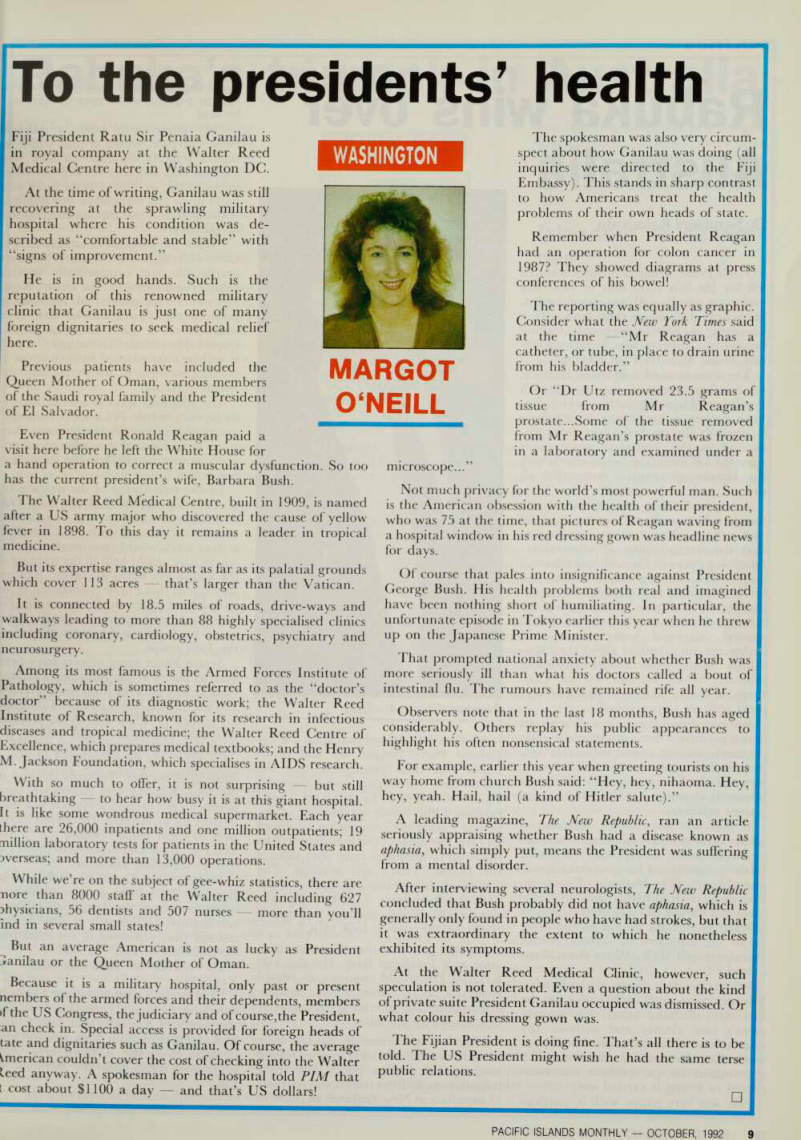
Fiji President Ratu Sir Penaia Ganilau is in royal company at the Walter Reed Medical Centre here in Washington DC.
At the time of writing, Ganilau was still recovering at the sprawling military hospital where his condition was de scribed as “comfortable and stable” with “signs of improvement.”
He is in good hands. Such is the reputation of this renowned military clinic that Ganilau is just one of many foreign dignitaries to seek medical relief here.
Previous patients have included the Queen Mother of Oman, various members of the Saudi royal family and the President of El Salvador.
Even President Ronald Reagan paid a visit here before he left the White House for
a hand operation to correct a muscular dysfunction. So too has the current president’s wife, Barbara Bush.
The Walter Reed Medical Centre, built in 1909, is named after a US army major who discovered the cause of yellow fever in 1898. To this day it remains a leader in tropical medicine.
But its expertise ranges almost as far as its palatial grounds which cover 113 acres that’s larger than the Vatican.
It is connected by 18.5 miles of roads, drive-ways and walkways leading to more than 88 highly specialised clinics including coronary, cardiology, obstetrics, psychiatry and neurosurgery.
Among its most famous is the Armed Forces Institute of Pathology, which is sometimes referred to as the “doctor’s doctor” because of its diagnostic work; the Walter Reed Institute of Research, known for its research in infectious diseases and tropical medicine; the Walter Reed Centre of Excellence, which prepares medical textbooks; and the Henry M. Jackson Foundation, which specialises in AIDS research.
With so much to offer, it is not surprising but still breathtaking to hear how busy it is at this giant hospital.
It is like some wondrous medical supermarket. Each year there are 26,000 inpatients and one million outpatients; 19 million laboratory tests for patients in the United States and overseas; and more than 13,000 operations.
While we’re on the subject of gee-whiz statistics, there are more than 8000 staff at the Walter Reed including 627 physicians, 56 dentists and 507 nurses more than you’ll ind in several small states!
But an average American is not as lucky as President 3anilau or the Queen Mother of Oman.
Because it is a military hospital, only past or present nembers of the armed forces and their dependents, members >fthe US Congress, the judiciary and of course, the President, an check in. Special access is provided for foreign heads of tate and dignitaries such as Ganilau. Of course, the average American couldn’t cover the cost of checking into the Walter leed anyway. A spokesman for the hospital told PIM that t cost about SHOO a day and that’s US dollars!
The spokesman was also very circum spect about how Ganilau was doing (all inquiries were directed to the Fiji Embassy). This stands in sharp contrast to how Americans treat the health problems of their own heads of state.
Remember when President Reagan had an operation for colon cancer in 1987? They showed diagrams at press conferences of his bowel!
The reporting was equally as graphic.
Consider what the New York Times said at the time —“Mr Reagan has a catheter, or tube, in place to drain urine from his bladder.”
Or “Dr Utz removed 23.5 grams of tissue from Mr Reagan’s prostate... Some of the tissue removed from Mr Reagan’s prostate was frozen in a laboratory and examined under a
microscope...”
Not much privacy for the world’s most powerful man. Such is the American obsession with the health of their president, who was 75 at the time, that pictures of Reagan waving from a hospital window in his red dressing gown was headline news for days.
Of course that pales into insignificance against President George Bush. His health problems both real and imagined have been nothing short of humiliating. In particular, the unfortunate episode in Tokyo earlier this year when he threw up on the Japanese Prime Minister.
That prompted national anxiety about whether Bush was more seriously ill than what his doctors called a bout of intestinal flu. The rumours have remained rife all year.
Observers note that in the last 18 months, Bush has aged considerably. Others replay his public appearances to highlight his often nonsensical statements.
For example, earlier this year when greeting tourists on his way home from church Bush said: “Hey, hey, nihaoma. Hey, hey, yeah. Hail, hail (a kind of Hitler salute).”
A leading magazine, The New Republic , ran an article seriously appraising whether Bush had a disease known as aphasia , which simply put, means the President was suffering from a mental disorder.
After interviewing several neurologists, The New Republic concluded that Bush probably did not have aphasia , which is generally only found in people who have had strokes, but that it was extraordinary the extent to which he nonetheless i exhibited its symptoms.
At the Walter Reed Medical Clinic, however, such speculation is not tolerated. Even a question about the kind of private suite President Ganilau occupied was dismissed. Or what colour his dressing gown was.
The Fijian President is doing fine. That’s all there is to be told. The US President might wish he had the same terse public relations. □