Discovering island o[?]he glowing sky
pp. 58-59 · Read in the full issue
Yachting
By Sally Andrew
DOZENS of rare Hector dol phins escorted us down the east coast of New Zealand’s South Island as we sailed toward a place the Maori call the “island of the glowing sky” Stewart Island.
That evening the Aurora Australis, the mystical Southern Lights, streaked gold in the sky ahead.
Surfing down the fronts of big ocean swells,, we crossed Foveaux Strait. The crests of these ever changing hills broke and bubbled under our stern as they lifted us and then sped away. We reached Stewart Island at dawn, an chored in Paterson Inlet and began feasting on the bounty of this remote paradise oysters, scallops, mussels, cockles, pipi , blue cod.
In our dinghy, we paddled into the backwaters of inlets and streams, discovering waterfalls, blooming red rata trees, aban doned sawmills and docks dated from the 1860’s, an old whaling ship-repair station and birds ga lore. An unbelievably large num ber of shearwaters, gannets, alba
tross, petrels, prions, gulls,
mollymawks, terns, ducks and cormorants nest and fish along this coast. Oyster catchers with their bright orange beaks and legs let loose with great whistles and screams as they flew over head.
Just north of Paterson Inlet we anchored at Halfmoon Bay (population 500), Stewart Island’s only town and the southernmost village in the South Pacific. The harbour is home to a small fishing fleet. Ashore we
bought fresh food and visited the Depau ment of Conservation’s museum, P amiable Maori lady who runs the loc Fisherman’s Co-operative Store told all about “birding”, a Maori traditio and privilege. Once a year titi i muttonbirds (sooty shearwaters) a. collected on the outer islets in the an and are preserved by Maori family They are considered a great delicacy.
Southbound, we sailed to Stewa Island’s Port Adventure and anchored Abrahams Bosom. Brilliant sunshine ai blue skies gave an almost tropical look the Roaring Forties and inside tl harbour a broad expanse of fine whi sand glistened in the afternoon sun. i night, a pink pulsing aurora and freshening west wind greeted the ft moon as it rose in the east.
After Port Adventure, we headi towards Lord’s River. Although it w only twelve 12 miles away, we arrivi cold, wet, and feeling the effects of a stei breaking sea and a 17-foot ro Tradewind sailing seemed a long, k memory as the Roaring Forties lived i to their name. We anchored just insii the entrance and caught blue cod f lunch. At low tide, a mustard och beach surrounded by native bush skirti the anchorage. Hunters camped asho invited us for a venison dinner. What treat!
We waited a long time for a favourat weather report to go further south, ar eventually slogged upwind with 30-kn winds that kept heading us and fi metre seas which kept swamping i Another yacht, Desire, a 34-foot ste sloop out of Bluff, N.Z., followed down. We both got within five miles the entrance to Port Pegasus before tl wind increased and forced us around. V retreated to the refuge of Lord’s Rive A few days .later we tried again ai were hardly underway when a gu flattened us. At the same time v punched through a huge swell whi« roared down the side of the cabin top lii a freight train gone wild. Green wat pinned me against the lifelines ar soaked me. Brrrr, it was cold. This w not the South Pacific touted in the trav brochures. Perhaps this is why we saw! few cruising boats at these Stewart Islar anchorages, only a handful of Kiw i boa and four foreign yachts Akvavit fro; Alaska, Tokumaru from Japan, Jackei from Great Britain, Tenere from Ge many.
Once inside of Port Pegasus the
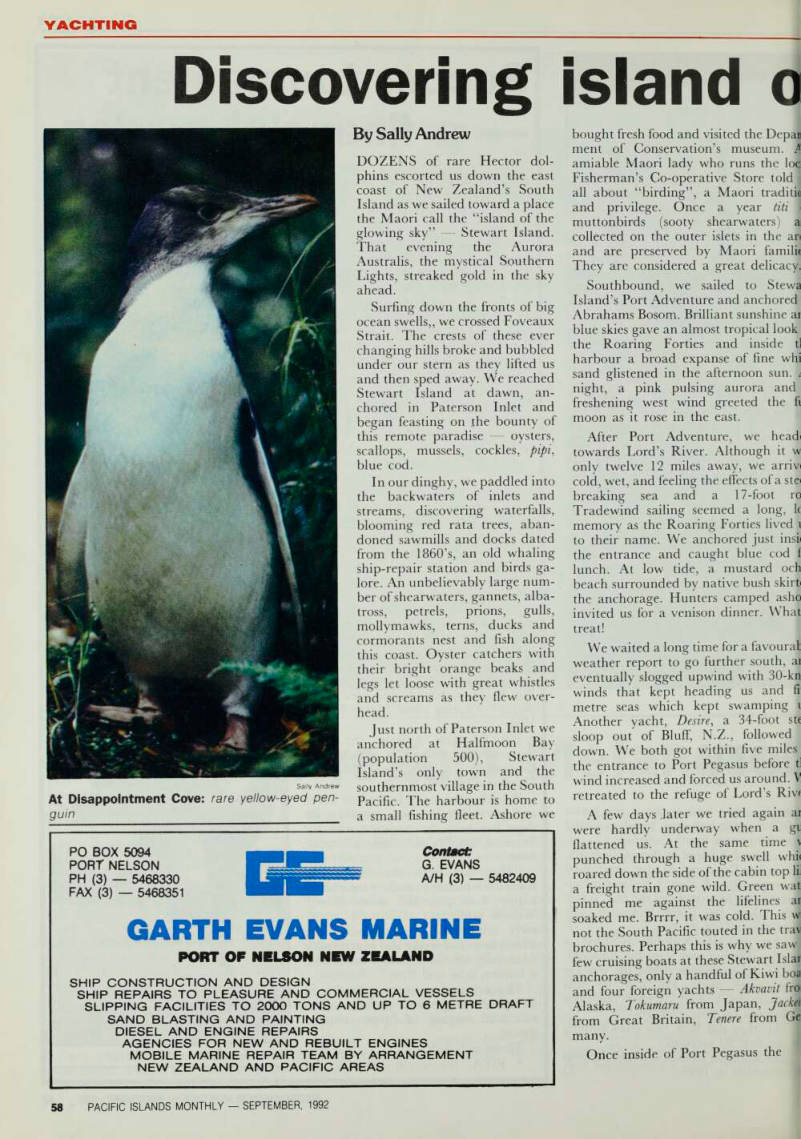
Sally Andrew At Disappointment Cove: rare yellow-eyed pen guin
:enery is spectacular. The landscape is ominated by bald granite domes remi iscent of Yosemite in California. Huge ranite slabs are thrust together into glossal monuments which top each peak nd from the top we were able to see the asman Sea to the west and the Pacific > the east.
It was so windy on top, with guests in :cess of 100 kilometers per hour, that I id to flatten myself to the rocks or risk ang blown away. Elsewhere, cliffs and ets were carpeted in native bush and ta or grasses, thistles, yellow gorse, flax, I stunted and wind-pruned.
There were many well-protected an orages inside Port Pegasus. Evening >ve was our favourite since a short trail t us above the bush line where the liking and vistas were fantastic. Near sappointment Cove we came across
o rare yellow-eyed penguins strolling
the woods. Arrogant sunshine inter red with gale force winds and distent hailstorms convinced me that • “island of the glowing sky” was also ne to the screwiest weather on earth. ‘Shocking weather” is what the locals led it. We had so much hail on deck t we made snow balls and Jello-ed ve ice.
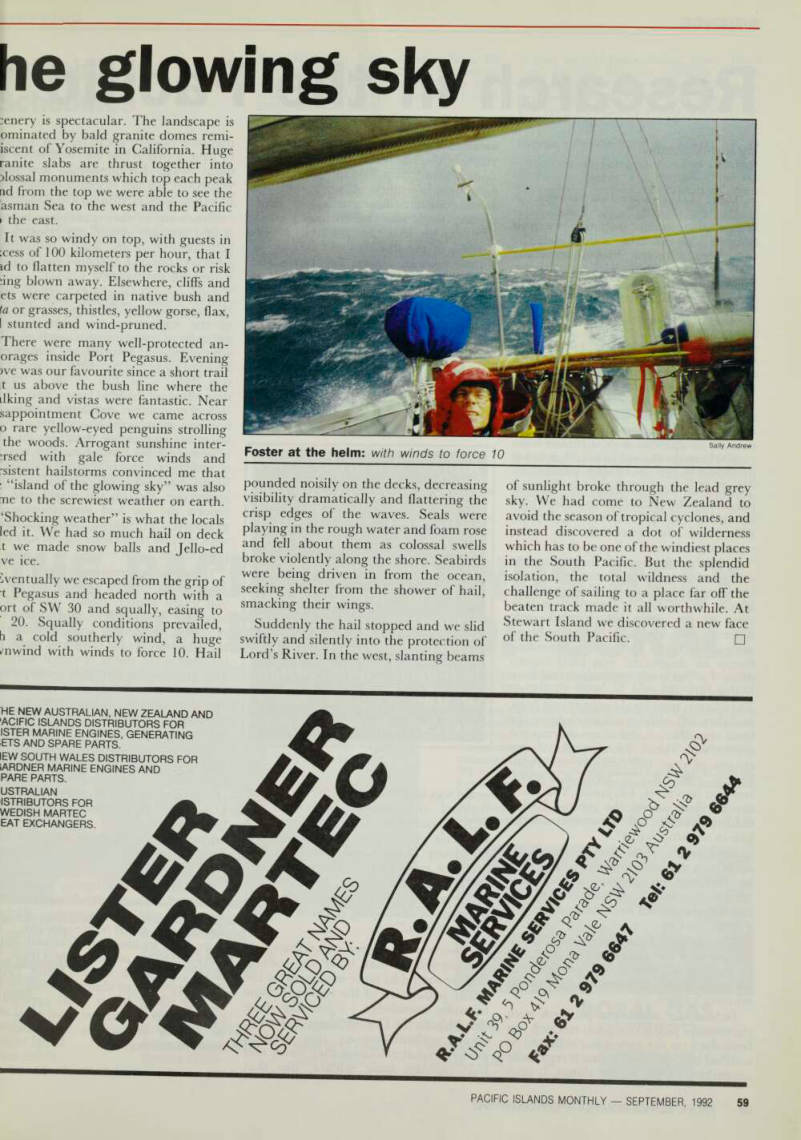
Eventually we escaped from the grip of t Pegasus and headed north with a ort of SW 30 and squally, easing to 20. Squally conditions prevailed, h a cold southerly wind, a huge mwind with winds to force 10. Hail
pounded noisily on the decks, decreasing
visibility dramatically and flattering the
C^ S P edges of the waves. Seals were P* a y m g * n the rou gh water and foam rose a bout them as colossal swells broke violently along the shore. Seabirds bei ng driven in the ocean, see^m g shelter from the shower of hail, smack i n g their wings.
Suddenly the hail stopped and we slid swiftly and silently into the protection of Lord’s River. In the west, slanting beams
of sunlight broke through the lead grey sky. We had come to New Zealand to avoid the season of tropical cyclones, and instead discovered a dot of wilderness which has to be one of the windiest places in the South Pacific. But the splendid isolation, the total wildness and the challenge of sailing to a place far off the beaten track made it all worthwhile. At Stewart Island we discovered a new face the South Pacific. □
Foster at the helm: with winds to force 10
Sally Andrew