The writing is on the wall
From The Editor’S Desk
All good things must come to end. And so it is with the euphoria Pacific island states have been experiencing over the boom in many of their industries. There have been the unprecedented growth in Fiji’s garment industry; the success offish canning in Fiji, the Solomons and now in Papua New Guinea. And then of course there is sugar the life-blood of Fiji’s economy.
But in their haste to expand these industries in the expectation the recent trends would continue, the island states have perhaps overlooked the major
changes taking place in global trade
changes which will lower trade barriers between trading partners forcing the island economies to compete on the same level and without the preferential access they have enjoyed so far.
The Pacific island nations are signatories to a number of trade treaties which offer them special treatment.
Among these are the Lome Convention, SPARTECA, the Multi-fibre Agreement and the Generalised System of Preference. However, as trade barriers, designed to either protect local industries or to give preference to island nations, are being eroded, stiffer competition looms ahead for the region.
It would, for instance, have to compete with such large exporters as Hong Kong, the Phillipines and Taiwan. Unless the region comes to grips with this new order in global trading about to emerge, it
could face major problems.
Most of the regional countries have,
for instance, invested substantially in industries designed to specifically meet the requirements of the preferential treaties. Others have invested in tax free zones which are at the moment attract ing foreign investment. But with greater trade liberalisation, it appears uncertain
the zones would remain as attractive.
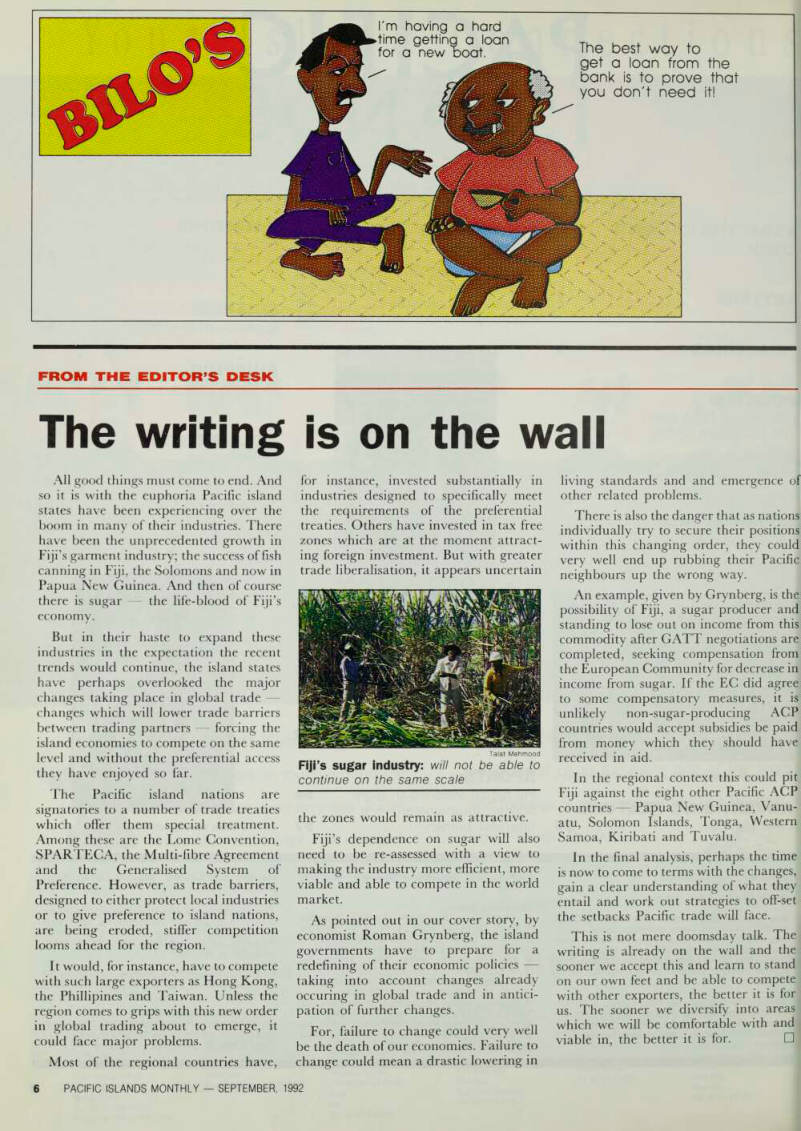
Fiji’s dependence on sugar will also need to be re-assessed with a view to making the industry more efficient, more viable and able to compete in the world market.
As pointed out in our cover story, by economist Roman Grynberg, the island governments have to prepare for a redefining of their economic policies taking into account changes already occuring in global trade and in antici pation of further changes.
For, failure to change could very well be the death of our economies. Failure to change could mean a drastic lowering in
living standards and and emergence of other related problems.
There is also the danger that as nations individually try to secure their positions within this changing order, they could very well end up rubbing their Pacific neighbours up the wrong way.
An example, given by Grynberg, is the possibility of Fiji, a sugar producer and standing to lose out on income from this commodity after GATT negotiations are completed, seeking compensation from the European Community for decrease in income from sugar. If the EC did agree to some compensatory measures, it is unlikely non-sugar-producing AGP countries would accept subsidies be paid from money which they should have received in aid.
In the regional context this could pit Fiji against the eight other Pacific AGP countries Papua New Guinea, Vanu atu, Solomon Islands, Tonga, Western Samoa, Kiribati and Tuvalu.
In the final analysis, perhaps the time is now to come to terms with the changes, gain a clear understanding of what they entail and work out strategies to off-set the setbacks Pacific trade will face.
This is not mere doomsday talk. The writing is already on the wall and the sooner we accept this and learn to stand on our own feet and be able to compete with other exporters, the better it is for us. The sooner we diversify into areas which we will be comfortable with and viable in, the better it is for. □
Talat Mehmood Fiji’s sugar industry: will not be able to continue on the same scale