Fellowship at Christmas Island
pp. 53-55 · Read in the full issue
Yachting
By Sally Andrew
IT WAS hard to believe that the ocean could be so calm but it was. Not a breath of wind, not a ripple on the water, not a cloud in the sky. Curious sea birds flew overhead from time to time and apart from the occasional slatting of the mainsail as Fellowship rolled on a long gentle ocean swell, there was absolute silence. After sunset, the moon appeared directly ahead, a beautiful orange globe rising slowly out of the eastern ocean.
The stars turned on, one by one, illuminating the night sky. Hour by hour we were being set further away from our destination by a strong westerly current.
Relentlessly drifting to leeward, we fired up the “iron genoa” and motored through the night.
The lagoon entrance at Christmas Island was too shallow for Fellowship and icr two-metre draft
\o we anchored in he roadstead just mtside of the en rance. Open to all he ocean with just a
ittle protection
ifforded by the fland itself, the an horage can be ex
remely inhospi
able if the wind hifts or the swell ises. We were lamed with water s smooth as glass, at calm with a egligible ocean veil.
Standing watch
irough the night ad been tiring and quick swim
seemed the perfect antidote. An Ameri can yacht, Tandem Cay (a North Sea 27) with Steve and Heather aboard, was anchored nearby and we swam over to say “Hello”. They had arrived the previous day after a passage of some 1200 miles south from Hawaii. Inside the lagoon, Kona Star was waiting to continue her passage from American Samoa home to Hawaii.
Christmas Island (or “Kiritimati”, the Gilbertese spelling of Christmas, “ti” sounds like “s”) is less than two degrees north of the Equator and is the largest island of purely coral formation in the world. It is 160 kilometers in circumfer ence and has a land area of 363 sq km, an area equal to the rest of Kiribati’s 32 other islands together. Sparse and irregu lar rainfall limits the cultivation of staples such as breadfruit, taro, bananas and pandanus and scrub and saltbush pre dominate. Not surprisingly, when Cap tain James Cook discovered Christmas
Island on Decem ber 24, 1777 (during his third and final voyage) the island was uninhabited.
Christmas Island is now home to 1500 I-Kiribati, many of whom work for the Kiribati gov ernment. It is the administrative
headquarters for
the Line and Phoenix
(Linnex)
Island Groups
and is considered
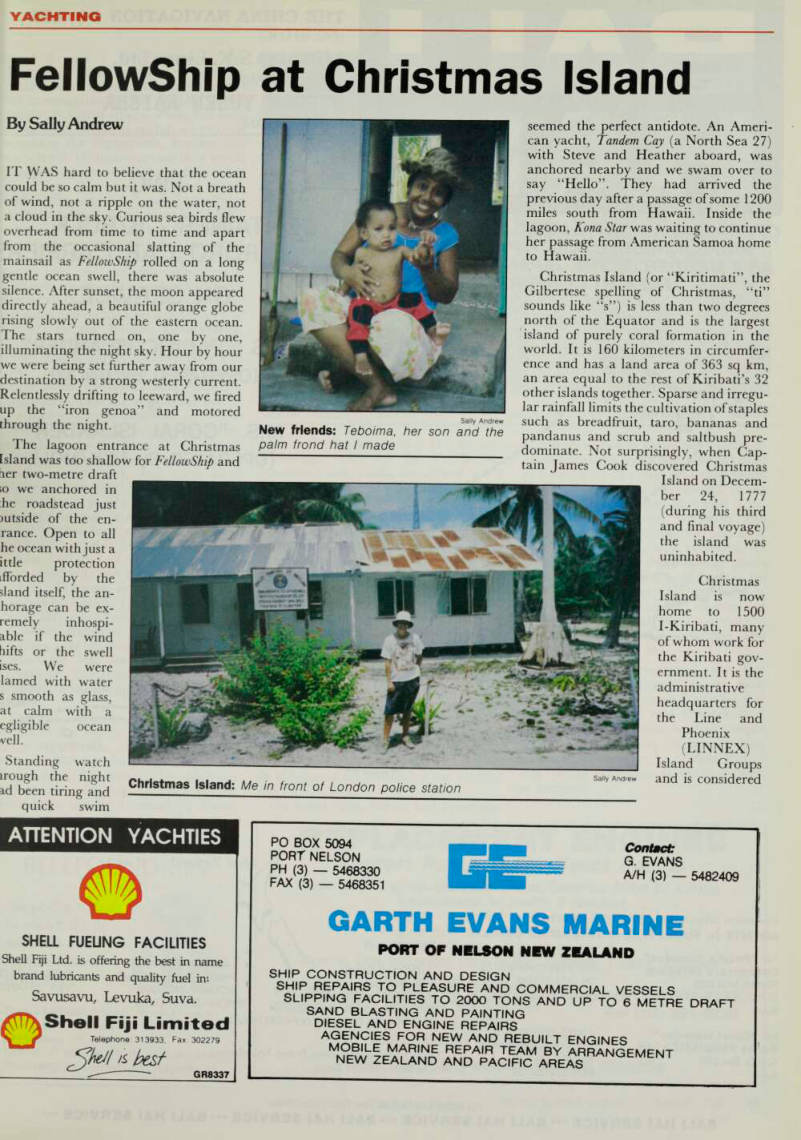
Sally Andrew New friends: Teboima, her son and the palm frond hat I made
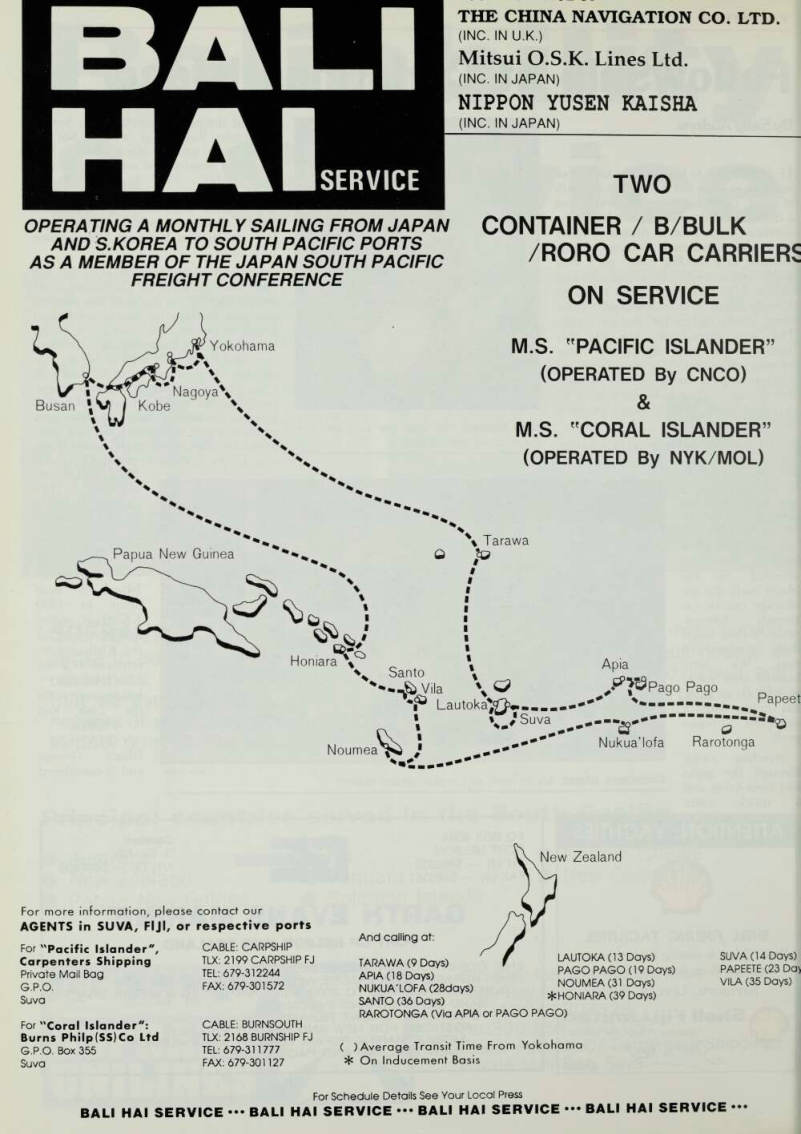
Christmas Island: Me in front of London police station
Sally Andrew
an Economic Development Zone.
There are three villages London, Banana and Poland, interesting names for communities in the middle of the Pacific! A fourth village, Paris, has been abondoned. While at anchor we enjoyed watching the frigatebirds, boobies and sooty terns. Without warning they would swoop down out of the sky and dive into the water. We were fascinated to see birds fishing and fish flying. At irregular intervals schools of iridescent half-beaks, a type of narrow-nosed needle fish, took to the air to escape from water-based predators. But while airborn they be came prey for the fish-eating birds.
Eighteen species of rare migratory birds nest at Christmas Island and the princi pal seabird areas have been designated as reserves by the Wildlife Conservation Unit of the Republic of Kiribati. Black, brown and blue-grey noddies; fairy and sooty terns, red-tailed tropic birds, wedge-tailed Christmas and Audubon shearwaters, phoenix and strom petrels ... a bird-watcher’s paradise.
When we rowed ashore, we were greeted on the beach by Uriam (“William”), a policeman with the London police unit, and some local :hildren. Uriam and his wife, Teboima, welcomed us to the island with tra litional drinking coconuts. Teboima is a chool teacher but because of a school )reak she was able to spend some time vith us. I showed off my skill at weaving )lam-frond hats and made hats for both )f them. Teboima, in turn, showed me low to weave mats. They taught us a lot ibout life on Christmas, and about -Kiribati traditions. When we left, feboima gave me two treasured gifts pandanus mat and a bright yellow raditional Gilbertese blouse. Their enorisity was typical of I-Kiribati hos •itality.
For what seems a sleepy atoll in the liddle of the Pacific Ocean, Christmas sland has a diverse, albeit short, history, iround 1860 the island was worked for be phosphate rich guano of seabrids, an
gricultural fertilizer. Twenty-eight
ears later it was annexed by Great
Britain. During World War II it became a strategic base for the Pacific Air command, and, roads, an airfield and a wharf were constructed. These facilities were later modernised when British and American servicemen arrived to conduct atmospheric tests as part of a nuclear testing program. Millions of seabirds were blinded and killed before the Test Ban Treaty went into effect in 1963 and testing stopped. Surprisingly no known contamination remains on the island today and the birds have made a remarkable come-back. What does re main is a lot of military junk the rusted out bodies of abandoned vehicles and buildings which have been salvaged for diverse uses. Currently the National Space Development Agency of Japan (NASDA) operates a satellite tracking station (set up in 1976). NASDA con structed the only hotel on the island now called the Captain Cook Hotel. It is six kilometres northwwest of the airstrip and has 24 rooms.
On board Fellowship we had a package
to deliver to Father Bermond, a Catholic priest from the French Alps who has lived in Kiribati for 30 years. We finally found him, cycling around the village, visiting his parishioners. Father Bermond is tri lingual and has great sympathy and much love for the Gilbertese and their way of life. A typical Frenchman, he loves good food, so painstakingly grows vegetables in his garden and cooks his own gourmet meals. He prepared a marvelous lunch for us, and we returned to the boat with fresh baby tomatoes, a rare treat in such a remote outpost, and scrumptious land crab.
Because of its remoteness, only few yachts call at Christmas Island each year, and usually because they need fuel and water. But the real attractions of Christmas are its warm-hearted people and tropical isolation, its massive size and natural wonders, its bizzare history and rusting junk-piles. It has to be seen to believed.
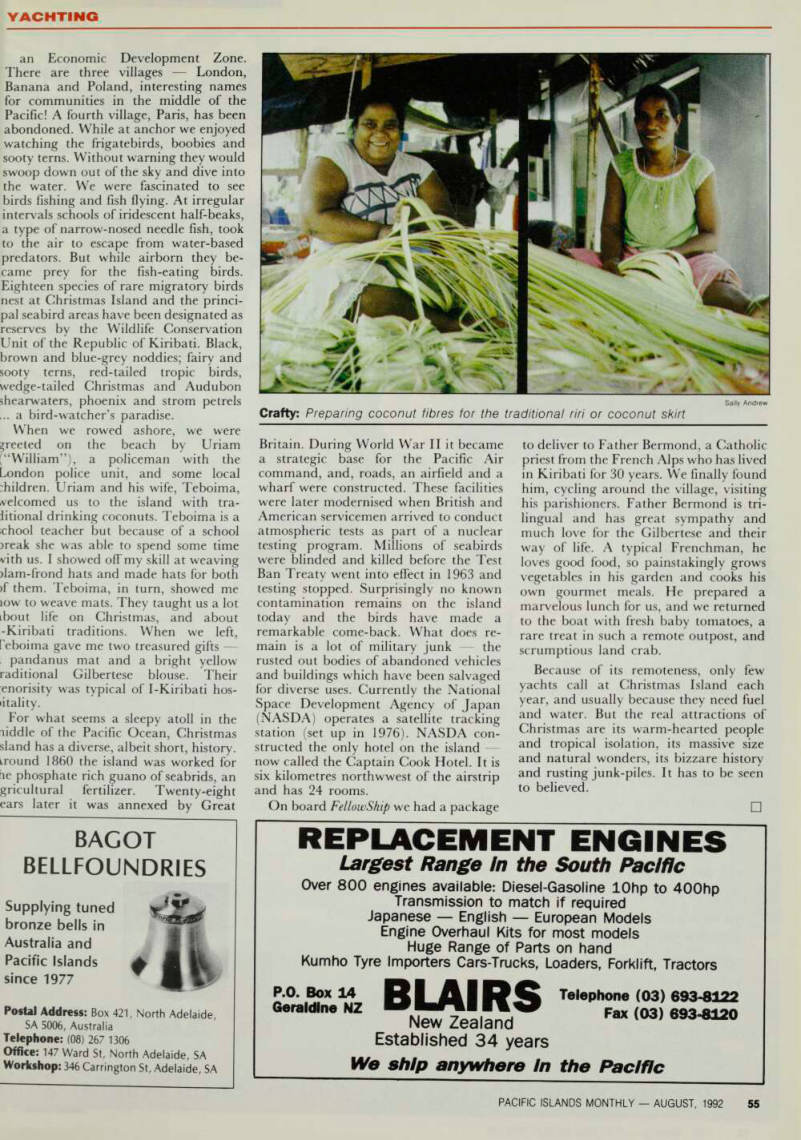
Crafty: Preparing coconut fibres for the traditional riri or coconut skirt
Sally Andrew