Tradition lives on
pp. 43-46 · Read in the full issue

The Region
By Norman Douglas
Fragments of empire
still cling to
republican Fiji
QUEEN ELIZABETH II of Britain gazes imperiosuly from the banknotes, but is more primly profiled on the coinage, minted as recently as 1990. An even more recent announcement in early 1992 - that there would be a new issue of paper currency, informed one that the major change would be the addition of a metallic thread, not the replacement of the head of the British monarch by that of some Fijian digni tary, historic or contemporary. No serious possibility as yet of dropping the queen’s likeness in favour of that of a Ganilau or a Mara, or perhaps less controversially a Sukuna or even a Cakobau. Almost five years after Fiji pronounced itself to be a republic and was ostracised by the commonwealth, Queen Elizabeth still maintains some kind of spiritual sway over the country’s Reserve Bank.
On flag-poles all around the nation fly the standard first unfurled in 1970, as representative of Fiji now, it seemms, with its status as “sovereign democratic republic”, as when it was a proud and valued member of the old colonial boys’ commonwealth club. Although the flag displays the coat of arms of Fiji in the fly, with a number of traditional symbols, its most immediately obvious feature is the Union Jack in the upper hoist. Never mind that in the nearby incipient republic of Australia, politicians, appar ently incapable of offering the multitudes the bread of employment, have turned instead to the diversionary circus of nationalism, and are suggesting oc casionally demanding that the re moval of their flag’s British component should be one of the first steps towards a brave new republican world.
If anyone thought seriously about changing Fiji’s flag in the early days of
the republic, the prospect of the cost of such a change, together with the fact that no really heart-stirring alternative design was submitted, was enough to blunt any initial enthusiasm for the idea.
Besides, despite official protestations to the contrary, there is still a widespread belief that the country’s removal from the commonwealth is only temporary and the flag will come in handv when its
membership is restored. A postcard of the flag which enjoys wide sale in Fiji explains it this way: “While Fiji was declared a Republic in 1988 (sic), it still has close historical ties with the British Commonwealth and thus the Union Jack remains part of the flag.” Simple. At the University of the South Pacific in 1989 my mature-age students in history were quick to point out that all the symbols necessary to an understanding of Fiji’s
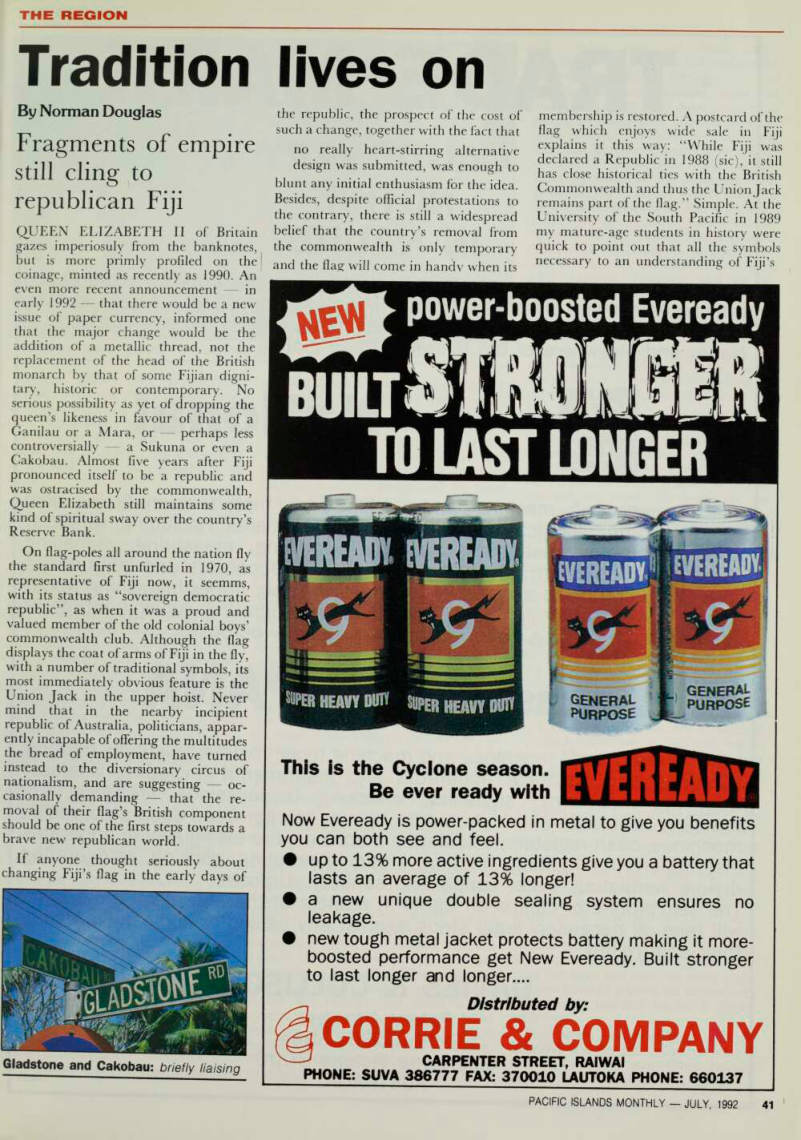
Gladstone and Cakobau: briefly liaising
modern history (the British con nection), economy (agricultural prod ucts illustrated in the coat of arms), and political philosophy (the dove of peace, a device that dates back to the Fijian Kingdom of the 1870 s), were displayed on the flag, why then should it be changed?
Pride must give way occasionally to sheer pragmatism. Until very recently, when, presumably, the supply ran out, I was receiving my monthly bulletins from the Republic’s Bureau of Statistics in mvelopes bearing the boast that they were O(n) H(er) M(ajesty’s) S(ervice). indeed, the bureau may well be the :entre of a closet society devoted to the mgoing admiration (adulation?) of the British royals. The walls of the tiny office lear its library bear an interesting issortment of pictures, not all of which eem to be covering holes in the /allboard. Here is a Fijian beach resort, here a Charles and Diana. Here a Blue .agoon cruiser, there an Elizabeth and 'hillip. Come to think of it, this might ctually be putting British royalty in its ght context, as tourist attraction or rtifact. Not so ambiguous the portrait of ie queen and the duke which adorns the all of the Fiji Club, itself evocative of a colonial ? e members (and guests) appear to - present by their grace.
Up in the fairly unprepossessing pre nets of suburban Toorak —.names after lother suburb in a British colony of the ne one comes across another gem large sign, noticeable from some stance, announces the modest building 3ngside it to be the Queen Victoria hool Old Boys Club House. A number beer kegs outside provide an illus ion of the old boys’ clubbability, and satellite dish (the better to receive gger telecasts presumably) gives evi nce of the club’s motto “Forward Fiji”, en Victoria might have been slightly
amused. None of these splendid examples of incongruity, however, can possibly match the official Ministry of Infor mation picture of Sitiveni Rabuka coup leader and proclaimer of the Republic of Fiji being sworn into office as civilian politician by President Ganilau under a portrait of the royal couple smiling benignly.
A walk through the streets of Suva is an excursion into colonial history, a kind of leg-powered time machine in which the names of the principal and many of the supporting players in Fiji’s historical drama confront the visitor.
Colonial civilians and politicians are celebrated in street names and other urban features Scott and Thomson, Grahame and Joske, Marks and Gumm ing; mayors and merchants and land grabbers, and the last a travel writer; “a tall, thin, rather masculine woman and a great pedestrian,” with a lion hunter for a brother and Fiji’s first substantive governor, Sir Arthur Gordon, for an uncle.
The names of colonial governors appear frequently on street signs. Pos terity recalls the vigorous along with the
ineffectual; the inept along with the
ineffectual; the inept along with the able.
Gordon is here, of course, as well as his successor and admirer Des Voeux.
Gordon and Des Voeux come together to meet MacGregor, who had served with Gordon prior to his Fiji experience and briefly acted as governor in Des Voeux’s place in 1885. The wives were not overlooked either Marion Denison Pender Des Voeux is recalled by her first name only a little distance away, but in the once exclusive residential area called the Domain her other names appear, and serve to honour other members of her family as well. Further uptown, Goodenough Street is named, not for its condition, which was for a long time barely that, but for the Royal Navy
Commodore, who, with Consul Edgar Layard, did so much to bring about the annexation of Fiji to Britain.
Other colonial identities, some less than memorable, are done more than justice by association. The controversial sixth governor, O’Brien — recalled by Colonial Secretary Chamberlain in 1901 — has a comfortable niche in the Domain, where he sits adjoining eigth governor, Im Thurn, scholar of early Fiji as well as administrator, and a far more impressive figure. Chief Justice Gorrie, detested by Des Voeux, and suspended from his judicial duties in his post-Fijian career, sits cosily between the visionary fifth governor, Thurston, and the re doubtable anti-colonialist British Prime Minister Gladstone, who ironically flanks the colonial-era government buildings.
Gladstone’s successor — the arch imperialist Disraeli, who took over the office of British PM in 1874, the year of Fiji’s cession to the British Crown occupies a lesser position further up the hill.
The colonial lumps are occasionally leavened by the gentle intrusion of Fijian names, as though issuing a reminder that Fiji was given to, rather than taken by, the British. Ratu Mara, first PM of Fiji, has not yet made his mark on the nomenclature of Suva city streets — he occurs elsewhere, in sometimes seedy Samabula, although, appropriately, he continues for some considerable distance.
But historical figures and near legends Cakobau, ruler of the 19th century Fijian Kingdom, and Sukuna, was hero, poli tician and “Father of Modern Fiji”, are here, the latter sweeping with character istic vigour up from the sea-front to skirt the Domain and continuing well past the city into the suburbs. Cakobau, having liaised briefly with Gladstone, who would probably not have accepted his offer of cession anyway, emerges to meet Victoria — whose assistance he solicited — and her descendant Elizabeth, who is here a literal and lineal continuation of Victoria, as she is in Britain. And what more convivial place for them to meet than at the entrance to Thurston Gardens and in front of the Grand Pacific Hotel, completed in 1914 during the hey day of British rule and presently being restored to its former colonial glory.
The Fiji Military Forces may have
dropped the appellation “Royal”, only
to retain the abbreviation RFMF (now standing for Republic (of) Fiji — what would they have done with all the surplus badges and flashes?), but their headquarters remains the Queen Eliza beth Barracks, and one-time army leader Sitiveni Rabuka assured his biographers; “She knows that my loyalty is always with her.”
The police were also faced with the necessity of a change of title, but seem to have gone about it in fairly hesitant fashion. New vehicles now proclaim
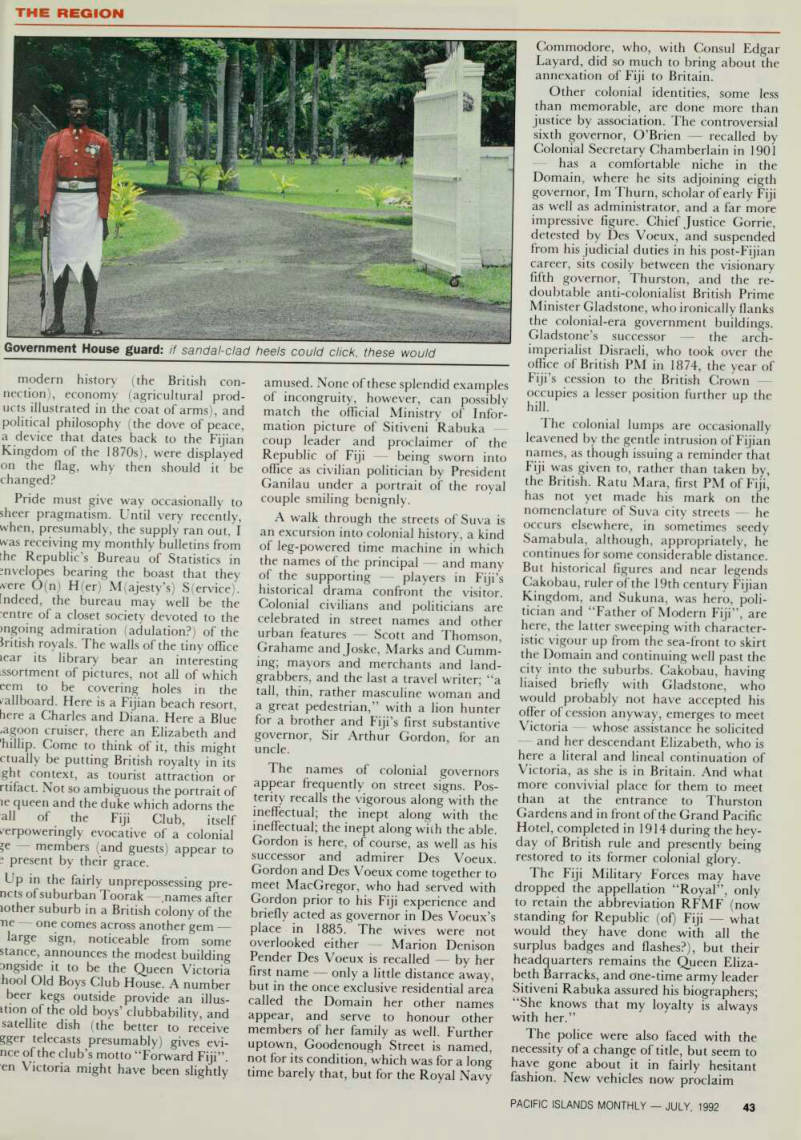
Government House guard: if sandal-clad heels could click, these would
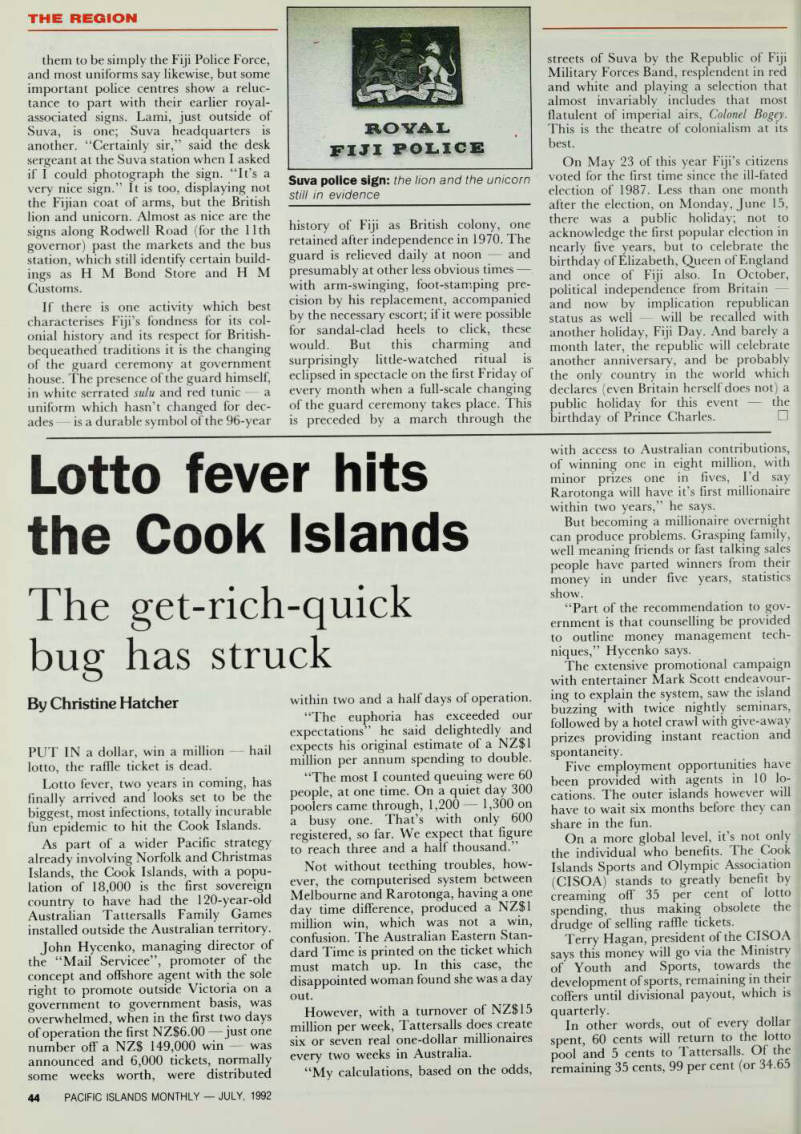
them to be simply the Fiji Police Force, and most uniforms say likewise, but some important police centres show a reluc tance to part with their earlier royal associated signs. Lami, just outside of Suva, is one; Suva headquarters is another. “Certainly sir,” said the desk sergeant at the Suva station when I asked if I could photograph the sign. “It’s a very nice sign,” It is too, displaying not the Fijian coat of arms, but the British lion and unicorn. Almost as nice are the signs along Rodwell Road (for the 11 th governor) past the markets and the bus station, which still identify certain build ings as H M Bond Store and H M Customs.
If there is one activity which best characterises Fiji’s fondness for its col onial history and its respect for British bequeathed traditions it is the changing of the guard ceremony at government house. The presence of the guard himself, in white serrated sulu and red tunic a uniform which hasn’t changed for dec ades is a durable symbol of the 96-year
history of Fiji as British colony, one retained after independence in 1970. The guard is relieved daily at noon and presumably at other less obvious times with arm-swinging, foot-stamping pre cision by his replacement, accompanied by the necessary escort; if it were possible for sandal-clad heels to click, these would. But this charming and surprisingly little-watched ritual is eclipsed in spectacle on the first Friday of every month when a full-scale changing of the guard ceremony takes place. This is preceded by a march through the
streets of Suva by the Republic of Fiji Military Forces Band, resplendent in red and white and playing a selection that almost invariably includes that most flatulent of imperial airs, Colonel Bogey.
This is the theatre of colonialism at its best.
On May 23 of this year Fiji’s citizens voted for the first time since the ill-fated election of 1987. Less than one month after the election, on Monday, June 15, there was a public holiday; not to acknowledge the first popular election in nearly five years, but to celebrate the
birthday of Elizabeth, Queen of England
and once of Fiji also. In October, political independence from Britain -
and now by implication republican
status as well will be recalled with another holiday, Fiji Day. And barely a month later, the republic will celebrate another anniversary, and be probably the only country in the world which declares (even Britain herself does not) a public holiday for this event the birthday of Prince Charles. □
Suva police sign: the lion and the unicorn still in evidence