Lost?
pp. 19-20 · Read in the full issue
Environment
Paradise Lost?
Treading the delicate balance between economy and ecology
By Sean Weaver
The balance of trade, international relations, the cost of foreign borrowing, the burden of debt servicing, protection ism in developed market economies . . . sounds like the overtures of an economic summit held in the depths of a finance ministry somewhere. But without a doubt, this is also the language of conservation.
There are currently many different plans and strategies being developed for improving environmental management in the Pacific. National environmental management strategies are currently being prepared in Fiji, Samoa, Solomon Islands, the Federated States of Micro nesia, the Cook Islands, the Marshall Islands, and Tonga. Much in the way of technical expertise is being gathered together from all over the world in order to prepare the environmental panacea for the Pacific.
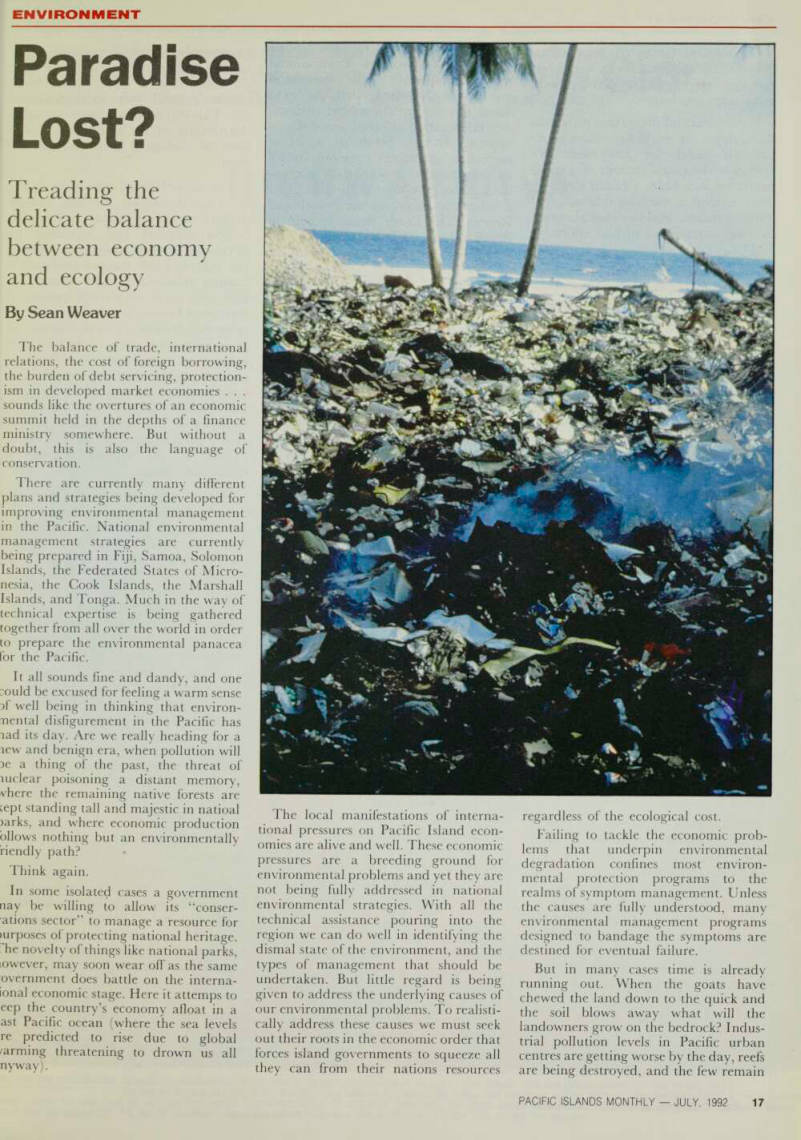
It all sounds fine and dandy, and one :ould be excused for feeling a warm sense T well being in thinking that environ mental disfigurement in the Pacific has lad its day. Are we really heading for a lew and benign era, when pollution will ie a thing of the past, the threat of luclear poisoning a distant memory, vhere the remaining native forests are :ept standing tall and majestic in natioal larks, and where economic production
bllows nothing but an environmentally
fiendly path?
Think again.
In some isolated cases a government nay be willing to allow its “conser ations sector” to manage a resource for ►urposes of protecting national heritage, he novelty of things like national parks, lowever, may soon wear off as the same overnment does battle on the interna ional economic stage. Here it attemps to eep the country’s economy afloat in a ast Pacific ocean (where the sea levels re predicted to rise due to global warming threatening to drown us all nyway).
The local manifestations of international pressures on Pacific Island economies are alive and well. These economic pressures are a breeding ground for environmental problems and yet they are not being fully addressed in national environmental strategies. With all the technical assistance pouring into the region we can do well in identifying the dismal state of the environment, and the types of management that should be undertaken. But little regard is being given to address the underlying causes of our environmental problems. To realistically address these causes we must seek out their roots in the economic order that forces island governments to squeeze all they can from their nations resources
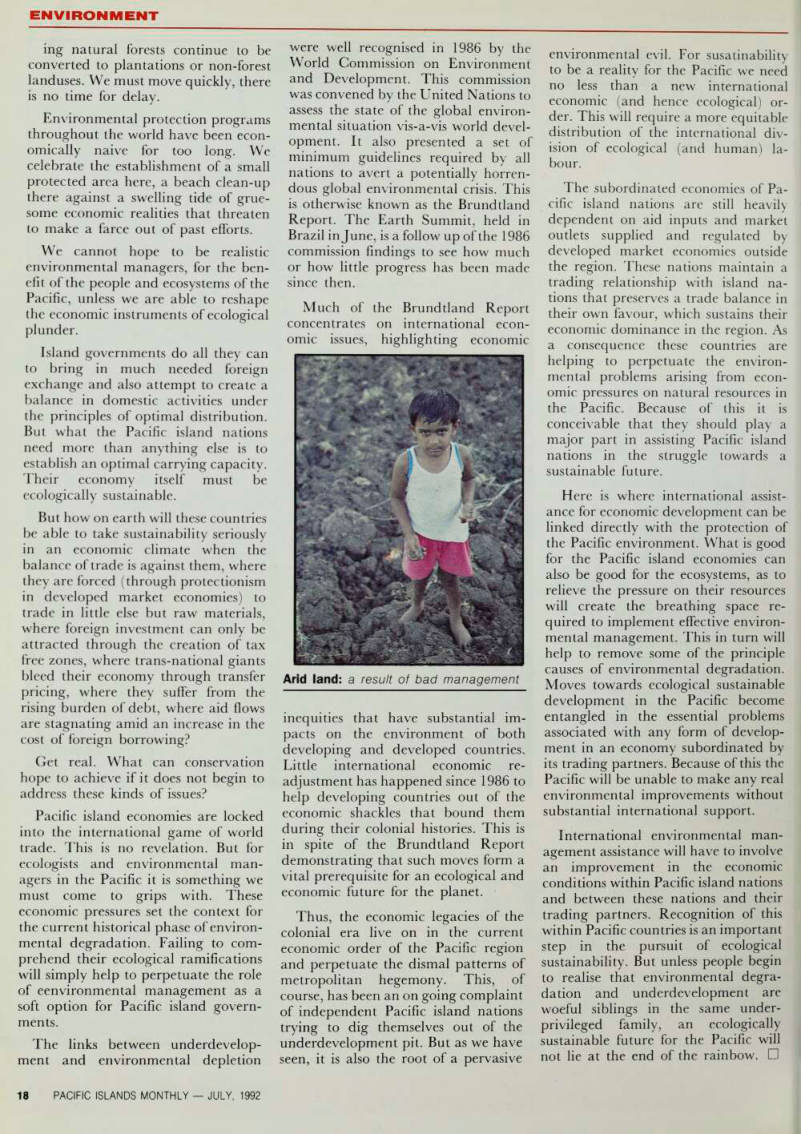
regardless of the ecological cost, Failing to tackle the economic prob- Jems that underpin environmental degradation confines most environ mental protection programs to the realms of symptom management. Unless the causes are fully understood, many environmental management programs designed to bandage the symptoms are destined for eventual failure, But in many cases time is already running out. When the goats have chewed the land down to the quick and the soil blows away what will the landowners grow on the bedrock? Indus trial pollution levels in Pacific urban centres are getting worse by the day, reefs are being destroyed, and the few remain
ing natural forests continue to be converted to plantations or non-forest landuses. We must move quickly, there is no time for delay.
Environmental protection programs throughout the world have been econ omically naive for too long. We celebrate the establishment of a small protected area here, a beach clean-up there against a swelling tide of grue some economic realities that threaten to make a farce out of past efforts.
We cannot hope to be realistic environmental managers, for the ben efit of the people and ecosystems of the Pacific, unless we are able to reshape the economic instruments of ecological
plunder.
Island governments do all they can to bring in much needed foreign exchange and also attempt to create a balance in domestic activities under the principles of optimal distribution.
But what the Pacific island nations need more than anything else is to
establish an optimal carrying capacity.
Their economy itself must be
ecologically sustainable.
But how on earth will these countries be able to take sustainability seriously in an economic climate when the balance of trade is against them, where they are forced (through protectionism in developed market economies) to trade in little else but raw materials, where foreign investment can only be attracted through the creation of tax free zones, where trans-national giants bleed their economy through transfer pricing, where they suffer from the rising burden of debt, where aid flows are stagnating amid an increase in the
cost of foreign borrowing?
Get real. What can conservation hope to achieve if it does not begin to address these kinds of issues?
Pacific island economies are locked into the international game of world trade. This is no revelation. But for ecologists and environmental man agers in the Pacific it is something we must come to grips with. These economic pressures set the context for the current historical phase of environ mental degradation. Failing to com
prehend their ecological ramifications
will simply help to perpetuate the role of eenvironmental management as a soft option for Pacific island govern ments.
The links between underdevelop ment and environmental depletion
were well recognised in 1986 by the World Commission on Environment and Development. This commission was convened by the United Nations to assess the state of the global environ mental situation vis-a-vis world devel opment. It also presented a set of minimum guidelines required by all nations to avert a potentially horren dous global environmental crisis. This is otherwise known as the Brundtland Report. The Earth Summit, held in Brazil in June, is a follow up of the 1986 commission findings to see how much or how little progress has been made since then.
Much of the Brundtland Report concentrates on international econ omic issues, highlighting economic
inequities that have substantial im pacts on the environment of both
developing and developed countries.
Little international economic re adjustment has happened since 1986 to help developing countries out of the economic shackles that bound them during their colonial histories. This is in spite of the Brundtland Report demonstrating that such moves form a vital prerequisite for an ecological and economic future for the planet.
Thus, the economic legacies of the colonial era live on in the current economic order of the Pacific region and perpetuate the dismal patterns of
metropolitan hegemony. This, of
course, has been an on going complaint of independent Pacific island nations trying to dig themselves out of the underdevelopment pit. But as we have seen, it is also the root of a pervasive
environmental evil. For susatinability to be a reality for the Pacific we need no less than a new international economic (and hence ecological) or der. This will require a more equitable distribution of the international div ision of ecological (and human) la bour.
The subordinated economies of Pa cific island nations are still heavily dependent on aid inputs and market outlets supplied and regulated by developed market economies outside the region. These nations maintain a trading relationship with island na tions that preserves a trade balance in their own favour, which sustains their economic dominance in the region. As a consequence these countries are helping to perpetuate the environ mental problems arising from econ omic pressures on natural resources in the Pacific. Because of this it is conceivable that they should play a major part in assisting Pacific island nations in the struggle towards a sustainable future.
Here is where international assist ance for economic development can be linked directly with the protection of the Pacific environment. What is good for the Pacific island economies can also be good for the ecosystems, as to relieve the pressure on their resources will create the breathing space re quired to implement effective environ mental management. This in turn will help to remove some of the principle causes of environmental degradation.
Moves towards ecological sustainable development in the Pacific become entangled in the essential problems associated with any form of develop ment in an economy subordinated by its trading partners. Because of this the Pacific will be unable to make any real environmental improvements without substantial international support.
International environmental man agement assistance will have to involve an improvement in the economic conditions within Pacific island nations and between these nations and their trading partners. Recognition of this within Pacific countries is an important step in the pursuit of ecological sustainability. But unless people begin to realise that environmental degra dation and underdevelopment are woeful siblings in the same under
privileged family, an ecologically
sustainable future for the Pacific will not lie at the end of the rainbow. □
Arid land: a result of bad management