The proof we fear
pp. 35-36 · Read in the full issue
Envronment
The proof we fear could kill us
By Anna Buckley
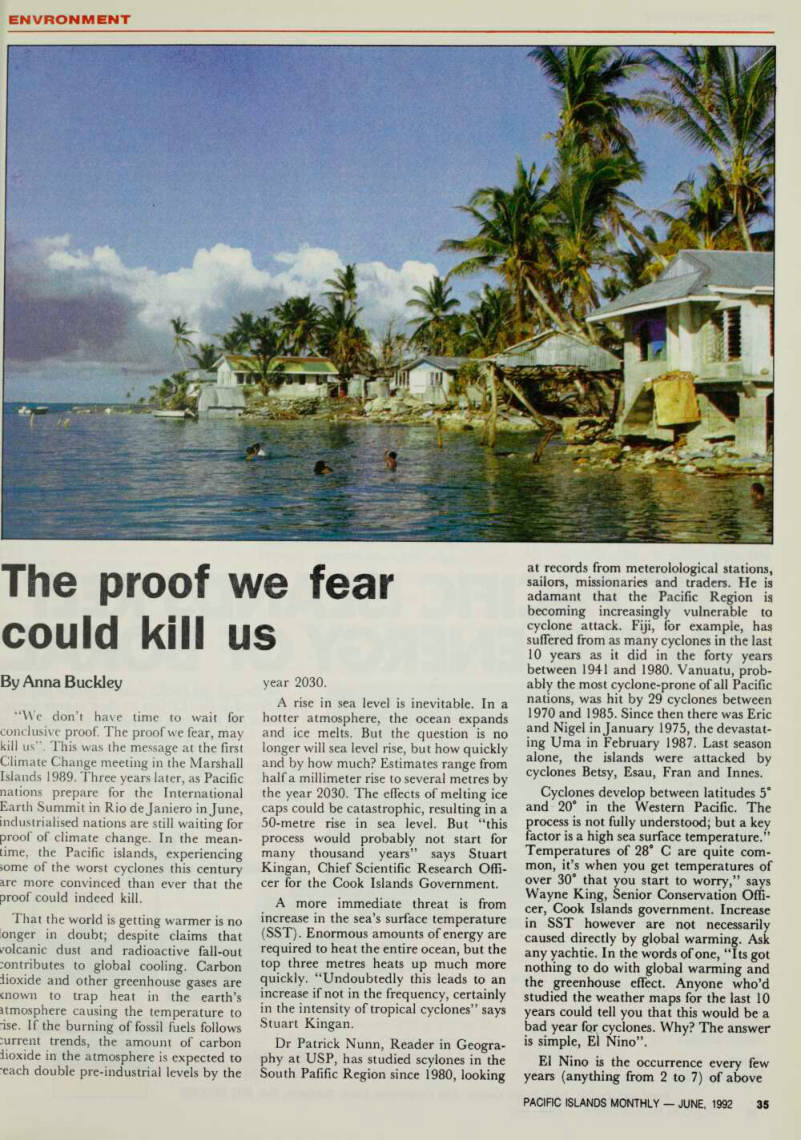
“We don’t have time to wait for conclusive proof. The proof we fear, may kill us”. This was the message at the first Climate Change meeting in the Marshall Islands 1989. Three years later, as Pacific nations prepare for the International Earth Summit in Rio de Janiero in June, industrialised nations are still waiting for proof of climate change. In the mean time, the Pacific islands, experiencing some of the worst cyclones this century are more convinced than ever that the proof could indeed kill.
That the world is getting warmer is no longer in doubt; despite claims that /olcanic dust and radioactive fall-out :ontributes to global cooling. Carbon dioxide and other greenhouse gases are mown to trap heat in the earth’s itmosphere causing the temperature to ■ise. If the burning of fossil fuels follows :urrent trends, the amount of carbon dioxide in the atmosphere is expected to 'each double pre-industrial levels by the
year 2030.
A rise in sea level is inevitable. In a hotter atmosphere, the ocean expands and ice melts. But the question is no longer will sea level rise, but how quickly and by how much? Estimates range from half a millimeter rise to several metres by the year 2030. The effects of melting ice caps could be catastrophic, resulting in a 50-metre rise in sea level. But “this process would probably not start for many thousand years” says Stuart Kingan, Chief Scientific Research Offi cer for the Cook Islands Government.
A more immediate threat is from increase in the sea’s surface temperature (SST). Enormous amounts of energy are required to heat the entire ocean, but the top three metres heats up much more quickly, “Undoubtedly this leads to an increase if not in the frequency, certainly in the intensity of tropical cyclones” says
Stuart Kingan.
Dr Patrick Nunn, Reader in Geogra phy at USP, has studied scylones in the South Pafific Region since 1980, looking
at records from meterolological stations, sailors, missionaries and traders. He is adamant that the Pacific Region i$
becoming increasingly vulnerable to
cyclone attack. Fiji, for example, has suffered from as many cyclones in the last 10 years as it did in the forty years between 1941 and 1980. Vanuatu, prob ably the most cyclone-prone of all Pacific nations, was hit by 29 cyclones between 1970 and 1985. Since then there was Eric and Nigel in January 1975, the devastat ing Uma in February 1987. Last season alone, the islands were attacked by cyclones Betsy, Esau, Fran and Innes.
Cyclones develop between latitudes 5° and 20° in the Western Pacific. The process is not fully understood; but a key factor is a high sea surface temperature.”
Temperatures of 28° C are quite com mon, it’s when you get temperatures of over 30° that you start to worry,” says Wayne King, Senior Conservation Offi cer, Cook Islands government. Increase in SST however are not necessarily
caused directly by global warming. Ask
any yachtie. In the words of one, “Its got nothing to do with global warming and the greenhouse effect. Anyone who’d studied the weather maps for the last 10 years could tell you that this would be a bad year for cyclones. Why? The answer is simple, El Nino”.
El Nino is the occurrence every few years (anything from 2 to 7) of above
average ocean .surface temperatures between South America and the Interna tional Dateline, associated with changes in atmospheric circulation. The last major El Nino was during 1982/3 when severe drought in Australia brought the phenomenon to international attention.
“South Pacific societies are innocent victims of a 300-year orgy of fossil fuel burning in the Northern hemisphere in the name of industrialisation” claims the Association of Small Islands States (AOSIS). Recently the nature of the emergency has changed. Small islands states will become uninhabitable before they are submerged. But the message is the same.
Association of Small Island States (AOSIS) is now a powerful pressure group. Since its formation, it has grown from a coalition of 28 “victim” states campaigning for industrialized nations to cut carbon emissions, to a 36-member lobby demanding financial compen sation for vulnerable states, increased research into alternatively energy sources, and ‘fast and fair” transfer of
environmentally sound technologies.
Most developed nations have not agreed to try and stabilise their carbon emissions at 1990 levels by 1995. And, as recom mended by AOSIS, will produce state ments describing the steps that they have taken. That many other not so small islands such as Sri Lanka and Singapore now want to join, as well as some who are
not islands at all, namely Guinea Bissau, is testimony to the success of AOSIS.
AOSIS sees itself as the conscience of the convention. It stresses that small island states are a special case. “We in the Pacific contribute little or nothing to the problem. Yet we will be the first to suffer and will be affected proportion ately more,” says the Rt Hon Bikenibeau Paenia, Prime Minister of Tuvalu. Small island nations deserve special attention on account of both their environmental fragility and their economic vulnerability.“ You only have to look at the negotiating table in New York to see where the resources are. The US can produce a technical expert in every field.
As far as the Cook Islands is concerned, there’s only me,” says Patricia Tuara, Climate Change Representative for the Cook Islands. “Like many Pacific Islands we don’t have the resources but we know best what the problem is.
At the meeting on Climate Change in New York in April, AOSIS presented plans for an international insurance mechanism to compensate small island nations for loss and damage caused by climate change. Contributions would be based on the level of carbon emissions and a country’s ability to pay, measured in terms of GDP. The response from industrial nations was a familiar one. We sympathize with your plight but we need to be realistic. This is a complex issue requiring further consideration. Several
African nations suggested compensation for drought and desertification should be included in the insurance scheme.
As custodians of a tenth of the earth’s surface, South Pacific nations have an important role to play in the Earth Summit in Rio. “With an estimated population of 5.8 million, the region’s capacity to protect its fragile environ ment against damage from both internal actions and external influences is con strained. However, the region accepts responsibility placed on our numerically small community as it is essential for the sustainable development of the region as a whole” says Vili Fuvao, Director of South Pacific Regional Environment Programme (SPREP). It is a responsibil ity that has not been taken lightly.
Eighteen Pacific nations have worked hard to co-ordinate their efforts in preparation for the Earth Summit. The environmental problems facing the Pa cific are diverse; but Pacific Islands have shown solidarity in the preliminary negotiating rounds. Supporting their neighbours, so as to compete with the block voting of other regional groups.
For selfish if not humanitarian reasons, industrialized nations want Pacific Islands to be preserved, if only to keep the South Pacific dream alive. Let’s hope in Rio, however, that Pacific nations can extract more than sympathy, however heartfelt, from the West.