Tourism
pp. 19-23 · Read in the full issue

Special Report
Tourism at what price?
The cost of a holiday here could be turning visitors away
By Martin Tiffany
7 IJI the way the world should be. seven or eight years ago under that manner the country seemed to have got ts image especially its tourism image - right. A land full of beautiful sunshine, fiendly people and miles of white sandy reaches with affordable accommodation md a quality of life that was the envy of he rest of the world. fhen in May, 1987 the unthinkable lappened a coup in paradise, fol owed, not long after, by another. The
world watched, stunned. They certainly did not come to get a first hand look as visitor numbers plummeted from a healthy 257,824 in 1986 to 189,866 in 1987.
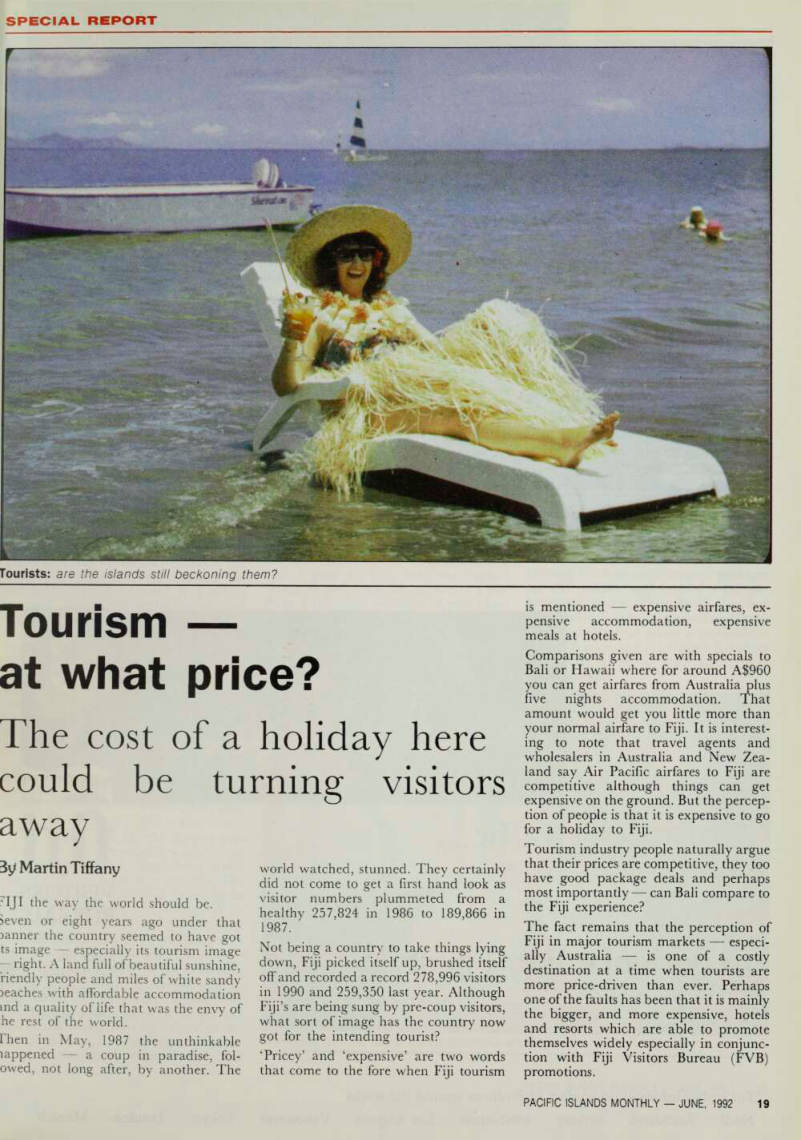
Not being a country to take things lying down, Fiji picked itself up, brushed itself off and recorded a record 278,996 visitors in 1990 and 259,350 last year. Although Fiji’s are being sung by pre-coup visitors, what sort of image has the country now got for the intending tourist? ‘Pricey’ and ‘expensive’ are two words that come to the fore when Fiji tourism
is mentioned expensive airfares, ex
pensive accommodation, expensive
meals at hotels.
Comparisons given are with specials to Bali or Hawaii where for around AS96O you can get airfares from Australia plus five nights accommodation. That amount would get you little more than your normal airfare to Fiji. It is interest ing to note that travel agents and wholesalers in Australia and New Zea land say Air Pacific airfares to Fiji are competitive although things can get expensive on the ground. But the percep tion of people is that it is expensive to go for a holiday to Fiji.
Tourism industry people naturally argue
that their prices are competitive, they too have good package deals and perhaps most importantly — can Bali compare to
the Fiji experience?
The fact remains that the perception of Fiji in major tourism markets especi ally Australia is one of a costly destination at a time when tourists are more price-driven than ever. Perhaps one of the faults has been that it is mainly the bigger, and more expensive, hotels and resorts which are able to promote
themselves widely especially in conjunc
tion with Fiji Visitors Bureau (FVB) promotions.
Tourists: are the islands still beckoning them?
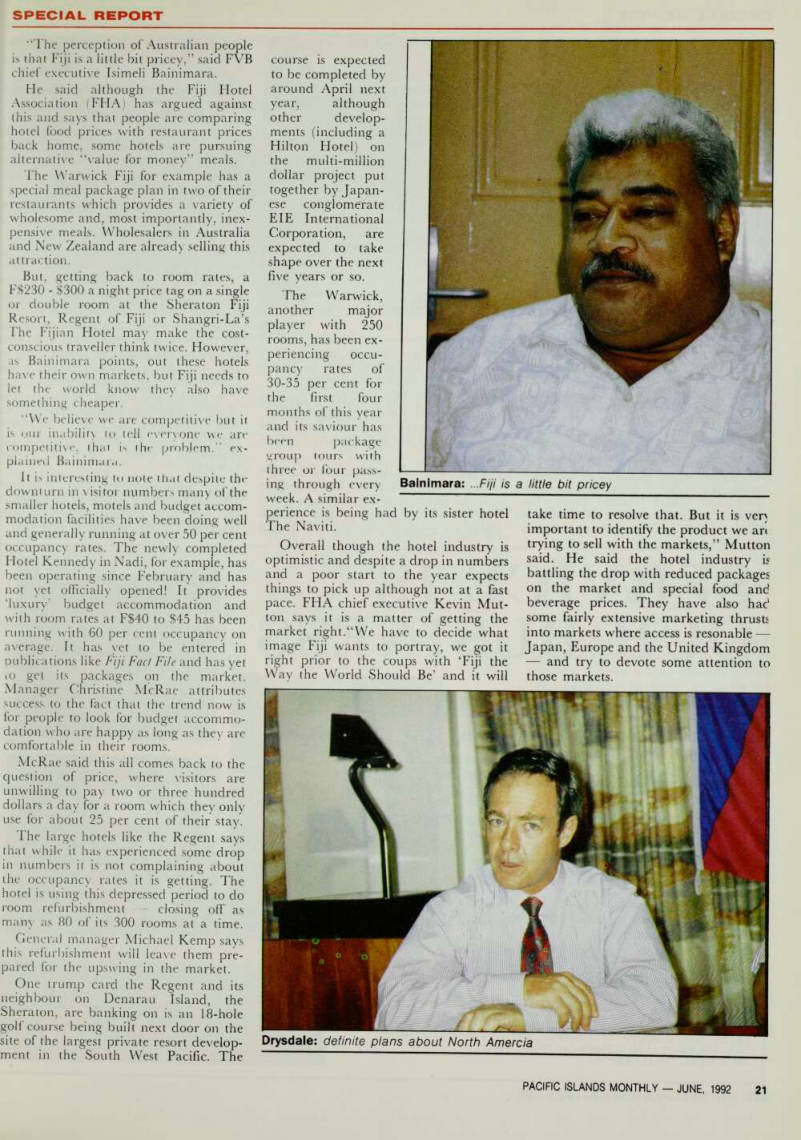
“The perception of Australian people is that Fiji is a little bit pricey,” said FVB chief executive Isimeli Bainimara.
He said although the Fiji Hotel Association (FHA) has argued against this and says that people are comparing hotel food prices with restaurant prices back home, some hotels are pursuing alternative “value for money” meals.
The Warwick Fiji for example has a special meal package plan in two of their restaurants which provides a variety of wholesome and, most importantly, inex pensive meals. Wholesalers in Australia and New Zealand are already selling this attraction.
But. getting back to room rates, a FS23O - $3OO a night price tag on a single or double room at the Sheraton Fiji Resort, Regent of Fiji or Shangri-La’s The Fijian Hotel may make the cost conscious traveller think twice. However, as Bainimara points, out these hotels have their own markets, but Fiji needs to let the world know they also have something cheaper.
“We believe we are competitive but it is our inability to tell everyone we are competitive, that is the problem, ex plained Bainimara.
It is interesting to note that despite the downturn in visitor numbers many of the smaller hotels, motels and budget accom modation facilities have been doing well and generally running at over 50 per cent occupancy rates. The newly completed Hotel Kennedy in Nadi, for example, has been operating since February and has not yet officially opened! It provides ‘luxury’ budget accommodation and with room rates at Fs4o to $45 has been running with 60 per cent occupancy on average. It has yet to be entered in publications like Fiji Fad File and has yet io get its packages on the market.
Manager Christine Mcßae attributes success to the fact that the trend now is for people to look for budget accommo dation who are happy as long as they are comfortable in their rooms.
Mcßae said this all comes back to the question of price, where visitors are unwilling to pay two or three hundred dollars a day for a room which they only use for about 25 per cent of their stay.
The large hotels like the Regent says that while it has experienced some drop in numbers it is not complaining about the occupancy rates it is getting. The hotel is using this depressed period to do room refurbishment closing off as many as 80 of its 300 rooms at a time.
General manager Michael Kemp says this refurbishment will leave them pre pared for the upswing in the market.
One trump card the Regent and its neighbour on Denarau Island, the Sheraton, are banking on is an 18-hole golf course being built next door on the site of the largest private resort develop ment in the South West Pacific. The
course is expected to be completed by around April next year, although
other develop
ments (including a Hilton Hotel) on the multi-million dollar project put together by Japan ese conglomerate EIE International
Corporation, are
expected to take shape over the next five years or so.
The Warwick, another major player with 250 rooms, has been ex
periencing occu
pancy rates of 30-35 per cent for the first four months of this year and its saviour has been package group tours with three or four pass ing through every week. A similar ex-
perience is being had by its sister hotel The Naviti.
Overall though the hotel industry is optimistic and despite a drop in numbers and a poor start to the year expects things to pick up although not at a fast pace. FHA chief executive Kevin Mut ton says it is a matter of getting the market right.“We have to decide what image Fiji wants to portray, we got it right prior to the coups with ‘Fiji the Way the World Should Be’ and it will
take time to resolve that. But it is ven important to identify the product we an trying to sell with the markets,” Mutton said. He said the hotel industry is battling the drop with reduced packages on the market and special food and
beverage prices. They have also had
some fairly extensive marketing thrusts into markets where access is resonable Japan, Europe and the United Kingdom and try to devote some attention to those markets.
Bainimara: ...Fiji is a little bit pricey
Drysdale: definite plans about North Amercia
According to Mutton this seems to be working especially in the European sector which in time could cause a major redefining of the market from which Fiji sources tourists.
In conjunction with this European thrust Air New Zealand last month announced plans to invite 150 British travel agents to a four-day event in November. Called ‘Project Pride’, the event is aimed at boosting the profile of Fiji and Air New Zealand’s other South
West Pacific destinations in the UK market.
As a small isolated island nation, Fiji is at the mercy of international air carriers to bring in the bulk of its tourists.
When American carrier Continental Airlines pulled out its services following the coups the number of North American visitors plummeted from around 70,000 in 1986 to around 36,000. The numbers however rose to 47,084 last year.
Also, Canadian Airlines did not live up to promises and has dropped all services to Fiji so the country is not getting the numbers out of Canada it expected. The carriers ceased services based on cold economic facts.
But eyes are once again turning to North America (and Canada).
Bainimara, Mutton and Tourism Council of the South Pacific (TCSP) director Malakai Gucake, among many others, agree the sooner a North Ameri can service is started the better.
Air Pacific’s chief executive Andrew Drysdale said it has “very definite plans” to operate services to North America in the future and this formed part of its five year plan.
“The intent is to commence in 1994 with the introduction of charter services initially, just during the peak season, and then as the charter services become viable to gradually extend the period
during the year until they eventually become a regular service,” Drysdale
explained.
“We believe that with the turnaround in the US economy now having begun, by 1994 the market will have grown to the point where we would hope it would be viable. But I would point out, as the Prime Minister said when he first announced this at last year’s tourism convention, that it must be viable.”
“We in the Pacific have to find a formula whereby we can make it viable and were working on that now.”
On the possibility of an American carrier flying to Fiji, Drysdale said both he and his management team have done a great deal in an attempt to encourage an American carrier to fly to Fiji.
“A major North American carrier has the domestic marketing power to be able to turn on the American tourist to fly to Fiji. And that was clearly proven when Continental Airlines was operating here from the US and we had the highest ever of North American arrivals, in fact in one year I think it was 1986 the North American arrivals nearly equalled the Australian visitor arrivals,” said Drysdale.
He said, however, that long-term stability needs Air Pacific to fly the route the way that tourism developers and investors can be reasonably sure that
Gucake: eyeing North America
the) will have the seats available that they need to support the properties that they are going to build.
Drysdale said he doubted there was any possibility of the three North Ameri can carriers which fly to Sydney Continental, Northwest and United making the additional hop into Fiji or the South Pacific.
“Given the turmoil that the North American aviation market is in at the moment and the billions of dollars these carriers are losing, it is highly unlikely they will embark upon new destinations while their market is in such turmoil.
These carriers would have to return to some degree of profitability before they would ever turn their planning to new
developmental routes.”
Air New Zealand’s manager Fiji, Robert Fullarton, said his airline oper ates four flights a week from the West coast of America to New Zealand and two of these connect with London or Frankfurt. Air New Zealand are the initiators of a ‘Destination South West Pacific’ promotion and are involved in promotions in the United Kingdom and Europe, Canada and the United States.
Fullarton said the trend now was for a multi-destination package holiday rather
than a mono-destination one.
Meanwhile, Japan in recent months has become an important contributor of visitors to Fiji after the introduction of a second weekly service to Tokyo’s Narita airport by Air Pacific. To some extent the Japanese have off-set the shortfall of tourists from Australia, which has seen a decline of about 16 per cent so far this year.
Air Pacific is happy with the two Narita services and says it would take a third if it could. The first reason they can’t is the bilateral agreement between Fiji and Japan which only allows the Fiji carrier two flights a week. The airline would have to re-negotiate the agree ment before a third service was mounted.
Drysdale said Fiji was approximately 43rd on the list of countries wanting to negotiate or re-negotiate bilateral agreements. Secondly, would be getting a slot at Narita airport.
The importance of Japan was shown last month when the Fiji Visitors Burean and Air Pacific put together a 5F500,000
promotional campaign in Japan.
Many in the tourism industry agree that Japan, North America and, to some extent, Europe will be major players in terms of visitor source markets. Asia too
is expected to feature strongly in the coming years.
Taiwan, for example, is rapidly emerg ing as a major source market for tourists and a potential route to Taiwan is currently under study by Air Pacific.
In relation to the importance of Japan, Asia and North America as source markets for the Pacific it is interesting to compare Fiji with Guam.
While Fiji is looking at breaking the 300,000 mark for visitor arrivals, Guam, a 549 sq km island at the southern extremity of the Mariana archipelago is looking at welcoming up to one million visitors by year’s end.
Last year Guam played host to more than 700,000 visitors and so far this year has recorded 87,000 visitors a month for the first quarter.
Perhaps its secret lies in the fact that it is served by several major airlines including Japan Airlines, All Nippon Airways, Northwest Airlines, Continen tal Airlines, Korean Airlines, Phillipines Airlines and Thai Airways. The island’s airport, AB Won Pat International, will soon be undergoing major expansion to accommodate the increasing traffic.
To date Guam has an estimated 5219 tourist rooms with an additional 2231 under construction and another 3619 approved for construction. It has also realised the importance of golf as a tourist attraction and already has five golf courses, seven under construction and five approved for construction.
If comments from tourism industry people in Fiji are anything to go by the country will see a slow upward growth but it will need to change its image as a pricey destination and look away from Australia to source tourists.
Perhaps in the not too distant future, it may once again hear the strains of the ditty once popular in Fiji, “We are Fiji, we are the way the world should be.”
Kennedy Hotel: providing budget accommodation
Sheraton: luxury at a price